2009 Riesling “Jean’s Block”

We often discuss a vineyard year in terms of the wonderful wines that result.  I’ve certainly heard many superlatives thrown around in describing just that from Niagara’s 2007 Vintage.  For a change, I’d like to give a different account of  2007, one of extreme vineyard challenges and of personal highs and lows.  This is the story of Jean’s Block.

I was blessed on February 24th of 2007 to marry my soulmate.  Our honeymoon would have to wait, however, as my hard working new spouse still had some schooling to take care of.  Having just moved back from the easy-goin’ east coast, I was about to embark on my first summer at the helm of our yet to be named winery.  There wasn’t really any wine yet, just nerves and self-doubt.  Were we making the right decision?  Am I really a winemaker?  There was only one way to find out.

My mother-in-law, Jean Tkaczyk, was always a fan of Riesling.  She’d made it clear to me over the years at many lively family dinners that I’d better make her a Riesling one day!  I’d always promise her that I would, but there was that small hurdle of not having any Riesling grapes in our vineyard.  It was never a variety that our winery clients had desired, so it had never been planted.  I fondly remember a trip that Jean, Tanya and I made to Vineland Estates one summer to taste their renowned Rieslings.  I quickly became a convert.  On that day I was convinced that our new winery needed this variety in its portfolio.

My parents and I decided to plant 14 rows of Clone 49 Riesling on the easternmost part of our farm adjacent to Four Mile Creek.  It is a well-drained block, with good airflow and a mixed soil composition of sand and clay-loam.  I was well aware that the ultimate challenge with Riesling is keeping the rot at bay, and these parameters would surely help in our efforts.  Clone 49 originated in Alsace and is widely considered to be better suited for Niagara-on-the-Lake and St.Davids Bench terroir.  It’s known for producing wines featuring floral and tropical fruit notes.

My father spent the spring of ’07 doggedly preparing his field for the coming vines.  It was an exciting time.  We were off to a hot, dry start to the growing season with all varieties well ahead of schedule.  One problem: where were the April showers?  They never came.  For that reason I’ll always remember 2007 as a challenging drought year more than anything else.  We actually had to purchase irrigation equipment!  This was unimaginable on a farm that had been bathed with adequate rainfall for five generations.  There had been dry years in the past but nothing like this.  Maddeningly, it would rain in Queenston and Virgil, but not in St. Davids.  It was a bleak prognosis for our soon to be planted Riesling.  Young vines need lots of water, and there simply wasn’t enough available in the soil.  As the time to plant drew near,  however, this was the furthest thing from our minds.

Heartbreak.  We lost Jean to cancer that summer.  I’ll never be able to understand such things.  She will always be remembered with love and her zest for life is still resonant in her children.  Her Riesling vines were planted in sorrow.

When I work in Jean’s Block today, three years later, I’m struck by it’s beauty.  Not only did it survive the drought of 2007, it thrived.  It is without a doubt the prettiest spot on our farm.  I’m reminded of Jean every time I look up to see a majestic hawk or encounter a curious cardinal sitting on the top wire.  She loved nature and took every opportunity to get her hands dirty in the garden.  I’ll never take these earthly pleasures for granted again.  My worries magically disappear in Jean’s Block.

The first crack at making wine from this vineyard came in 2009.  We harvested about 500kg of fruit on October 25th.  The cool ferment was carried out solely in stainless steel with W15 yeast.  The wine was left slightly off-dry (14 g/L), but has plenty of acidity to balance the sweetness.  We bottled 36 cases on August 30th, 2010.

Bottles #2 through 437 are now available to you.  Bottle #1 was put away for someone special.  I hope she likes it.
“Abandoned to Dumb Idleness”

I struggle to describe what this time of year feels like for a grape grower.  You usually wake up in the morning in a state of panic: what am I picking today?  how is the weather?  how bad are the birds?  are there any leaves left on my vines?

Then reality inevitably sinks in.  Your grapes are off the vine and all you’re left with is an empty feeling of no longer being needed.  This should lead to a long and relaxing winter, but all those nagging jobs that were left behind during the busy season are still staring you in the face.  General clean-up, prepping the ground for winter, hilling up around vines, digging drainage ditches, and installing post and wire into newly planted fields are just a few of these tasks.

The working days are much shorter now and, frankly, so is my level of ambition.  I always felt guilty about this annual lack of drive until just recently.  I read a book entitled “Outliers” by Malcom Gladwell on advice from my Uncle Don.  It was a great read and I was struck by one chapter in particular that described the life of vineyard workers in Burgundy many years ago.

Gladwell quotes historian Graham Robb from his book “The Discovery of France”:

An official report in 1844 described the strange mutation of the Burgundian day-laborer once the harvest was in and the vine stocks had been burned: “After making the necessary repairs to their tools, these vigorous men will now spend their days in bed, packing their bodies tightly together in order to stay warm and eat less food.”

Human hibernation was a physical and economic necessity.  Lowering the metabolic rate prevented hunger from exhausting supplies.  After the Revolution in Alsace and Pas-de-Calais, officials complained that wine growers and independent farmers, instead of undertaking “some peaceful and sedentary industry” in the quieter season, “abandon themselves to dumb idleness.”

I laughed out loud when I read this because it hit so close to home.  The context of this chapter is that we are very much a product of our cultural legacy.  So I’m not to blame for my lethargic winter blah’s after all, chalk it up to those who came before me!

A Day in the Life of a Grape Farmer


A Day in the Life of a Grape Farmer

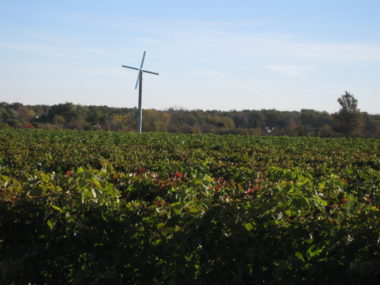
3:30am: Awaken to frost alarm.  Fire up the windmill for a few harrowing hours until dawn.

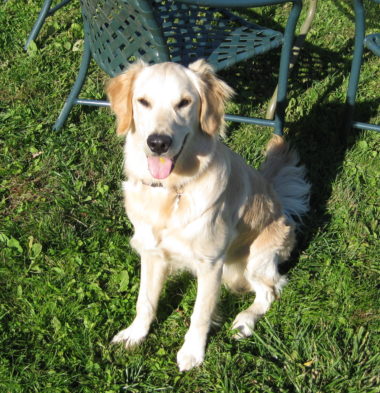
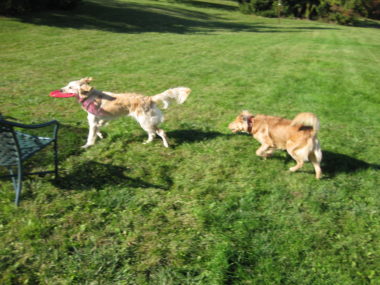
7:30: Groggy Winemaker Son arrives.  Exchange pleasantries and play fetch with “grand-dogs”.

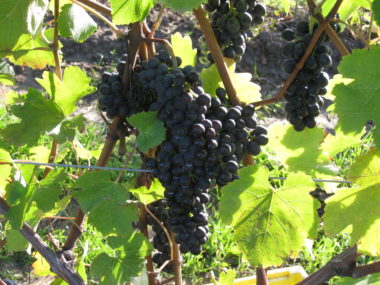
9:00: Dew finally gone, off to hand-pick some Five Rows Shiraz.

9:03: “Man, they look beautiful!”

10:30:  coffee #5

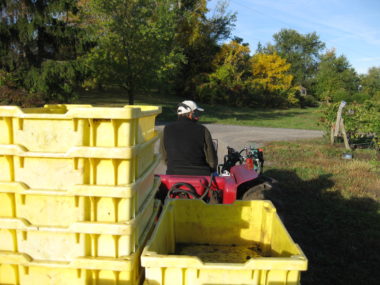
10:30 – 6:00:   A sun-filled, back-achin’ day of quality Father/Son/Shiraz time.

Harvest 2010


Three down, three to go.  In one fell swoop, we now have all of our 2010 Pinot Noir, Pinot Gris and Sauvignon Blanc off the vines and in the tanks.  All were harvested earlier and riper than in any previous vintage, including the much heralded 2007 crop.

It was a hectic start to harvest this year as all three early-ripening varieties were deemed ready to pick much quicker than anticipated due to rapidly decreasing acid levels.  What a difference a year makes!  I would like to sincerely thank the skilled crew who helped us painstakingly hand-pick our Pinot Noir.  It’s always a challenge to harvest Pinot because every rotten or under-ripe berry must be carefully removed from each cluster before I deem it acceptable.  The harvested fruit is then sorted both in the vineyard and at the crusher.  This ensures that our Pinot gets off to a good start, with no “off” aromas or flavours in the must.  Excess rot can also play havoc with fermentation and eventually filtration.

Just prior to harvest we were able to schedule a bottling run of our 2009 whites, including the much anticipated (at least by my mom) 33 case debut of our Five Rows Riesling.  I intend to release these wines sometime soon, so keep an eye on the blog and website.  All three of these wines showcase exciting aromatic intensity.  I can’t wait for you to try them.

Slowly they turn…


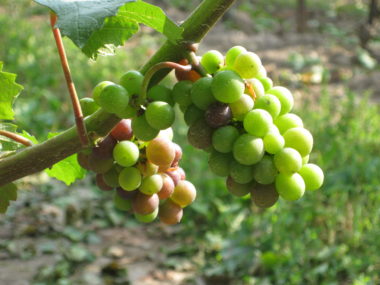
That faint thud you just heard was my jaw hitting the terroir when I returned home from a quick vacation to find colour, yes colour, in my Pinot Gris and Pinot Noir.  It seems eerily too early.  The race is on, it’s veraison.

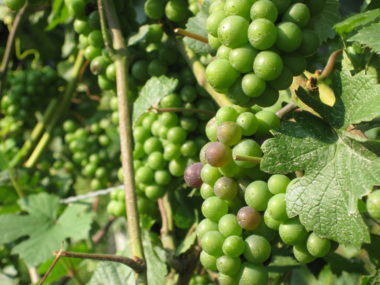
Veraison is the physiological stage of grape development where the hard, green berries finally soften and start to accumulate sugars and gradually turn colour.  That first flash of colour is always a “noose tightener” of sorts, in that so many jobs need to be squeezed in before the imminent harvest.  In early years such as this one, we are already fighting to keep the clusters exposed and canopy trimmed, but now it is even more important.  Recent studies out of Cornell University have shown that longer fruit exposure to sun can decrease methoxypyrazine levels (green, vegetal characters) in late ripening varieties like Cabernet Sauvignon and Cabernet Franc.

Coloured berries also attract hungry birds, so our protective netting needs to be put up as soon as the hedging, leaf removal and cluster thinning is complete.  I honestly can’t decide if I’m excited or horrified at the prospect of working every day for the next three months.  I reassure myself that we go through the same song and dance every year, but that doesn’t seem to quell my uneasiness.  Amid the vineyard duties, we have to squeeze in a bottling run and get all tanks and crush equipment ready for the first fruit of the season.

Just as my anxiety peaks, the faint light at the end of the tunnel begins to emerge.  “Push on lad!”, I tell myself.  Pluck a few more leaves, thin a few more bunches, finish one more row.  Visions of brilliant autumn colours and cozy fall clothes begin to warm my thoughts.  The thrill and challenge of ripening Shiraz emboldens me.  I can taste that luscious free run juice now!

Bring on veraison!

Vineyard Update

It dawned on me today, as I  hurriedly thinned Pinot Gris in the midst of an earthquake, that I hadn’t given a thorough vineyard update in a while.  So here goes…

Mother nature is two weeks ahead.  I’m three weeks behind.  This good news / bad news situation is the familiar refrain I’ve heard in talking to many grape growers throughout the peninsula.  We’ve seen a boon of growth in all vines over the last couple of weeks, leaving us scrambling to keep up with the expedited hand labour chores.  Adequate rainfall, heat, and blistering sun are making my vines very happy, but leaving me a little worried.  Disease pressure has been low to this point (kiss of death) but the current humid conditions will challenge even the best of viticultural practices.

The accelerated growth creates the need to shoot-thin and shoot-position all vines before we are able to start hedging.  As always, vine vigour was particularly problematic in our Shiraz blocks, so I targeted them first.  After two weeks of what felt like hacking through a rainforest with a dull machete, I was happy to kiss the Shiraz good-bye and move on to the more manageable Cabernet  Sauvignon.  We are well through bloom in all varieties, and very close to berry touch stage in the Pinot Gris.  Air flow through the canopy is critical at this stage, as is fruit exposure for optimum fungicide penetration.

I’m happy to report that the young Pinot Noir vines we planted last season are doing very well, with less than 5% vine failure.  In the spirit of Father’s Day, I give my dad all the credit for these thriving vines.  It was he who ploughed the field ad nauseam to his own exacting specifications, he who sat vigil through many winter and spring evenings waiting to fire up the windmill, and he who artfully maneuvered the grape-hoe around each baby vine with the deft touch of a surgeon.  Judging by a couple of the catastrophic first year fields I’ve witnessed while out consulting this year (upwards of 60% vine death), I really believe that the use of the windmill combined with proper site selection and field preparation helped save our bacon.

PS:  I send a special thank-you and congratulations to Insite Design for designing an Ontario Wine Awards silver medal winning wine label that still makes me proud every time I slap one on a bottle!

Assiniboine College

What a pleasure it was to have a keen group of culinary/hospitality students from Assiniboine Community College (Manitoba) stop by our barn this morning.  Prior to their arrival, I worried that it may be tough to keep our guests entertained for the full two and a half hours they were scheduled for, but once I met them I knew it wouldn’t be a problem!

They were all ears as my mother and I took turns explaining the history of our farm and some of the viticultural practices we employ.  The rest of the time was filled with very well thought out questions and subsequent discussion.  We concluded the morning with a tasting of our wines, of which I received some great feedback.  It is a perk of my job to be able to meet such engaging and talented young people getting set to embark on their careers.  I wish them all the best of luck in their future endeavours, and thank them for bringing a sampling of Five Rows back home to Brandon, Manitoba.

A special thanks also goes to Barbara Leslie from Niagara College for hooking us up with our new friends.

Here We Go Again


Starting Saturday May 1st, the barn doors will be open once again.  I encourage all friends of Five Rows to stop in for a quick sip and chat.  We’d love to hear how your winter was and give you a sneak peek at our upcoming release schedule.  All the wines are drinking well right now and, consequently, their numbers are dwindling rapidly.

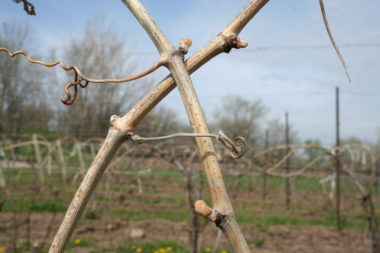
Make sure to bring your boots and take a leisurely stroll through the vineyard. It’s a great time of year to witness new buds popping right before your eyes.  I’d be happy to lead a tour for anyone interested.  Thanks to the wonderful spring weather that’s graced Niagara, we are a good 10-14 days ahead of a normal year.  As I envision what the 2010 vintage could potentially become, I hear the voice of my wise and battle-tested father reminding me not to count my chickens just yet.

A Blank Canvas

After a brief respite, work in the vineyard has begun again in earnest.  It’s time to evaluate just how many buds have made it through winter, then make an educated guess at how many to leave for the upcoming season.  We look at things like bud viability, cane density, internodal gap distance, and the long-range forecast before making our first cuts.

Generally, we prune our vines back to two trunks, each housing a cane of ten or so buds.  We’ve been lucky with a mild winter to this point and bud viability is relatively high compared to previous years.  However, one frigid night can quickly change this rosy outlook, so as an insurance measure we’ll leave a third cane on one of the trunks just in case March decides to go out like a lion.  This third cane is left untied early in the spring then either cut off or tied down at a later date based on how many total buds survive through the dreaded frost window.

The art of pruning may seem like a boring, monotonous chore to some, but I actually quite enjoy it.  I look at each vine as a blank canvas, ready to be fashioned into a viticultural masterpiece.  Laugh not, for the responsibility to empower a vine to produce stellar fruit should not be taken lightly.  This important task of renewal sets the tone for the year ahead and restarts the cycle of life.  With each successive snip of the pruners, it’s hard not to anticipate and envision the bounty this vine will bring us in the fall.

The Next Challenge


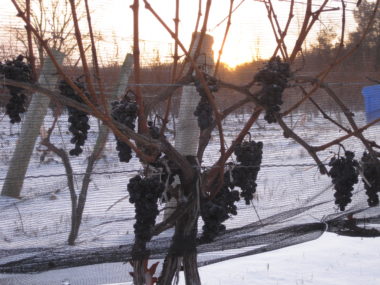
At 8:03 AM on January 2nd, a new era began at Lowrey Vineyards.  As the sun peeked over the escarpment we welcomed the dawn of our very own “Ice Age”.   After an evening of perfect freezing conditions (-12 degrees Celsius) it was decided to harvest five rows of Cabernet Sauvignon, our first foray into the world of Icewine.  A beautiful morning unfolded before us, with a light snow gently filtering the weak rays of winter sun.  It soon became clear that picking the fruit and braving the cold are the easy part, and actually quite enjoyable.

To understand the travails of pressing frozen grapes to yield minute amounts of juice, I want you to imagine trying to squeeze a tray of ice cubes in an effort to produce water.  It takes equal amounts of pressure and patience I assure you!  Too much of the former and not enough of the latter can lead to problems…big problems.  Less than a minute into the second press load I cranked up the pressure and was horrified to hear the sickening hiss of a slow leak in the press bladder.  Luckily we had a back-up bladder on hand, but the subsequent dismantling of the press load and bladder re-assembly really set us back.  In the end, patience prevailed and the luscious Cab juice began to flow.  It was thick, sweet and full of super-concentrated flavours of ripe strawberry and raspberry.

At this stage the plan is to make a traditional Icewine, but I could be persuaded to ferment it a little longer for those seeking more of a drier, “late harvest” style.  Initial feedback tells me that Icewine is often perceived as being “too sweet” for some palates (including mine at times), but I challenge those people to try Cabernet  Sauvignon or Cabernet Franc Icewine with dark chocolate or strong cheeses.  Simply delectable!