
A Snow Day to Reflect
As massive black clouds of starlings swirl ominously overhead, contrasting against the pure white snow, I retire to my cosy barn to reflect on the year 2013. I fear these flocks no more because the barrels and tanks are full, finally put to bed after what seemed like an oddly long growing season. The apparent quality of these young wines fills me with hope.
I won’t lie – there were certainly moments of doubt, well chronicled (if not over-dramatized) in previous entires of this blog. It became increasingly frustrating as we waited and waited for the fields to dry out and for eventual flavour concentration in our late-ripening varietals (Riesling, Cab Sauv and Syrah). Thankfully, frustration can sometimes yield immense satisfaction. This was reflected in the purple toothed grin I saw on my Dad’s face while tasting the freshly squeezed Cabernet Sauvignon directly from the press tray, “You could bottle this and drink it right now!”, he exclaimed. Easy now Pops.
Winter allows for the completion of some jobs that I treasure most as a Winemaker. A recent day spent racking the 2013 whites filled the barn with the most splendid aromas – I was in Sauv Blanc heaven! Equally excitng were the blending trials featuring the soon to be bottled 2011 reds. As early blends begin to take shape, I’m becoming more convinced that the 2011 vintage has a chance to be one our strongest across the board. It rivals 2010 in aromatic intensity and is perhaps more approachable even at this early stage. Easy now Son.
As we enter the winter months and start to sharpen up the pruners, we’ve decided to close the barn for a couple of months to catch our breath. This will allow me plenty of time to get the new wines ready to bottle in the spring. I wish to thank all who have visited over the past year and contributed to our most successful summer to date. It’s hard to believe our barn has been open for five years now and I look forward to more great visits and more new faces enjoying Five Rows wines in the year to come.
A couple of traditional events that we are planning for the winter are a Winemaker’s Dinner at Treadwell’s and Cuvée 2014. Details for these events will follow in future posts. Happy Holidays to all!
Fantastic Four
I’d like to thank Rick VanSickle for including us in his latest article “The Fantastic Four: Exciting New Niagara Wineries That Are Setting The Bar For Excellence”.
It’s especially satisfying when someone takes the time to thoughtfully share the way we’ve chosen to craft and present our wines. Rick has been a great supporter of Five Rows since we first opened back in 2008. To hear him describe the unique manner in which my mother entertains her guests makes me happy and proud. Rarely does a week go by wherein I don’t receive a heartfelt thank-you note from someone who has been introduced to our wines by Wilma. I’m a very lucky Winemaker (and son).
To be featured alongside Kevin and Thomas is a fun coincidence, as our journeys have been somewhat intertwined. It was back in 2002 that Kevin and I worked together at Creekside Estate Winery, a formative time when pie-in-the-sky dreams of starting our own wineries were just taking shape. We spent many days discussing those future plans while working side by side in the very Queenston Road vineyard he now uses for his wonderful 2027 Cellars Pinot Noir. Thomas discovered the Lowrey Vineyard while tasting some of the early Inniskillin Alliance Pinot Noir’s that we were fortunate to be a part of. As mentioned in the article, he now sources fruit from our old Pinot block for his Bachelder series of wines.
The Rains of 2013
It is not the most glamorous time to be a grape grower. I’m reminded of this in the midst of a downpour, as I trudge through shin deep mud on my way to cut rotten bunches out of barely ripe Riesling. I pull my hood tight and turn on my radio headphones in hopes of a distraction from the gloom. “There will likely be snow next week,” the announcer says as I slop past many tons of yet to be harvested Cabernet Sauvignon and Shiraz. Icewine anyone?
It’s been that kind of year. As farmers we’re quite accustomed to being at the mercy of mother nature, and have in fact been spoiled by six consecutive years of decent growing conditions – with a couple of real beauties sprinkled in! It’s rare in any type of farming to have more than a few good years in row. Hence, you’re never as rich as your best year and you’re never as poor as your worst.
At times like this it’s important to remember that you can only do everything in your power to give yourself the chance to produce premium fruit. I’m confident we’ve done just that and I still believe it a possibility to craft great wines from these grapes, albeit with less room for error.
My parents remind me of the “old days” when wet vintages seemed to be a little more common. Tales of stuck harvesters and trucks – and fields so saturated with water that the only choice was to hand pick and hand load (no tractor!) whole vineyard blocks thick with fruit. It stands to reason that in wet years the crop is usually much heavier and far more difficult to harvest.
I finally get to Jean’s Block and in the time it takes me to knock the clods of mud off my boots, the rain abruptly stops. Halfway down the first row I fail to discover as many rotten clusters as I had anticipated and the sun even threatens to peek out of the clouds. As I approach the old pear tree hill that is now Ravine Vineyard I start to smell the most amazing aromas coming from atop the hill. I’m reminded of the hearty lunches that we traditionally enjoy on those cold harvest days. With that, the glamour returns.
2013 Harvest Update
Cue the broken record…the 2013 Pinot Noir is rotting on the vine. We’ve done everything in our ability to nurse along these bursting clusters, but this last stretch of humid weather and looming rainfall (100% P.O.P.) has made our harvest decision an easy one. Excess rain brings the potential for berry split, the spread of sour rot and the dilution of all components within the grape pulp.
Thankfully, the fruit is ready to come off – wonderful flavours, browning seeds, shriveling berries and perfect acidity (TA 7.5 g/L). The sugar levels aren’t the highest they’ve ever been, but that’s not the most critical indicator of ripeness in my opinion. Others may disagree and choose to wait out the coming rain in an effort to squeeze out a few more degrees Brix. I envy their optimism, but my years (and tears) of experience with this fickle “heartbreak grape” will not allow me to take that risk. I will not sleep soundly until my Pinot is cooly soaking in sealed bins.
Prior to harvest I will scour my rows for rotten berries and clusters, surgically removing them where necessary. On the day of the pick we will re-sort every cluster to cull anything that was missed in the vineyard. If all goes according to plan (and it rarely does) I believe that each of the early varietals from 2013 could rival the tremendous wines of 2009.
Update 22/11/13: Over two barnstorming days dodging yellow jackets and ladybugs, we were able to harvest all rows of Pinot Gris, Sauvignon Blanc and Pinot Noir! As forecasted, the rain arrived on Saturday in the form of an all day soaker – 54mm total. For the record I am now sleeping soundly.
Pre-Harvest Jitters
What a curious growing season it has been to this point. I guess it really shouldn’t be a surpirse given that this year ends in “13”. Consistently cool and wet for the most part, but strangely no signs of disease pressure to speak of (knock on wood). Then we are blessed with a few weeks of ideal ripening conditions precisely when we need it at veraison. All varietals, save Cabernet Franc, are looking to be right on schedule.
The Cab Franc are likely lagging behind due to their prodigious uptake of water. The spring/summer rains have left our vines brimming with growth – even many lateral shoots are bearing clusters of fruit! The last couple of months have been spent paring back these layers of green growth in an effort to expose the vulnerable fruit. The Cab Franc vines put so much energy and resource into this shoot growth that the fruit will take longer to enter and complete the ripening process. It doesn’t help that our Cab Franc vines are relatively young and full of vim and vigour!
The task of thinning shoots and clusters has been very time consuming this season, but I can finally start to make out the post at the end of this long grape row. As I complete each row, my Dad follows behind to hang the protective bird netting. I must say that the sight of these nets brings me the ultimate in satisfaction. They represent the preservation of year’s worth of hard work and signify the end of my duties in that block until we harvest.
My mind can now shift to the preparation of tanks, barrels, crushers, presses and the like. It’s also the time to determine which yeasts and fermentation aids I will employ to best coax out the Terroir in my 2013 wines. The new supplier catalogues we receive each year put me in mind of the old Sears Christmas Wish Book I always looked so forward to as a child. My eyes light up as I flip through page after page of new “toys”, each seeming to promise more flavours and aromas than the next. I find it fascinating to think of the amount of research that has gone into refining the simple process of fermentation. We all have our “go to” yeasts that we swear by, but I’m usually tempted to try something new every year – even if it’s just in a single tank or barrel.
If I close my eyes I can almost smell those beautiful fermenting tanks already!
A Few Reviews
We’ve had the good fortune this summer to play host to a wide variety of wine enthusiasts. Each tasting is enjoyably unique and it’s been a pleasure to meet so many new fans of our wine. The feedback for our newest wines has been wonderfully motivational, as every thank-you note, email, review, recommendation and bottle registered on our provenance page makes working outside in the blazing July heat and humidity much easier to endure!
Here are a few recent reviews from some of those visitors:
Rick VanSickle – Wines in Niagara
2012 Riesling Vinification Notes
2012 “Jean’s Block” Riesling
Vineyard: Our Clone 49 Riesling vines budded out very early in 2012, perhaps two weeks ahead of a normal year. Although this may sound advantageous, it was actually problematic. A sudden frost followed bud-break and many fragile buds were frozen dead. Luckily, we left an extra cane that could be tied down to add a few precious growing shoots to the sparse canopy. The summer growth period proceeded nicely with warm temperatures and little rain. A lighter crop load required less thinning and ripened quickly near the end of August.
Winery: The bulk of our Riesling is purchased by Fielding Estate Winery. In talking with Winemaker (and friend) Richie Roberts, I learned that he likes to harvest Riesling with fairly high acidity to give some vibrant life to the resultant wine. As a bit of a “Riesling rookie” myself, I decided to experiment with this approach and harvest our 2012 crop at a higher TA value than I normally would. We brought in our Riesling on September 13th (earlier than ever) and the pressed juice tasted beautiful! The higher TA meant a juice with lower pH, and consequently a sluggish start to the fermentation. Eventually, with the help of a little extra nutrient, the W15 yeast hit its stride and worked at a nice slow pace over the next month and a half. The fermentation was finally halted on Halloween at a specific gravity of 1.006, a point where I perceived balance on my palate. Over the winter months the wine was protein and cold stabilized prior to coarse filtration. We bottled 96 cases on March 26, 2013. The 2012 “Jean’s Block” Riesling is now available for purchase in our barn.
Price: $25.00
Alcohol: 12.0%
2010 Five Rows Cabernet Sauvignon
One decision a winemaker is faced with as a wine evolves is whether they are making that wine for now or for the future. Variables such as the amount of time spent in barrel, new or previously used oak, French or American oak, health tannin level, acidity and pH all must be addressed. It is where experience really comes into play, as the decisions you make now may lead to the wine being tougher to enjoy in the short term, but hopefully pay dividends later on.
Then there are rare wines like the 2010 Cabernet Sauvignon that are enjoyable now while also exhibiting good aging potential. These wines can make winemakers look very clever, but are probably the easiest to craft. The fruit comes in ripe and clean with ideal parameters and the fermentations go exactly according to plan. After many years of dealing with devilish Pinot Noir, this is a welcome luxury!
The 2010 Cab Sauv was harvested on October 28th and 29th. If we push it, Howie, Wilma and I can hand-harvest and process about 1.5 to 2 tonnes in a day. We normally tackle the Clone 169 block first, then bring in the Old Block Cab on day two. It’s always a relief to get through these two days as the Cab Sauv is the last variety we harvest each year. Needless to say, we slept in on October 30th.
70 picking boxes were harvested from rows 4 and 13 in the Clone 169 Block and 78 boxes from rows 5 and 8 in the Old Block. Following a four-day cold soak, the two bins of fruit were inoculated and warmed to start fermentation. Two yeasts were chosen to work with the specific strengths of each vineyard. The slightly riper Clone 169 fruit was fermented with FX10, known to retain polyphenolic potential (structure and colour), release and bind polysaccharides, and aid in the expression of terroir through minimal “fermentation odour” production. The Old Block was inoculated with CSM, a yeast that specializes in producing intense aromatic profiles of berries, spice and licorice, while concurrently reducing vegetal aromas. A winemaker can only hope that these yeasts live up to such bold claims!
Finished wines were racked to four barrels: Clone 169 to a new Taransaud and two-year-old Billon; Old Block to a two-year-old Taransaud and five-year-old DAMY. Through the years I’ve found that Taransaud barrels do magic for my Cab Sauv. They have a way of “framing” the fruit components of the wine, while contributing just the right amount of oak spice and wood tannin. I usually opt for a tight grain oak, medium toast level with three years of air drying to balance the longer time our red wines spend in barrel. After 24 months in oak, the 2010 Five Rows Cabernet Sauvignon was blended and allowed to bulk age in a tank for five more months. 103 cases were bottled on March 26, 2013. This wine is now available for purchase.
Aromas: blueberry, cherry, Stanley prune, mint
Palate: soft tannin, ripe cherry, savoury mouthfeel/flavour
Cellaring: I personally enjoy drinking this wine now (call it winemaker bias), but it should really be cellared for at least another six months. It has the tannin and structure to age and improve for many years to come, I prefer not to put a limit on it.
Price: $50/bottle
Alcohol: 13.3%
2010 Five Rows Shiraz
Is it a Shiraz or is it a Syrah? The debate over the name of this wine has played out numerous times around our tasting table since we released our first one back in 2008. That 2008 “Shiraz” was a hit with our friends, but most agreed it was more reminiscent of a “Syrah” in style.
I get a kick out of this debate because it brings me nostalgically back to the origins of this grape in our vineyard. We planted Shiraz Clone 100 back in the late 90’s at the request of Creekside Estate Winery, who were bravely setting out to turn Shiraz into a key part of their varietal portfolio and winery identity. Fueled by the knowledge and vision of an enterprising Australian winemaker, Marcus Ansems, my parents agreed to plant the 11 rows of Shiraz that now stand tall along our driveway, across from Wilma’s lavender.
Upon planting, we quickly found out that these vines loved to grow! They shot up like the most vigorous of weeds, making us wonder why few farmers had attempted to grow this grape variety in Niagara before. The first cold winter would provide us the harsh answer to that question.
Just as the vines were starting to mature and bear their first fruit, we were hit with some cold winter conditions that killed nearly half the vines in our new Shiraz vineyard. The Achilles heel of this fast-growing, high-cropping varietal was now all too clear. Should we replant the vineyard or wash our hands with Shiraz altogether? This was a tough call, but in the end we decided to give it one more shot. Thankfully, the winters have been more co-operative since then and we’ve also learned a few tricks in the vineyard to help the vines overwinter better. We switched from a Scott-Henry training system to a more simple, two-arm pendelbogen trellis. More attention was paid to controlling vine vigour through soil nutrition and cropping levels. The vines performed well enough to merit planting 8 more rows of a second Australian Shiraz Clone (#7) in soil with higher clay content to aid in vine development. Both blocks are doing well to this day.
Due to the success of these Shiraz vineyards on our farm and the legitimacy brought to the varietal by Creekside (think luscious Broken Press Shiraz…mmmm!) it was a no-brainer that I would order a large run of labels adorned with “Shiraz” for my 2008 debut. However, as it came time to blend my 2008 Shiraz – the jammy, hot (high-alcohol) and bold notes present in all of our favourite Aussie “critter” wines were nowhere to be found! In fact, every time I sampled these barrels I felt as if I had just tacked up a horse and ridden through a fragrant lavender field, only to suddenly realize I was surrounded by blackberry bushes and Marijuana plants (for the record this has never happened…yet). Alas, despite what thousands of freshly printed labels now proclaimed, my first Shiraz had just become a Syrah – and I didn’t mind one bit!
A second issue with growing Shir..I mean Syrah in a cool climate is that it tends to ripen very late in the season, making it a challenge to vinify in lackluster, “shorter” growing seasons like 2009. For that reason we decided not to attempt a Syrah in 2009 as the acidity levels never seemed right for crafting a premium wine.
The opposite was true for 2010. It will be remembered as one of the warmest vintages Niagara has ever seen. The growing season started early and never slowed down. Precipitation was spotty but adequate – just perfect for wine grapes. We harvested the Syrah on October 11, much earlier than any other vintage. Sugar levels hit an all-time high (24°Brix) and the skins and seeds showed excellent maturity. Three rows were selected from the older Clone 100 block (#2,9,10) along with two rows from the younger Clone 7 block (#4,8).
The fruit was de-stemmed into bins, which were then sealed for a four-day cold soak on the skins. Fermentations were allowed to start wild, then inoculated with a yeast known as “Enoferm Syrah” (an isolate from the Côtes du Rhône in France). It was chosen for this ripe fruit because it’s known to be a good glycerol producer for smoother mouthfeel with typical aromas including violets, raspberries, cassis, strawberries and black pepper. Fermentations lasted about 8 days with temperature peaks around 28°C. I could tell early on that this wine would one day be something special!
Five barrels were filled following pressing. The Clone 7 fruit was racked to a new Taransaud barrel and a two-year-old Billon, while the Clone 100 fruit was split between two older French and one American oak barrel. The wine was allowed to mature in oak for 24 months. We bottled 118 cases of this Syrah on March 26th, 2013. This wine, along with all of our 2010 reds, is now available for purchase.
Price: $50/bottle
Alcohol: 13.4%
Cellaring: 3-5 years
Of Buds and Blue Eggs
When setting out for a morning of work in the vineyard, I never know what I might encounter. I’ve witnessed deer bounding gracefully right between our trellis wires and lone coyotes sauntering about, slyly portraying ignorance yet fully aware of my presence.
More often than not I encounter birds. From majestic Hawks and rare Bluebirds to annoying Starlings – it runs the gamut. I especially look forward to spring, when new life in the vineyard is not limited emerging buds and dandelions. This past week, while tying down canes of Pinot Noir (specifically Row #7 in the Old Block), I was fascinated as I closed in on one particular vine.
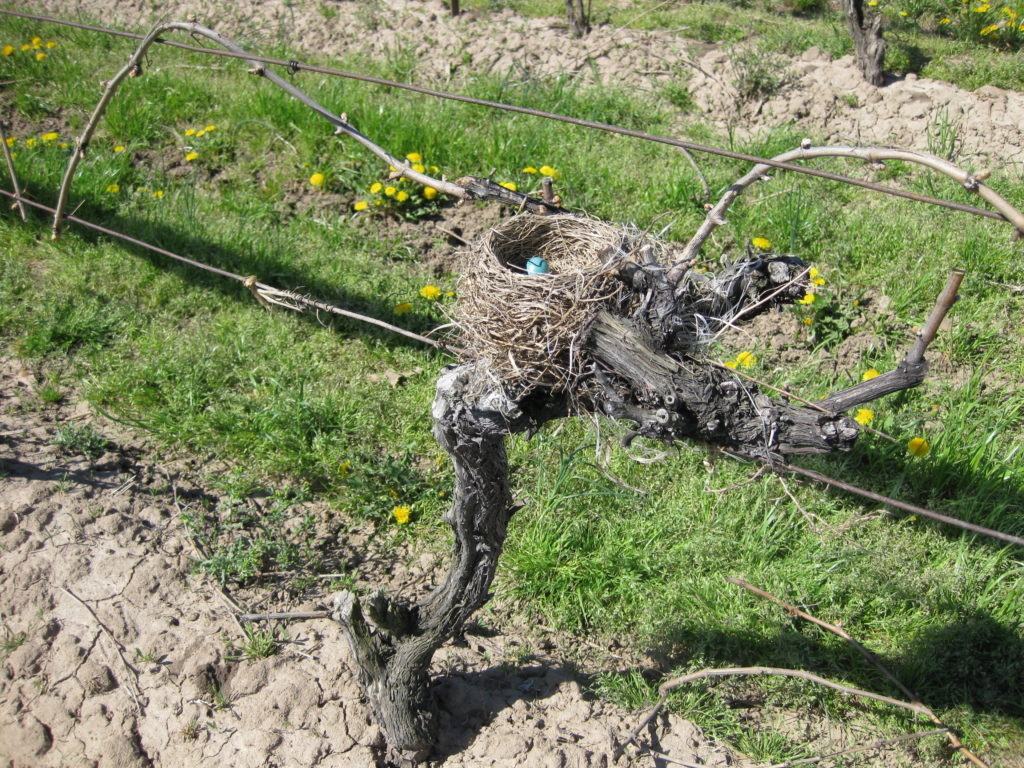
Cautiously creeping closer, it became evident that a determined Robin had chosen one of my oldest Pinot vines as the perfect place to raise its family. I recognized the irony in this nest full of future grape-pecking Robins staring me in the face, but I couldn’t bring myself to relocate the cosy looking abode. Instead, I tied down the canes and snapped a few quick pictures as mama Robin chirped at me rather aggressively from two rows away.
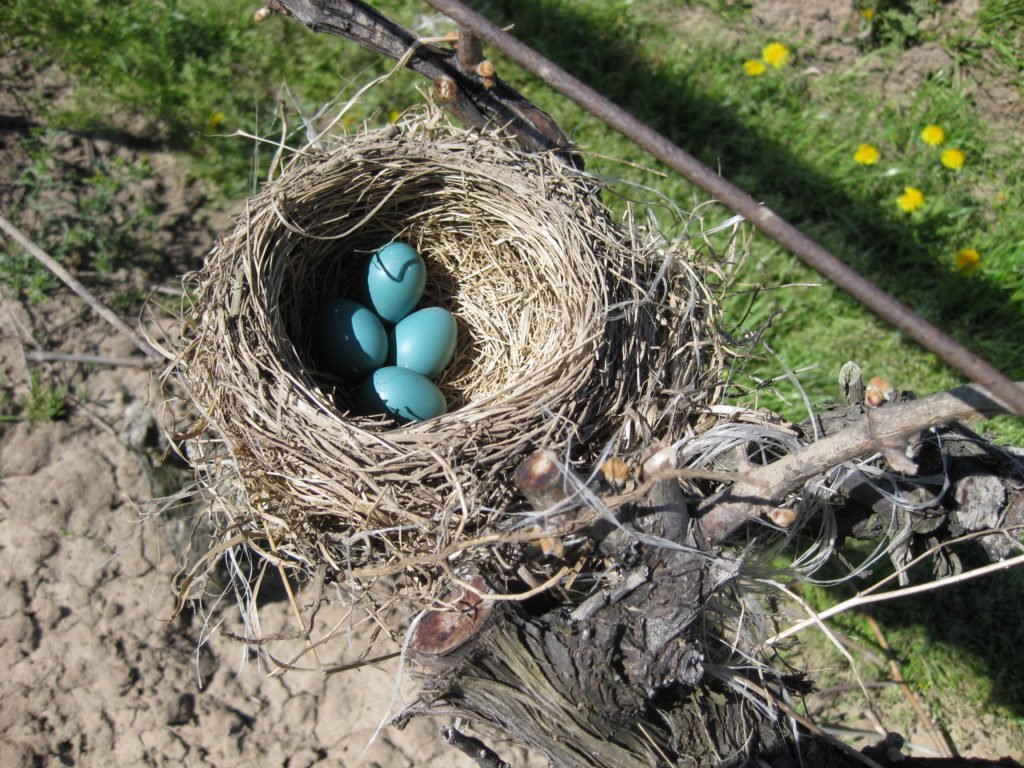
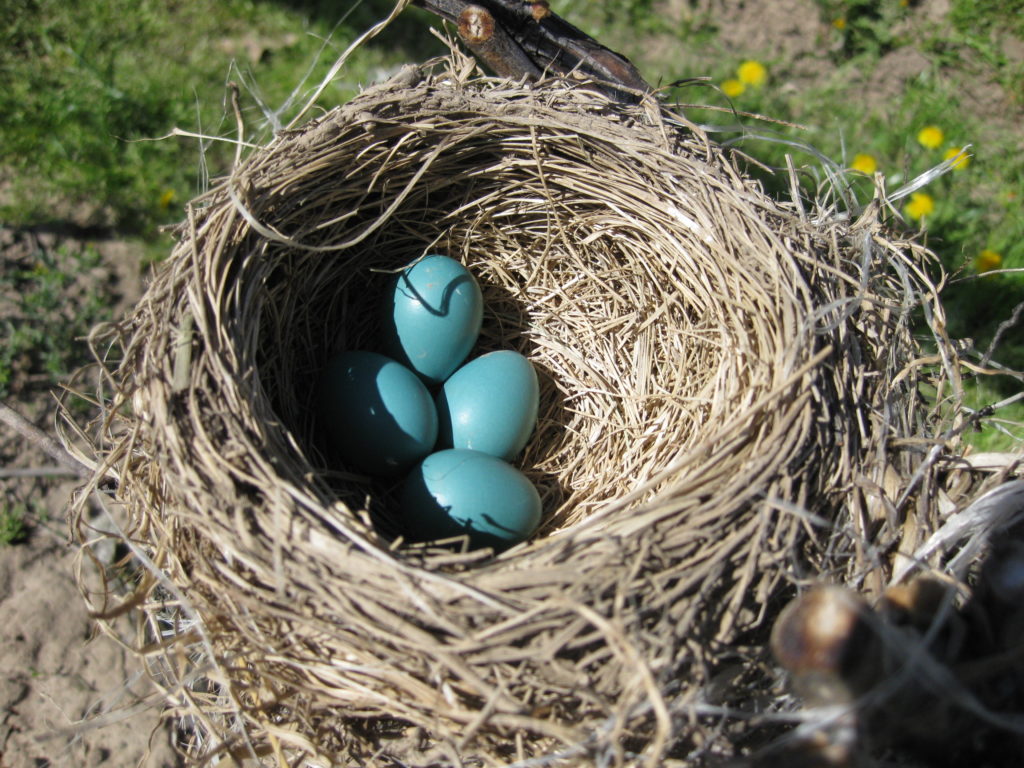
This is actually a common vineyard occurrence. The most interesting discoveries are the camouflaged Kildeer nests dotting the ground between grapevines. Mother Killdeers are seemingly fearless. As you approach the nest she will frantically charge at you, feigning a broken wing in an effort to seem more vulnerable to the perceived predator. In the ultimate act of altruism the mother will then attempt to lead you in the opposite direction of her nest, all the while fanning her “broken” wing. I always get a kick out of this evolutionary trait and try to vacate the area as quickly as possible. Inevitably, I must approach the nest as work continues in the adjacent row and the whole dance starts again.
My mind flashes to a vision of yours truly, arms flailing and yelling wildly, as Howie approaches one of my dogs on the tractor. He is blissfully unaware, and they are all too eager to greet him. Finally, I get his attention and danger is averted. My inner Kildeer is satisfied.