
Big Berries and Happy Vines
I’ve decided to initiate this writing by optimistically pouring myself a half full glass of 2011 Pinot Noir.
In what seems like the wettest summer in recent memory, there have been a few positives. Not the least of which is that I now know it’s possible to grow grapes in a climate where it rains every other day. The vines are indeed lush and happy, but ripening this crop of monster-sized berries could prove to be the rub.
It may be a blessing in disguise that our poor, winter-ravaged vines were treated to a stressless year such as this. We haven’t exactly been afforded the heat units and dry conditions seen in “glorious” years like 2010 and 2012, but that isn’t the be-all and end-all of crafting decent wine. I’ve come to accept this stubbornly, as people continually seem to prefer the wines we’ve made in less extreme years like 2009 and 2011. The superior elegance and early approachability of these vintages has been surprisingly matched by their ability to age splendidly. However, given the choice I’d take the easy growing season every time!
I shudder at the memory of the nightmare harvest of 2011, and that optimistic glass of Pinot suddenly becomes half empty. I start to worry that even an unprecedented two month stretch of dry heat may not be enough ripen our beautiful (but late) crop of Cabernet Sauvignon. Due to the sluggish start and lack of sumer heat, we’ve had to thin the crop down to its lowest level since 2009 and the cluster and berry sizes are reflective of that – GARGANTUAN! Winemakers are not generally fans of big berries, although farmers like my dad love them. Larger berries tend to be more dilute in terms of flavour and suffer from lower skin to juice ratio, not the textbook combo for premium wine.
Perhaps it’s too early to worry about such things. The glass is now empty.
Rainy Day Winemaker
It occurs to me, as I hit a few golf balls into my Cabernet Sauvignon early on this Sunday morning, that we’ve evolved into a rather unconventional winery. I don’t know what triggered this random thought – perhaps the vision of a Winemaker more intent on grooving a sand wedge than racking barrels…warped priorities indeed.
Admittedly, I’ve morphed into a “rainy day” Winemaker of sorts, as there are just too many jobs to do in the vineyard when the sun is shining and field conditions are ideal. It is on those rainy days when I employ some techniques that most would consider uncommon (certainly not smart) oenological practice.
I’ve learned the hard way that gravity-siphoning Syrah, on a tipsy ladder into two barrels simultaneously, will most assuredly lead to a violent Syrah volcano that is not discriminate about where it splatters. This is especially problematic when your winery space is also a retail store lined with finished packages. Those “specially stained”, collector’s edition bottles are now reserved exclusively for family and friends.
The eccentricities do not end there. I’m not sure how many Winemakers must arrange daily tasks around their mother’s laundry schedule, but I’m willing to bet there are only a few of us. You see, water pressure is of the utmost importance in cleaning both tartrate-laden oak barrels and Wilma’s linens. Despite these limitations, the wines get made and our whites are still bright.
Those visiting our barn on weekdays can attest that it doubles as a very large dog house. A stickler to routine, my days are planned around letting my dogs out at a quiet time when they won’t bother our guests. I treasure these few moments of leisure and serenity…
That is until my one-eyed King Charles Cavalier x Chihuahua, named Bella, becomes seemingly possessed by a Tasmanian Devil. It usually begins with her running really fast in large circles (one-eyed dogs tend to do this) eventually setting out on a wild foray into the vineyard despite my attempts at verbal restraint. Onlookers sit back and enjoy the spectacle, often marveling, “Look at her go!” And go she does. I’d like to say that I play it cool and never get sucked into chasing her…but that would be a lie. Picture Forrest Gump chasing a weasel.
A more fitting winery mascot would be hard to find.

An Explosion of Pinot
Those unfamiliar with the otherworldly vigour exhibited by Pinot Noir grapevines in early June are welcome (and encouraged) to witness this phenomenon firsthand, before the dramatic shoot-thinning begins.
It is actually comical to see how much growth these vines can throw in ideal conditions. For every shoot there is a secondary, for every secondary there are three suckers. This all adds up to mayhem. Observing Pinot at this stage leads one to wonder if these vines could ever be fashioned into something resembling “organized”.
Over the next few weeks I will tackle this chaotic cluster of green with hopes of taming my Pinot into submission. Sadly, I already know this is a losing proposition, but what I lack in smarts I make up for in persistence. This is a key job that sets the tone for producing good, clean Pinot Noir.
If you do decide to visit in the coming days I would suggest bringing along a machete and ample hydration. If you can find me, I will happily teach you the ways of the jungle.
Overwhelming Response
I’m overwhelmed at the response we’ve received to our new wines and the number of keen visitors we’ve entertained over the last couple of weeks! It is all we can do to write and apply labels fast enough to keep up.
I’ve become accustomed to putting off my vineyard work on weekends in May to stick around the barn and help the girls with tastings. I must admit that I secretly enjoy this, as it allows me to overhear all the interesting and thoughtful reviews of my wines. There is always a gut-wrenching fear belying my calm facade that these wines won’t live up to their predecessors. You would think that after nine vintages of wrenching guts I might have learned to trust my palate by now, but it always takes a few satisfied customers to reassure me.
That is all part of what makes this time of year is so exciting, from the inbox full of pre-orders to the smiling faces of return visitors parading through the barn door. The fact that people would think enough of our wines to pre-order them on spec, without even trying them first, is the ultimate in trust. I treasure this trust as much as any award or five star review we’ve ever received. The “pre-order” is my gold medal.
With that trust comes the pressure not to disappoint. This challenge drives what I do in the vineyard every summer. In the back of my mind is the knowledge that this vine I’m currently thinning will produce fruit to make a wine that someone may already have dibs on for next year. On one hand it’s a very reassuring thought, but it also means there isn’t much room for error!
As the first buds of 2014 start to reveal themselves one precious leaf at a time, I confidently venture out to the vineyard and strive to earn more trust.
New Wines
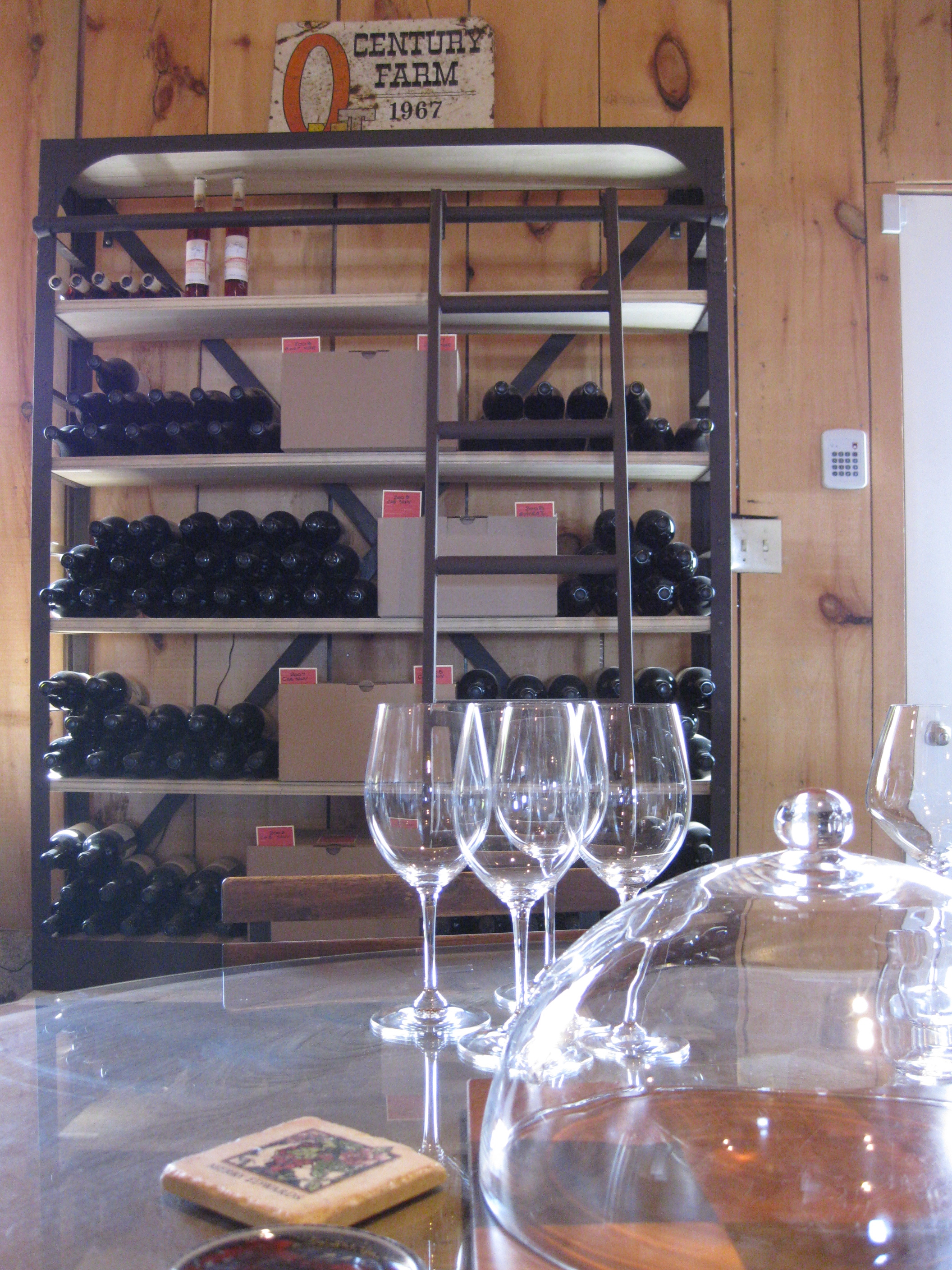
On the eve of the New Release here at Five Rows there is palpable anticipation is in the air. The barn is full, brimming with fresh wines ready to introduce themselves to some palates. Taking a mental snapshot of these tall stacks I recall the sheer amount of work that went into each one of these wines from the first moment of bud emergence until now. There is contentment in this reflection.
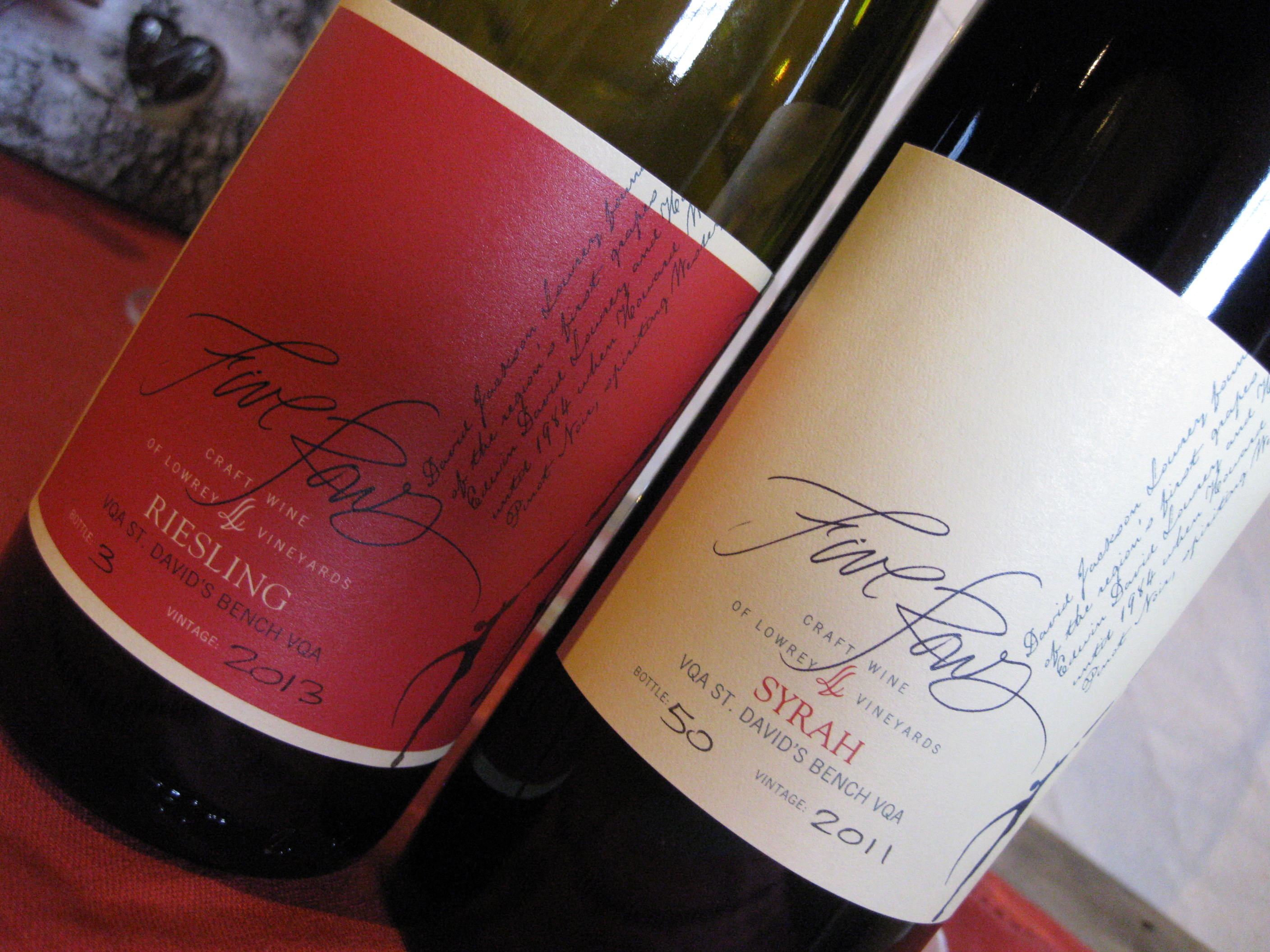
I leisurely wax the cork tops while Wilma pens and applies the new labels. Next weekend we will officially open for the year and debut all of the recently bottled 2013 whites and 2011 reds. Experience tells me that there will be nothing “leisurely” about the next couple of weekends, as all of our friends stop in to pick up their orders. It’s a whirlwind of visits and tasting, but we wouldn’t have it any other way!
The First Official Jacket Hanging of 2014
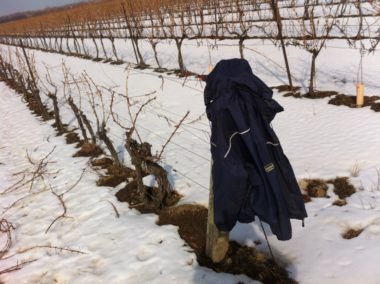
It’s official. March 10, 2014 marked the first outdoor workday of the year that I was compelled to take off my jacket and hang it over an endpost in a symbolic act of optimism. I don’t know that I’ve ever enjoyed a day of pruning (and fetching) this much. I guess it takes a long, cold winter to make a 7 degree March afternoon feel so heavenly.
Lucy will miss the snow.

Winemaker’s Dinner
For those interested in a special culinary experience, I encourage you to join us for our upcoming Treadwell Winemaker’s Dinner on March 22.
This night is always a treat for my family, an opportunity to catch up with friends and share the amazing creations put together by the Treadwell team. It is an oasis of sorts in the midst of the winter grind.
Call James for details or to book a spot at the table (905-934-9797).
Uncorking A Hidden Gem
Back in the fall, we were visited by St. Catharines Standard photographer Bob Tymczyszyn on a few occasions over the course of harvest. The images he shot and subsequent article he wrote can be read here.
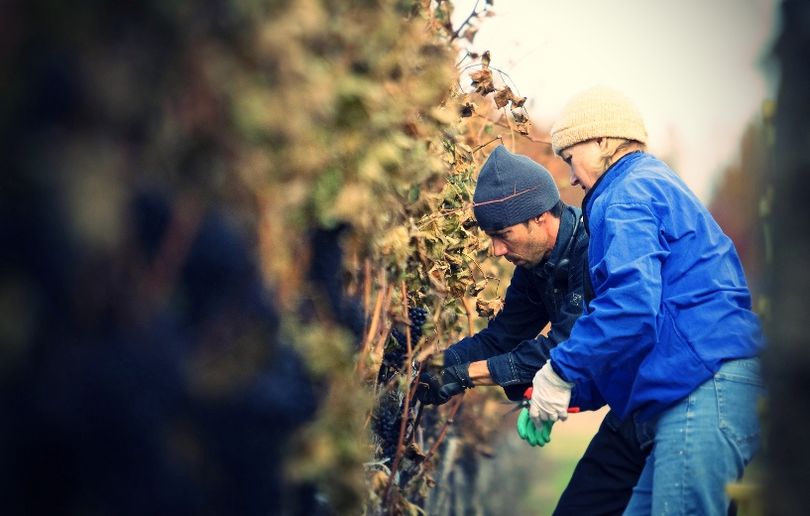
I will be forever grateful to Bob for capturing some special moments I enjoyed harvesting Syrah with my Mom and pressing Cab Sauv with my Dad. These are times I cherish, yet can’t truly appreciate until I see them through the eyes of someone creative like Bob.
Fighting The Winter Blahs
It’s hard to know just how many buds and trunks have succumbed to one the harshest winters of their lifetime. Although I prefer not to entertain these thoughts – they can’t be ignored.
Pruning decisions are based on how many buds are estimated to be alive on a given vine. The only way to really calculate this number is to take a cane sample, cut open the primary buds and count how many still appear viable. This gives us a rough percentage that we can take into account when fashioning the vine for next season.
The tricky part is that each variety has a different sensitivity to extreme cold. On our farm the most sensitive varietals happen to be two of our more popular wines: Sauvignon Blanc and Syrah. For this reason I get a little panicky at the prospect of little or no crop in these vineyards!
Preliminary counts don’t look great. We’ve experienced lows of -21C and most all varietals show some sign of bud mortality. Hearty varietals like Cab Sauv are in the 60-70% alive range, while the Sauv Blanc and Syrah are more in the 30-40% range…and it’s only the beginning of February.
Unfortunately, bud viability is not the only hurdle. The vascular tissue in the trunk of the vine is also susceptible to damage in these conditions. If the trunk is dead – the amount of viable buds obviously becomes a moot point. Cruelly, trunk death is usually not noticeable until the buds emerge like gangbusters only to slowly whither and die along with your false hopes.
The positive I’ve been able to take away from this winter is a greater appreciation for the wines I currently have in barrel and tank. Previous mild winters have spoiled me into taking a “full barn” for granted. Growing sensitive Vinifera grapes in Niagara should never be considered a sure bet. It will take patience and hard work, but we will recover from this winter like we did in 2004-2005.
2010 Pinot Noir
Consider this my therapy. The ability to write and reminisce about a finished wine whilst going through the rigours of harvesting and vinifying that same grape varietal is a welcome shift of thought. It doesn’t get much rosier than the memories I have associated with our 2010 Pinot Noir.
Simply put, 2010 was an ideal vintage to grow grapes. Heat when you needed it and just wet enough for excellent vine growth, but not excessive vigour. The risk with Pinot Noir in these warm, dry conditions is overripening. Pushing the grapes to a point where they almost become “un-Pinot like”. For that reason we harvested our crop on September 4th – a full week earlier than we ever had before. All ripening parameters were dialed in. Sugars high, but not so high as to make the wine overly alcoholic (22 degrees brix) and decent enough acid (TA 7.5) to keep the pH low and aid in ageability. This would be a bold Pinot for sure, but not so bold that our Terroir couldn’t shine through.
We harvested 8 rows from our Old Block and 3 rows from our new Clone 777 block. The fruit was sorted, chilled and processed into bins for traditional punch-downs during fermentation. I chose to let the three bins cold soak for a few days and let the fermentations start via indigenous yeast. Each bin was then inoculated with a different cultured yeast to add complexity to the overall blend. The 777 bin was treated with a strain called BRL97, while the the old block was fermented with RC212 and W15. The fermentations lasted about 10 days whereupon each bin was pressed to barrel (25% new oak, all French). The wine was allowed to mature for 24 months in oak before bottling 143 cases on March 26th, 2013.
In the end this is a Pinot Noir that should age gracefully for at least another ten years. It’s the kind of wine that sneaks up on you and demands another sip, another glass…
Aromas: cherry, leather, mushroom, wet stone, vanilla, red currant, meat jus, violets
Flavours: cherry, pomegranate