
2022 Syrah
2022 Syrah
My perspective on growing Syrah is a complicated one that has shifted over time. Winterkill vintages, like 2022, are a reminder of just how tenuous this whole business can be. An entire vineyard that holds only 15% of its normal yield is a depressing challenge that can lead one to question the worthiness of the pursuit. However, the fact that there is any fruit at all is a blessing compared to the travails faced by those in the Okanagan, who’ve lost everything in recent years.
I’ve come to learn, through the process of trying to source replacement Syrah grapevines in a time of high demand, that the clones we currently grow are a dying breed. Nurseries are hesitant to propagate Clone 100 or Clone 7 these days, due to their likelihood of developing a foreboding (and aptly prophetic) grapevine disease known as “Syrah Decline”. Moreover, Syrah was not included as one of the acceptable varietals to plant in a recent Government funded vineyard replacement initiative. Key evidence that industry stakeholders do not view it as a financially viable option to grow in our region.
With so many strikes against Syrah one is left wondering, “is the juice worth the squeeze?”
Well…of course it is!
The 2022 Syrah crop was one of cleanliness and quality, thanks to a trend of dry weather in the late September days of that vintage. The precious few hanging clusters ripened optimally in those conditions and started to show signs of desiccation and concentration by the time they were ready to harvest on October 11th. The final tally was 84 picking boxes (1008 kg), with the majority of the fruit being sourced from the Clone 100 block.
The entire crop was fermented together in one bin for twelve days, with three daily punchdowns and a pretty hot peak temperature of 35°C. The Syrah was then gently squeezed in our antique basket press after two full weeks on the skins. Three French oak barrels were then filled, where the wine was allowed to undergo malolactic fermentation and mature for two years. 66 cases were bottled on April 17th, 2025.
The hallmarks of Syrah grown in a cool climate are on full display here: dark fruit, peppercorn, smokiness and smooth texture all in harmony. Any dish of wild game or hearty ragù would make a great pair for this wine. I would expect even more fruit intensity over the next few years in bottle, based on the evolution of previous small yield vintages.
I treat every year that I can put Syrah into a bottle, however small the quantity, like a gift from the vineyard Gods.
2024 Pinot Gris
2024 Pinot Gris
For as long as I can remember, I’ve had a passion for organizing. My youth bedroom was a shrine of toys and sports memorabilia that I cherished and methodically categorized. Toys were for displaying and keeping in meticulous condition, while actually playing with them was an afterthought. Everything had its place and I was happy. Marie Kondo would have been proud of me.
In grade school, I thoroughly enjoyed creative writing. However, when faced with the task of writing a story, I much preferred the process of editing to the actual creative endeavour of coming up with original content. Being able to massage a sentence into something borderline coherent still gives me great joy. I am no wordsmith, perhaps more of a “wordslayer”.
One area where this penchant for organizing and editing has served me well is the many hours I’ve spent tending to Pinot Gris grapevines over the last 20 years. When embarking on an adventurous journey down a row of Pinot Gris, the mindset one must adopt is “survive and advance”. There is a gradual process to canopy management and thinning that can wear on those in need of instant gratification, so it pays to enjoy each vine along the way.
The ultimate goal is a well-spaced, vertically growing canopy with two uncrowded clusters per shoot. It will take multiple passes down a row to achieve this preferred arrangement, so it’s advisable to focus on a single task with each trip. In my experience Pinot Gris is the most difficult varietal to tame, as it has a tendency to flop over, grow laterally and create “clumps” wherein many clusters are growing tightly together. Tackling the shoot thinning first, then shoot positioning (tucking), followed by cluster thinning is the usual order of business. A careful removal of leaves in the fruiting zone is a late season finishing touch.
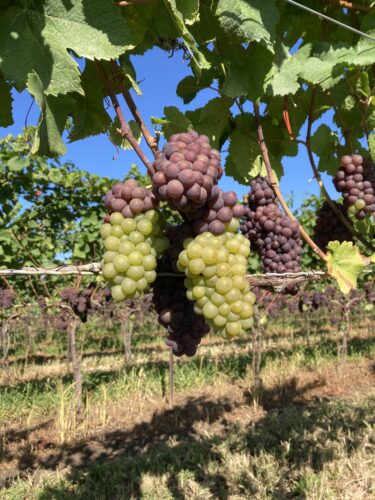
The grapes for our 2024 Pinot Gris are sourced from two different blocks on our farm. The older block, a 2004 planting of Clone 457 rootstock SO4, tends to be more vigourous and wild, but fairly predictable in regard to flavour production once properly organized. The younger block of Clone 53 rootstock 3309 was planted in 2019 and is still in the discovery phase. The vines seem more amenable to my efforts, with slightly looser clusters that are more robust to disease pressure. The initial crops have been light and VERY ripe, providing a nice complement to the older block fruit.
The crop from both blocks was harvested on September 11, 2024. Pressed juice was notably flavourful and came in at 21.2ºBrix, TA 7.13 and pH 3.38. Two-thirds of the juice was fermented in neutral French Oak barrels, with the remainder housed in tank. The cool temperature fermentations spanned September 17 to October 17, gradually accumulating the familiar Pinot Gris aromatics of canned pear, dried apricot and honey. The most noticeable contribution of the Clone 53 block is in the added aromatic intensity and more complex mouthfeel elements.
To know that vines you personally organized, provided the fruit for a wine that you created and edited into its optimal form, is the ultimate in satisfaction.
2024 Riesling
2024 “Jean’s Block” Riesling
Let’s face it, there are very few things in life that we can comfortably rely upon. The constant expansion of the Universe, the predictable enthusiasm of a Golden Retriever and the aromatic intensity of Riesling are just a few examples that immediately come to mind. I’ll tackle the origin of Riesling aromatics here and leave the other two phenomena for you to ponder at your leisure.
The Riesling story always begins in the vineyard, with clone choice and terroir. In most instances, choosing the best clone for your site is a strategic exercise of thorough consideration, while other times a shipping container mysteriously gets “lost at sea” and you take what you can get. The planting of Clone 49 Riesling on our farm falls more into the latter category, which I now consider a stroke of luck. The well-drained, clay loam soils bordering the Four Mile Creek proved to be a perfect home for this finicky, Alsatian clone.
While we may not have the dramatic slopes and altitude of its clonal homeland, our unique St. David’s Bench climate and terroir somehow manages to spoil us with expressive Riesling aromatics on a yearly basis. Channeling my inner Alsatian farmer, the focal points early in the growing season are crop level and canopy management. I’ve come to learn that Clone 49 can be cropped on the heavier side, providing the canopy is healthy and green. Fruit exposure decisions are made later in the season based on disease pressure, water status and weather trends.
In 2024, we faced a summer of extreme precipitation events, leading to a fuller canopy and an average size Riesling crop. It was decided to remove a few leaves in the fruiting zone at veraison to air things out a bit, but care was taken not to overexpose the fruit and compromise our preferred style. Prospects were looking good in the Riesling through August and early September until a stretch of typical harvest-time humidity. Windless, humid days and foggy mornings made it impossible for the vines to dry out properly and in quick succession botrytis spores began multiplying on the surfaces of our soaking clusters. We opted to harvest (in the nick of time!) on September 27th with ideal juice numbers of 18ºBrix, TA 8.6 g/L and pH 3.06.
It was apparent early on in the fermentation process that the aromatic potential was high – i.e. you could distinctly smell the fermenting Riesling as you pulled into the barn parking lot. I prefer to ferment my Riesling in tank with W15 yeast at a very cool temperature (9-10ºC) to preserve the bright fruit components, eventually stopping the fermentation before reaching complete dryness at a specific gravity of 1.004.
The resulting wine showcases standout notes of candied green apple, citrus, peach and perfumed floral undertones. It also features palate-awakening acidity and just enough residual sugar to achieve harmonious balance. In other words, everything that I’ve come to love about Clone 49!
2021 Pinot Noir
2021 Pinot Noir
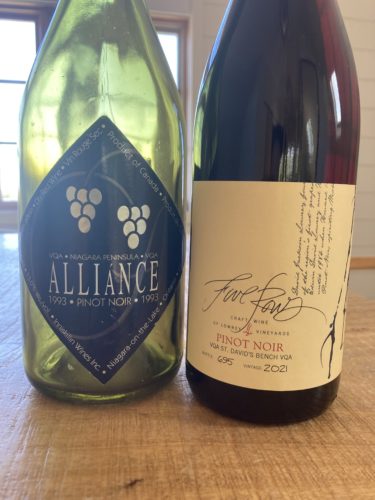
The 2021 growing season, and the red wines that resulted, are a study in contrast and perseverance. In my vintage notes for the 2021 Pinot Noir there is written but one telltale comment, “One of those years.”
As a varietal Pinot Noir presents inherent contradictions. In the vineyard, it is a grape that requires intense labour, constant attention and a heavy hand, at times, to properly manage the canopy. In the winery, conversely, I’ve come to learn that restraint, patience and a gentle approach are critical to successfully translating terroir.
So that is why, given the difficult fall conditions of 2021, I took a different attitude toward crafting my Pinot Noir. Instead of lamenting the breakdown of clusters and writing off the vintage, I took the long view. Past vintages (and wiser winemaking colleagues than I) have taught me that the final sprint to cut out all of the rotten clusters and berries is not the end of the game, but actually just the end of the first half. I’ve been witness to many great late-game comebacks in my life, mostly against my rooting interest, but this could represent a moment of redemption!
So it was with guarded optimism that we harvested our Pinot Noir on September 21st, surely to get them off before the next imminent downpour. The ripening parameters were to my liking, but the field was soaked and my time was limited to cull out as much rot as possible prior to the handpick. I conjured up my best Edward Scissorhands, minus the Johnny Depp looks, and set to work.
Once the fruit was picked, sorted and gently destemmed into one tonne bins, they were sealed for a four-day cold soak. It is normally my hope that the wild fermentations would kick off right after the fourth day, but that is rarely the case. Thankfully, in this instance the stars seemed to align and when I cracked the bin lids on day four, I was greeted with a nice firm cap of skins and whole berries and the wonderful smells of a burgeoning fermentation. We were off to the races; the comeback was afoot!
Indigenous yeast fermentations can be a wild ride at times, but those driving the 2021 Pinot bins were models of consistency and aromatic beauty. Must temperatures hovered around 20C and peaked at 32C, and the bins were dry in seven days.
The bins were lightly pressed, then racked into five French oak barrels. This is where the restraint and patience are put into practice. Aside from the odd tasting session and biannual racking, there is not much to do over the next two years providing the wines are sound.
The final barrel tasting and blending sessions are the make or break moment when everything is on the line. So many combinations, so many possibilities, it can send your mind in many different directions. Some wines, however, present clarity in those moments and that was the case for the 2021 Pinot. It ended up being “one of those years” when the cooperage variables of barrel age, forest, grain tightness and toast level all line up in sync with the wine. The result is a wine that stars the terroir, while the oak and the winemaker play the supporting role.
Sometimes you just have to trust that the vineyard can be the hero in the end.
2023 Sauvignon Blanc

2023 Sauvignon Blanc
As the first buds of 2023 started to push from their winter cocoons, the countdown was on to see whether the fickle new trunks we painstakingly established the previous summer were up to the task of supporting vegetative growth. It was a nervous, yet fascinating time to observe the delicate first spring growth of a Sauvignon Blanc grapevine.
We didn’t have to wait long. The one thing about young trunks (young anything for that matter) is that they are vigorous and impatient. Two years’ worth of underutilized nutrient supply awaited the voracious and deep roots of these vines. Early season conditions were very conducive to growth, so much so that efforts were soon undertaken to balance the number of primary shoots on each new trunk. It can be difficult to summon the aggressiveness required when thinning these vigorous canes, especially the year after a light crop, but the alternative is a crowded and unruly canopy – no thanks!
The rebound season stretched on through the summer months, with more than adequate precipitation to support the now thriving vines. It became apparent that we were dealing with a bumper crop of large-berried clusters, so extra attention was paid to achieving proper fruit exposure and cluster spacing to combat fungal growth. Thankfully, a relatively dry and cool September resulted in super-clean fruit. The deficit in precipitation seemed to dilute the water status in the berries to the point where the intensity of flavours was more noticeable in the week leading up to harvest.
We chose to harvest our bountiful crop of Sauvignon Blanc on September 25th, and ended up with about 2300L of juice after the press cycle. After cold-settling the juice, it was racked into eight French oak barrels (80%) and one tank (20%). The barrels were of varying ages (2-15 years) and mostly neutral in their tannic contribution.
The vessels were warmed to 20°C and then inoculated with X5 yeast. Once fermentations were established, the barrels were cooled to 8°C for about two weeks, then allowed to warm again to finish. I find that pushing the lower end temperature limits of the yeast tends to maximize the aromatic intensity. One must be cautious, however, not to overly stress the yeast – it’s a fine line!
The finished wine represents an amalgam of all the terroir-derived elements that Sauvignon Blanc enthusiasts would come to expect. It is less overtly opulent than the light-crop 2022 vintage, putting it more in line with a typical vintage like 2019 or 2021. Aromatically, there is an intense intermingling of tropical and citrus characters, with some typical Sauv Blanc gooseberry present as well. The TA for this wine is 7.9 g/L, which balances well with the 8 g/L of residual sugar and contributes to noticeable length on the palate.
This wine evokes a personal feeling of satisfaction and thankfulness, born out of the travails of re-establishing a beloved vineyard. Perhaps that is why I enjoy it so much. I hope this feeling of rejuvenation and joy is perceptible to all those that give it a try.
2021 Cabernet Sauvignon
2021 Cabernet Sauvignon
Tasting through Cabernet Sauvignon barrels early in their evolution can be a mouth-puckering challenge. The tannins at this stage tend to be bold and chewy, often times completely masking the subtle nuance of flavours. You are comforted in the knowledge that there is ample time for correction, with a full 24-30 months spent in barrel, but it is still a little disconcerting.
I can’t imagine having to make blending or culling decisions prior to that timeframe because I’ve seen so many “late” mouthfeel transformations during the last few months in barrel. Obviously, the tannic profile of the fruit and the oak strategy employed have a lot to do with those transformations, but it is definitely something I track in the wines made from our older blocks of Cab Sauv.
Enter our new planting of Clone 191 Cabernet Sauvignon.
The 2021 vintage marked the first fruit we were able to harvest from that 14-row, 2019 planting. There is a certain first crop mythology that floats about in wine circles that I’ve always been skeptical of. It goes that wine made from a first crop can be magical and mature beyond its years, then the field usually goes through some growing pains before finding itself again and establishing consistency.
In early barrel sampling sessions, the Clone 191 wine was noticeably smoother and had more discernable ripe red fruit flavours than the older block Clone 169 wine. So much so, that I was starting to become a believer in the whole first crop myth. I wouldn’t fully buy in until much later, when I witnessed the emerging dynamic between the two clones in the final blend. My expectation was that the older block wine would swallow up the new kid and assert its veteran dominance, but a pleasantly harmonious blend arose instead.
Featuring a combination of cherry, wild blackberry, flinty minerality and a subtle floral note; there is also an unforeseen component to the mouthfeel and structure of this Cab that can only be attributed to the new planting. I will be keen to see how this wine ages.
It’s hard for me not to emotionally personify the Old Block as a humble mentor that realizes its days are numbered and the torch must eventually be passed. Due to increasing rates of grapevine virus infection (red blotch and leafroll virus), winterkill and old age, our beloved original Cabernet Sauvignon blocks will gradually need to be replaced. It’s a bittersweet scenario, but it rekindles my excitement to work with new fruit and a yet to be determined potential. There are also good feelings associated with sustaining the vineyard for the generations to come.
2023 Pinot Gris
2023 Pinot Gris
“Strength in Subtlety”
I relish every opportunity I get to craft wine from Pinot Gris grapes.
It was such a disappointment not to have our usual allotment to vinify in 2022. Being unable to taste and share one of my favourite varietals with our customers was a harsh dose of grape growing reality.
A renewed excitement built up within me as the 2023 growing season unfolded. Our two distinct Pinot Gris vineyards, one old and one new, showed early signs of life and fruitfulness. Planted in heavier clay, these vines tend to exhibit stark growth variation depending on water status. In dry seasons the growth is less vigorous and drought stress is likely, while in wetter years like 2023 the vines can get a little out of control if one is not careful.
Thankfully, I enjoy spending time with my Pinot Gris. Getting to them early is critical, as they respond well to aptly-timed shoot positioning and leaf removal. Once cluster spacing is adequately set within the canopy, efforts can turn to routine hedging and exposure. Cluster and berry size was above average in 2023, making for some tense moments during late summer rain events.
The visual appeal of crimson-hued Pinot Gris clusters adorning green grapevines in September is something one has to witness in person to truly appreciate. There is almost a mystical sheen to the skins that I’m convinced finds its way into the textural elements of the wine. Moderate September temperatures and low humidity kept the dreaded botrytis at bay, allowing for gradual flavour accumulation and acid decline within those crimson berries.
In 2023, we were afforded the rare vintage where we could choose a precise harvest date at our leisure, aided by the fact that it would be some of the first non-sparkling fruit to be taken off in the region – i.e. picking crews were ready and waiting! That beautiful day came on September 25th, with both blocks being harvested, destemmed and pressed. The juice was sweet and tasty, with 20.5 °Brix of sugars and TA that seemed just right at 7.4 g/L.
Fermentations were encouraged to start wild, taking place in a combination of older French oak (67%) and tank (33%). The barrels and tank were cooled to 10°C once the fermentations were established, in an effort to stretch out the process for maximal flavour and aroma development. After 21 days, all vessels were stopped at a specific gravity of 0.998, which equated to about 8.1 g/L of residual sugar. The wine was aged a further 5 months before blending and bottling. Total production was 107 cases.
I adore the subtle nature of Pinot Gris. It will not wow crowds with aromatic intensity like Sauvignon Blanc or Riesling, but instead rewards those who are willing to look deeper behind the unassuming facade. It is both humble and complex, perhaps something many can relate to. The lovely aromas are an invitation take a sip and experience the true delights that Pinot Gris can offer.
2023 Riesling
2023 Riesling
Does Riesling have an image problem?
I’ve heard tale of debates on this controversial topic in recent years, and have been reticent to give my two cents, until now. I’ve never been one to really care about my own image, but my wines – that’s a different story!
Like anything in life that is abundant, reliable, low maintenance and versatile, Riesling tends to get taken for granted. Our region is not completely blameless in this oversight, as we’ve come to treat Riesling as a “plateau priced” varietal that is often overcropped and in surplus.
Riesling is a great blending varietal due to its intense aromatics and reliable balancing acidity. In fact, it may be such a good blender that it has exacerbated the aforementioned issues. It also tends to be a great value per price point single varietal wine, which can be a double-edged sword, making it relatively easy and inexpensive to find a decent bottle, yet hard to justify paying more to explore single vineyard terroir.
In our experience, Riesling tends to be the slowest seller of our whites each vintage, and I feel strongly that this does not reflect a quality disparity amongst the wines. The other whites tend to be more niche and get more fanfare, but the Riesling is often my preference.
There is a hidden benefit to the slower Riesling sales, however, in that it’s usually available for tastings in our barn throughout the summer. In the many tastings I’ve conducted over the years, I would say that Riesling is the wine that tends to get the most surprise reactions from our guests. Expectations of something sweet and dull or dry and bracing are quickly cast aside.
Niagara Riesling has consistently proven to be a unique take on the varietal and should continue to be celebrated as such. I encourage people to explore the many different clonal and terroir variations that we can offer throughout our region. As a grape grower and winemaker, I will continue to treat Riesling with the same reverence and effort that I afford all other noble grape varietals.
2023 “Jean’s Block” Riesling
There is usually a lot of drama and bluster in my yearly recap of vinifying Riesling. For once, I am extremely grateful to report, that was not the case. We’re talking drama free, and borderline enjoyable!
In terms of fruit cleanliness, the Riesling we harvested in 2023 stands on its own amongst previous Jean’s Block vintages. As much as I’d like to take credit for this result, it is 100% due to the lack of late season precipitation and humidity. Okay, maybe 99%.
Harvest date was October 11, and the pressed juice was cool-fermented with W15 yeast in stainless steel tanks. Fermentation was slow and steady over 26 days, then stopped at a specific gravity of 1.004 and 10.7% abv. Total production was 100 cases.
I think the cleanliness of fruit is reflected in the purity of the aromatics. There are distinct layers of apple, citrus and floral notes. I always associate Riesling with Springtime in Niagara, as it abounds with freshness and hints of tree fruit blossoms.
2021 Syrah

2021 Syrah
The nadir of the 2021 vintage on our farm was surely encountered in the days leading up to the Syrah harvest.
Soaking rain, followed by consecutive days of dense fog and stagnant air combined to put our nearly-ripe Syrah on the precipice of breakdown. I remember taking pictures of the pea soup fog and the mushrooms sprouting out of the vine trunks, just to have record of how dire the situation was. Beset by an unsettling feeling, I began to notice that the skins on a few, then many berries were starting to lose their integrity and become discoloured and mouldy. It was evident that some kind of fungal pathogen, likely Botrytis, was taking over and there was little time to act.
I’d seen this many times before, but not with such rapidity. The only course of action was to get the grapes off as soon as possible and deal with the soggy consequences in the winery.
The vigilance in fruit selection we employed that foggy October day bordered on silliness, with all clusters having to be methodically pored over to remove the worst-affected berries. The Syrah clusters were abnormally tight in 2021, which only added to their susceptibility. We ended up with less than one tonne of fruit when all was said and done, our lowest yield to date, but to have any fruit to vinify in this freak scenario was a victory in itself.
My first concern as a winemaker when working with “soft” skins is the unknown extent of the botrytis. Unlike white grapes that are pressed off the skins before fermentation, red grapes are fermented with skins and even given some extended maceration time afterwards if so desired. Having a high percentage of compromised skins in the must can lead to many issues with fermentation dynamics and eventually fining or filtration. So, with that in mind, the remedial protocol I employed was to forgo a cold soak, expediate the fermentation process and lightly press at dryness to limit overall contact with the skins.
The finished wine was pleasantly smooth from the get-go, likely due to a combination of limited skin contact and the clarification enzymes I added to remove unwanted botrytis metabolites. I think the saving grace for this wine (but the kiss of death for the greater crop) was just how ripe the fruit was when the rains came and the fog eventually rolled in. All components, including tannins, acid, pH and sugars were at or near optimal levels by the time we rushed in to hand pick.
It’s crazy to say, but at the moment this might be my favourite of the 2021 reds. It features invitingly smooth tannins, but doesn’t lack structure or length. I love the cool climate Syrah staple of pepperiness and blackberry, and the savoury components present on the palate. Total production was 42 cases, two of which will be set aside for my own personal collection.
Just another unique entry into the ever-widening Syrah vintage variation spectrum. After all, variety is the spice of life!
Life on the Farm
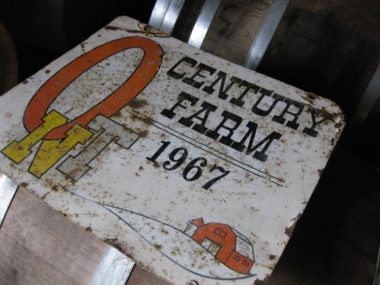
The end of a growing season is always a natural time for reflection, and this year I find myself contemplating larger themes and looking for meaning amidst the rows and barrels. Inevitably, I come to the conclusion that I am very fortunate to have the opportunity to spend my days working on a family farm.
Life on a farm is all I’ve ever known. It has been the constant that has shaped my personal relationships, my career and my thoughts. Sure, there were brief times when I seriously considered other callings, but a sense of duty and the love of a challenge eventually superseded any alternative ambitions.
My thoughts on farm life, stewardship and succession have evolved through the years as I’ve grown and matured. A young child can’t help but be ignorant to the challenges of succession, and is likely to perceive the passing down of land as a given part of the family story, the way things have always worked. But with each passing year and vintage, one becomes increasingly aware of how tenuous and vulnerable a farm can be, and how relatively small a window of time each steward occupies in the grand scheme of things.
I draw inspiration from the previous generations and land inhabitants whom I envision living a more mindful, “in the moment” lifestyle, one that I strive to emulate. Enjoying the here and now can add fulfillment to our lives, while devoting enough time to future planning is our moral obligation. The balance between these two is the burden that can weigh heaviest on farmers. One of my biggest faults is worrying too much in the moment, which is not beneficial to either of these pursuits!
Fretting about the failure of a crop can sometimes blind me from the mind-nourishing aspect of vineyard work. Just being outside, genuinely endeavouring to help things grow should be considered a triumph, not whether your Pinot Noir is squeaky clean (although that would be a nice consolation). Working in a vineyard can be equal parts exercise, meditation and stimulation – a payoff, of sorts, for the sacrifices that accompany a year-round farm operation.
In short, 2023 marked a wonderful year of rejuvenation for our vineyard. Young blocks that had struggled to get established, finally flourished, while the older blocks that were decimated by cold-induced trunk damage returned to full production. The crops were bountiful and we experienced a dream September for ripening grapes that made up for a less than ideal summer. The wines show great promise!
So my resolution, as I set out to make the first pruning cuts of 2024, is to view time in the vineyard as the unrelenting yearly cycle that is made up of individual vintages whose varied characteristics are formed through memorable daily experiences, both positive and negative. In other words, life.
It is filled with tremendous volatility, but there is also comfort in it’s reliable churn.