A Time to Reflect

As the harvest of 2009 comes to a close I find myself in a nostalgic state of mind, reflective of the intense year that we’ve just experienced.  In this time we nervously launched a winery, opened our barn to visitors, sold out of our first vintage and managed to carve ourselves out a small niche in the local wine scene.

In a recent radio interview, I was asked to shed a little more light on this experience.   You can listen to it here.
Vinification Notes


When you get to a point where the line between work and life is so blurry that the majority of your day seems like filler between fixes of caffeine, and what little sleep you do get is haunted by images of Multi-coloured Asian Lady Beetles and under-ripe Cabernet Franc…it’s best to step back, focus, and re-consider exactly why you do what you do.

Thankfully, success breeds perseverance.  The following are two reasons why I still choose life as a winemaker:

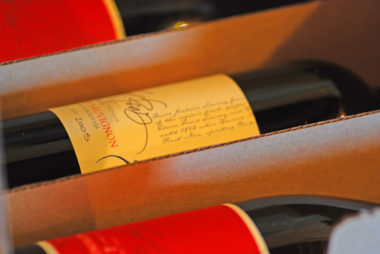
2005 Cabernet Sauvignon

A severe winter led to an average of 50% bud damage in the Lowrey Vineyard.  This Cabernet Sauvignon was sourced from vines that were shouldering a much lighter load than they were used to, hence a greater opportunity for ripening was in the cards.  Thankfully, the growing season weather co-operated and the resultant fruit was as good as has ever been produced on our farm.  The St. David’s Bench microclimate really strutted its stuff, with even the later-ripening Cabernet Sauvignon reaching optimal sugar and TA levels.  Like our first “Five Rows” vintage in 2004, we took equal portions of Young and Old Cab Blocks to maximize clonal complexity.  Following traditional small batch punch downs, the wine was aged in a 50-50 blend of American and French Oak with an average age of 1.7 years per barrel.  A comparative barrel tasting took place on July 5, 2007 and as with previous years, the highest rated wines were housed in two-year old wood (a 2003 Barrel Associates & 2003 Berthomieu).  These two superior bottles were bottled on July 18, 2008.  This wine showcases the potential of minimally-cropped Cabernet Sauvignon from warm vintages in the Lowrey Vineyard.  Aromatic highlights include wild blueberry, ripe cherry and vanilla.  Very ripe and jammy on the palate with soft, mature tannins and excellent length.  Although hard to resist its youthful charm, this Cab is only entering its prime.

Barrels: 2       Cases: 45        Alcohol: 13.4%         Price: $50/Bottle

2008 Pinot Gris

In an effort to instill confidence, I tell my wines that it is never fair to compare themselves to their predecessors.   For that reason we won’t speak further of the effusive praise garnered by the 2007 Five Rows Pinot Gris.  Some shoes are just too big to fill.

Harvested on September 19, 2008, this Pinot Gris began its life fermenting slowly in stainless steel and older French Oak.  The oak component was added in an effort to further enhance mouthfeel and increase aromatic complexity.  A nice cool ferment, dotted with periodic lees stirring, was complete by mid-October.  The finished wine was blended, then fined with bentonite for protein stability.

Early tasting sessions showed strong notes of McIntosh apple and anise, while one panelist was sure he could smell “catbox” (depending, of course, on the type of litter you prefer).  The French Oak and lees stirring helped create rounder texture and seemed to lend tropical nuances such as star fruit.  The wine was left with just enough residual sugar to balance the acidity.  Lemon-lime citrus flavours are predominant.  Bottled September 14th, 2009.

Cases: 57             Alcohol: 13.3%       Price: $25/Bottle

Both wines are now available for purchase!

Acid Reflux

Without fail, every vintage brings forth an unforeseen challenge.  This year that head-scratcher is the acid levels in our grapes.  Sugar levels in vineyards across the peninsula are sky high, usually the indication that grapes are ready to harvest.  However, upon a quick taste and further  laboratory analysis, most growers and vineyard managers are finding that their fruit remains quite tart and not quite balanced as of yet.  It seems as if the warmer daytime weather has spiked the sugar content, but the cooler nights have stalled the acid conversion.

Those who choose to harvest their fruit primarily on high sugar levels will surely pay for it in unbalanced resultant wines.  One major problem within our industry is that grape growers are paid mainly on tonnage with a bonus structure for sugar levels (degrees brix).  Clearly, this does not tell the whole story when it comes to the quality of fruit that it takes to craft premium wines.  Titratable acidity, flavour production, seed and tannin ripeness, colour, berry size, nutrient levels and cleanliness are all key components that a winemaker must take into consideration when evaluating incoming fruit.

Consider the plight of a grower who thins his vineyard to lower tonnage, but their fruit is above average in all the other ripening components at the base sugar level.  They get paid the same per tonne as a grower who overcrops underripe fruit at the base sugar level, which is fairly easy to do.  I’m of the opinion that we need to better reward the grower in the first scenario.  If we could come up with some kind of “ripening coefficient” that takes all the important parameters into consideration, perhaps more growers would be inclined to crop at the lower levels needed to ensure premium wine quality.

Thankfully, while we wait for the acid levels to drop, the grapes keep accumulating sugar and flavours.  If we can keep them clean (and that is one nervously typed “If”) the fruit should round out nicely, giving us the ability to craft great wine in 2009.

We’re Still Open!

I treasure the many great acquaintances we’ve made over our inaugural summer.  So why stop the fun?  We’ve decided to extend our weekend retail hours until the New Year.   I do caution that now more than ever, you may need to venture out to the vineyard to find us.  We may leave a large bell for you to ring outside the barn, or failing that a car honk should alert us to your presence.  If  your search leads you down a row of Cabernet Sauvignon or Syrah, please make sure to knock off any green bunches you encounter!

In other news, if you find yourself within earshot of a radio this weekend, please tune in to 610 CKTB on Saturday at 3pm or Sunday at 1pm for the wine show “Uncorked” with Stephanie Sabourin.  Excitingly, Five Rows will be featured in an interview segment off the top of the show.

The Birds


Anyone who has been traumatized by the Hitchcock classic “The Birds” would understand the chills that are currently inhabiting my spine.  As our first Pinot berries start to turn colour, so return the first starlings to terrorize my parents and I for the next three months.

Like the movie, our bird conundrum always starts with a few nosy stragglers and quickly advances to throngs of grape-thirsty beasts, hell-bent on vineyard devastation.  On the front lines, my dad is our General Patton, always devising new schemes to divert the feathered assassins from their target.   My mom is his trusty foot soldier, known to employ old fashioned yelling, clapping and even the banging of pots and pans in weaker moments.

I’m the net man.  Through the years we’ve experimented with about every bird control technique ever invented, only to realize that the physical netting of the grapes is the only answer.  It’s labour intensive, expensive and it works, plain and simple.

The problem with bird pecks is that it only takes one to spoil an entire bunch of grapes.  So preventing these pecks and the subsequent rot is paramount to the success of tight-cluster varieties like Pinot Noir, Pinot Gris and Sauvignon Blanc.  In our Pinot Noir we use a permanent netting system that is unfurled shortly after veraison and then gets rolled back up and stays in the vineyard after harvest in the fall.  In the Pinot Gris we’ve opted for temporary netting that must be put up and taken down every year.  It’s a little more work, but it should give us a more mileage out of the nets.

The bird pressure usually dies down once the early varieties are picked, but our guard is always up.  Left unattended, we could potentially lose a significant portion of our crop.  Yet another one of the pitfalls of growing grapes in Niagara!

The Fish of 1000 Casts


The weather over the last few weeks has left many farmers cursing their luck and already looking ahead to next year. Cold temperatures, rain and periodic hail have left us wondering if and when summer will finally arrive.

Determined not to let this “dampen” our annual trip to Bobcaygeon, I threw together a few barrel samples and we hit the road with an excited puppy in tow. I always look forward to this brief respite from the farm as it allows me to indulge in one of my true passions: the pursuit of the elusive Muskellunge.

Muskies are large, vicious predators that feast on other fish, small water fowl, and the occasional unlucky swimmer.  One encounter with these toothy monsters is all it took to breed my obsession.  I will caution, however, that muskie fishing can lead to extreme frustration, nightmares and hooks being painfully lodged into various body parts.

Come to think of it, fishing for muskies is a lot like growing and crafting Pinot Noir.  Both are very “results driven” hobbies that require the utmost patience.  I’ve learned that the joy must come in the anticipation and pursuit of that “result” or else you will be disappointed more often then not.  The near misses that one encounters in each of these endeavors can be as character building as they are heartbreaking.  For me, the thrill is knowing that the biggest and best is still lurking out there, just waiting to be caught or crafted.   Alas, despite many hours and thousands of casts, I came up empty on my muskie hunt this year.  There was one mighty strike though, and that is more than enough to satisfy my passion for another year.

I was a little luckier with the wine samples, as they were a big hit at one of our cottage feasts.  We tasted a bottle of our 2005 Cabernet Sauvignon and a barrel sample of the 2007 Pinot Noir in an effort to decide on a release date.  Understandably, the 2005 Cab was miles ahead of the 2007 Pinot in terms of being ready to drink, but the Pinot showed some exciting signs of maturity since the last time we tried it.  The tannins are finally starting to soften, allowing the classic Pinot flavours and satiny mouthfeel to shine through.  Aromatically, the 2007 Pinot has always packed a punch, but this particular blend took a while to open up, but once it did…oh my.  It was decided to bottle this wine soon, with hopes of a spring 2010 release. Look for the 2005 Cab in late November.

The Joys of Hand Labour


To me, a day spent grunting your way through hard, manual labour offers the ultimate in satisfaction.  Granted, there is the physical pain, the mental fatigue and the dragging hours – but at the end of that day you can look back and be proud of what you’ve accomplished, however big or small.

I am truly at peace when working in the vineyard.  It’s a time of introspection and reflection blended with intense focus on the job at hand.  This is where the “feel” aspect of viticulture comes into play.  I don’t know if I actually think about what I’m doing anymore, it just sort of comes naturally.   Years of suckering, thinning, shoot positioning and leaf removal have transformed me into a grape-trellising robot of sorts.

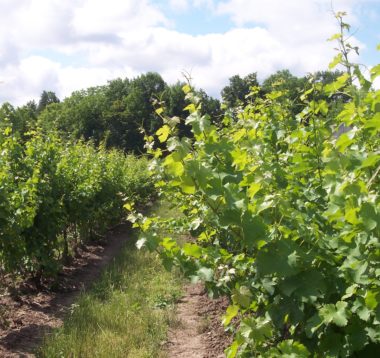
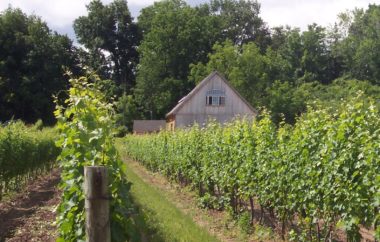
There are many levels of satisfaction involved with vineyard hand labour.  First is the feeling that you are helping the vine by removing excess growth.  There is also the visual appeal of a clean and vertically positioned vine versus a chaotic canopy.  As a neat freak I have an extremely low tolerance for chaos, so bringing order to the vineyard gives me a special joy.  Finding a proper spot for each shoot and grape bunch within the canopy is an important job that I am currently undertaking.   Large amounts of rain have made that canopy extremely crowded, and the job gets exponentially  harder each day as the vine starts growing laterally at a rapid pace.  I tend to perceive each vine as a puzzle that needs to be solved, which really gets my creative juices flowing.  The pictures below give you a good “before and after” look at our Sauvignon Blanc.

The advent of the iPod has added yet another enjoyment level to this work.  I find that the right song at the right time can elicit crazy emotions ranging from pride to the depths of sadness.  Ultimately, it helps break the monotony and makes the job go by quicker.  Working alone allows me to sing as loud as I want and even throw in the odd dance move if the mood strikes.

Finally, there is a weird spiritual vibe you get while working on a farm that dates back many generations.  You can’t help but feel many indelible ties to the past.  I must admit that there are days when I feel a definite presence alongside me while working among the vines.  It can be in the damp chill of an early morning fog, the flight of a majestic hawk and sometimes in the faint smell of pipe tobacco.  Hard to explain, but usually very vivid and strangely calming.

I feel lucky to be able to spend my summer days in the vineyard.  Being able to positively effect our 2009 vintage on a daily basis via my method of choice is a luxury that few winemakers are afforded.  It’s one of the things that makes Five Rows unique among wineries.

chaos


2009 Planting


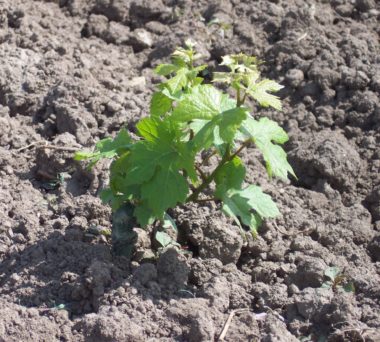
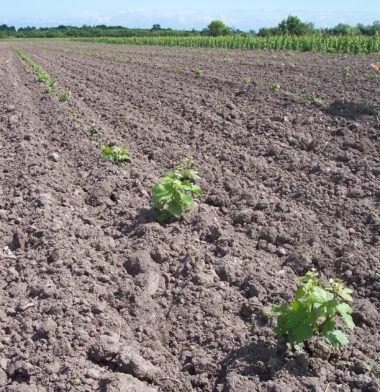
Planting a new vineyard is always a time of apprehension and crossed fingers.  Could these little wax-covered sticks present us with an opportunity to produce some world class wines?   Only time will tell.

In a moment of weakness, it was decided last year amongst the Lowrey Vineyards brain trust (and I use that term very loosely) to plant nine more rows of Pinot Noir.  If you’ve read previous entries of  this blog, you’ve no doubt heard me describe some of the challenges we’ve faced growing Pinot over the years.  So why opt for more punishment you say?  I found myself wondering that exact thing as we planted the vines this past Tuesday.  Why not plant something easy to grow like Chardonnay or Cabernet Franc?  Therein lies the allure of Pinot Noir.  It gets in your blood, it messes with your mind and  it leads to irrational decisions.  I liken Pinot to a parasite who’s goal is not to have its host die, but rather suffer just enough to allow itself to thrive.

In a nutshell, the thing that makes Pinot so tough to grow are it’s tight little clusters of thin-skinned berries.  These clusters are like ticking time bombs just waiting for the opportunity to explode.  If one single berry in the middle of that cluster were to split, the whole bunch is usually compromised with botrytis or sour rot.  Once this rot has taken hold within the canopy, it spreads like wildfire from cluster to cluster aided by the dreaded fruit fly.  This sad fate has befallen many of the most promising crops of Pinot Noir.  The end, however, more than justifies the means.  If you can survive the gauntlet, Pinot Noir will reward your hard work.  That is why we planted the nine rows:  a shot at glory!

To add complexity to future wines we decided to experiment with different clones and rootstocks in this block.  Our older Pinot vines are all famed Dijon clone 115 on S04 rootstock.  In the new planting, we’ve included equal portions of clones 777, 667 and more 115.  The two new clones are known to have slightly looser clusters and thicker skins, producing wines with stronger black fruit and gamey notes.  To help control vine growth, we had the vines grafted to lower vigour rootstocks (101-14 and 3309) and planted them more densely in a patch of clay-based soil.

Since Tuesday, we’ve thankfully had two substantial rainfall’s to help the little guys along.  I would like to thank Wes Weins and his staff at Gemmrich W. Nursery for providing us with vines grown to our exact specifications.


The Irony and Necessity of Thinning


Alright, your precious buds have made it through a long winter and recently survived a few very close calls with frost – now what is their reward?  Knock half of them off!

Arguably the most important job through the grape-growing season is “thinning” or the selective removal of excess shoots and clusters.  We normally start to focus on shoot-thinning at this time of year, as it becomes evident how many buds are viable and how crowded the vine is with growth.  Getting an early start is extremely important, as these growing shoots tend to explode towards the sun at rapid pace, especially in warmer spring weather like we are currently experiencing.  By my reckoning we are about 7-10 days ahead of the average season at this stage, boding well for getting things ripe at season’s end.

Shoot-thinning aids the growing vine in a number of ways.  It gives the remaining shoots a boost in resources, reduces the crop load on the vine, and prevents over-crowding in the canopy.  The goal is to get the vine to a stage where it can adequately ripen the crop load you are comfortable with.  A less dense canopy is advantageous because it allows better air flow for mildew and botrytis control and increased sun exposure for the clusters.  The finishing touch is cluster-thinning around veraison, which helps endow our wines with the concentrated flavours and aromas we are after.  I don’t even want to think about cluster-thinning yet, so I’ll tackle that subject at a later date!

I’d also like announce the arrival of the newest addition to our family, a puppy named Lucy.  She is an eight week old Nova Scotia Duck Tolling Retriever who will be in charge of bird control and public relations.  As for her guard dog skills, I’m skeptical at best, so we’ll spare her that chore for now.   I love Lucy.


Filling the Gaps


What do you do when a grapevine dies?  The simple answer is that you plant another one in its place.  As you navigate the process, however, you come to the realization that there is nothing simple about it!

Due to some cold winter temperatures a few years back, many of our vineyard blocks were left with significant vine death (up to 25% in some spots).  Of the surviving vines, many suffered trunk damage to the extent where new suckers had to be brought up from the ground to re-establish the trellis.  As a result, our yields were reduced for four consecutive years until the vines recovered and/or were replaced.

Once planted, a replacement vine usually doesn’t usually produce fruit until its third season.  They are finicky little buggers that need copious amounts of sun, water, nutrition, protection, structural support and general TLC.  They are usually flanked by two old, grumpy vines with deep roots (who were getting used to the extra leg room) that are unwilling to yield any of those aforementioned necessities to this new kid on the block.  You begin to see the conundrum.  The vineyard as a whole still has to be farmed the same in terms of tilling, hoeing, etc.; but now every practice has to be tailored around these fragile young vines.

The first line of protection for the little guys is the insertion a small stake beside each vine.  This prevents the tractor-operated grape hoe from ripping them out of the ground as it removes weeds between the other mature vines.  The second line of defence is a “jacket”, of sorts, that envelopes the vine and protects it from herbicides, mechanical damage and rodents.  Known as “grow tubes”,  they also provide some insulation on those frosty, nervous mornings in the spring.

The temptation is to try to get fruit by the second season of growth, but the smart farmer knows that fruit takes energy from the growing vine, and deep roots are more important than a temporary gain in crop.  For this reason the replants are pruned right back to a couple of buds over winter, and any clusters of grapes that do appear the next season are trimmed off.

So the next time you stop by our winery, make sure to take a stroll out to the Sauvignon Blanc and take a peek into the ugly pink grow tubes that dot the vineyard.  The little vine you see inside may one day produce fruit that makes the cut in one of our wines.  Until then, I just hope Dad doesn’t plow it under by mistake…