
Treadwell Winemaker’s Dinner
It’s fitting that the first Five Rows Winemaker’s Dinner will take place at Treadwell Farm to Table Cuisine in Port Dalhousie. James and the Treadwell family have been ardent supporters of our wines since they agreed to showcase our very first release of 2004 Unfiltered Cabernet Sauvignon. We’ve come a long way since that initial 12 bottle release, but our vision and commitment to small batch craft wine remains the same.
Not a week goes by that we don’t meet someone who was either directly or indirectly introduced to Five Rows through Treadwell’s. They are a key to our winery’s success and have always been a family favourite place to dine. In fact, my mother made James promise to include her favourite Mussel dish as an appetizer at the dinner. I’ve seen a draft of the menu and simply put – it’s tantalizing. The Treadwell team has chosen four complementary courses to pair with our wines. I’ll be pouring our 2007 Cabernet Sauvignon, 2007 Pinot Noir, 2009 Sauvignon Blanc and the last of our 2008 Pinot Gris.
I encourage all friends of Five Rows to join us for this undoubtedly memorable dining experience on Saturday, January 29. You can find ticket information here. I’m told they are selling fast.
“Abandoned to Dumb Idleness”
I struggle to describe what this time of year feels like for a grape grower. You usually wake up in the morning in a state of panic: what am I picking today? how is the weather? how bad are the birds? are there any leaves left on my vines?
Then reality inevitably sinks in. Your grapes are off the vine and all you’re left with is an empty feeling of no longer being needed. This should lead to a long and relaxing winter, but all those nagging jobs that were left behind during the busy season are still staring you in the face. General clean-up, prepping the ground for winter, hilling up around vines, digging drainage ditches, and installing post and wire into newly planted fields are just a few of these tasks.
The working days are much shorter now and, frankly, so is my level of ambition. I always felt guilty about this annual lack of drive until just recently. I read a book entitled “Outliers” by Malcom Gladwell on advice from my Uncle Don. It was a great read and I was struck by one chapter in particular that described the life of vineyard workers in Burgundy many years ago.
Gladwell quotes historian Graham Robb from his book “The Discovery of France”:
An official report in 1844 described the strange mutation of the Burgundian day-laborer once the harvest was in and the vine stocks had been burned: “After making the necessary repairs to their tools, these vigorous men will now spend their days in bed, packing their bodies tightly together in order to stay warm and eat less food.”
Human hibernation was a physical and economic necessity. Lowering the metabolic rate prevented hunger from exhausting supplies. After the Revolution in Alsace and Pas-de-Calais, officials complained that wine growers and independent farmers, instead of undertaking “some peaceful and sedentary industry” in the quieter season, “abandon themselves to dumb idleness.”
I laughed out loud when I read this because it hit so close to home. The context of this chapter is that we are very much a product of our cultural legacy. So I’m not to blame for my lethargic winter blah’s after all, chalk it up to those who came before me!
2009 Whites
2009 Five Rows Sauvignon Blanc:
Roughly one tonne of fruit was harvested on a beautiful day in early October of 2009. Half the fruit was sourced from our younger, more clay-based block of Sauvignon Blanc, while the other half came from the older vines located in predominantly clay-loam soil. Each block contributes distinct characters to the final blend.
The younger “clay” block tends to be less vigorous, leading to increased fruit exposure and consequently lends the riper, more tropical notes to the blend. The older “clay-loam” block vines are extremely vigorous and require more intense hand labour. Generally they are slightly more shaded, leading to the fresh citrus aromatics and crisp flavours that are classic characteristics of cool-climate Sauvignon Blanc.
As I mentioned last season, the key to achieving the full complement of flavours and aromas is a long, cool ferment carried out in a combination of older French oak barrels and stainless steel tanks. For this wine I opted to go with a two-thirds barrel (2003 Jacques Garnier) and one-third tank fermentation regimen. The tank-fermented portion was allowed to age in oak for a few months prior to final blending. All fermentations were carried out at around 13 degrees Celsius with X5 yeast. 68 cases were bottled on August 31, 2010.
Aromas: vanilla, pineapple, lemon, lime
Flavours: melon, lime, balanced finish
Technical data: 13.1% alcohol, 5.8 g/L residual sugar, pH 3.2
Price: $25/bottle
Production: 68 cases
2009 Five Rows Pinot Gris:
Pinot Gris is quickly becoming a standout varietal in the Niagara Peninsula. Rick VanSickle recently wrote about this trend and chronicled a tasting of 17 different Pinot Gris. Rick was kind enough to purchase a bottle of our Five Rows Pinot Gris to include in the tasting and you can read the exciting review here.
My view is that Pinot Gris is such a labour intensive variety to grow, it better damn well turn out to be a good wine! It would not be worth the extra hand work and stressful pre-harvest nail biting to produce a mediocre, uninteresting wine. “Good” Pinot Gris is without a doubt the most sought-after grape variety by premium Niagara wine producers at the moment. It even has enough clout to be used as a bargaining tool by many growers to help them unload their lesser in demand, easier to grow varieties like Chardonnay and Cabernet Franc.
As is evident in Rick’s article, getting good fruit is only part of the equation. Each winemaker seems to have their own method of coaxing out the best in their Gris. A few years back, a couple of wise Creekside winemakers introduced me to the benefits of fermenting a portion of Pinot Gris in older French oak barrels. I’ve experimented with different oak/stainless blends ever since. The barrel-fermented wine always seems to have weightier mouthfeel and more complex aromatics, so in 2009 I decided to go with a 2/3 barrel, 1/3 tank final blend. I’ve always had good luck with a yeast called R2, so I stuck with it and fermented at the coldest temperature the yeast could tolerate. This led to a slow and beautiful month-long ferment. 70 cases were bottled on August 31, 2010.
Aromas: honey, apple, pear
Flavours: vanilla, melon, spice, left slightly off-dry (1)
Technical Data: 13.0% alcohol, 8.5 g/L residual sugar, pH 3.46
Price: $25/bottle
Production: 70 cases
Both of these wines are now available for purchase at our winery, on our website or can be enjoyed at select licensees. We are happy to announce the addition of two new members to the Five Rows extended family: Ruby Watchco in Toronto and Brookstreet in Ottawa! Ruby Watchco will be carrying our 2007 Cabernet Sauvignon and 2009 Pinot Gris while Brookstreet will be pouring our 2007 Pinot Noir and 2009 Pinot Gris.
A Day in the Life of a Grape Farmer
A Day in the Life of a Grape Farmer
3:30am: Awaken to frost alarm. Fire up the windmill for a few harrowing hours until dawn.
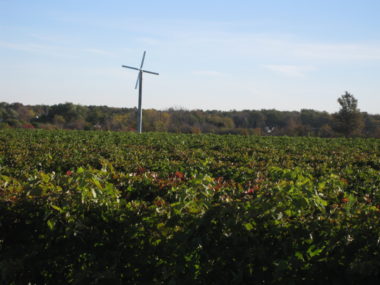
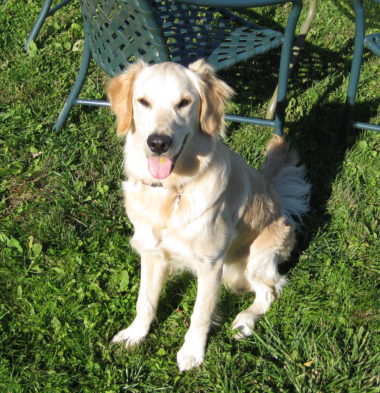
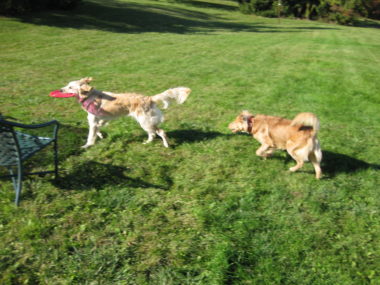
7:30: Groggy Winemaker Son arrives. Exchange pleasantries and play fetch with “grand-dogs”.
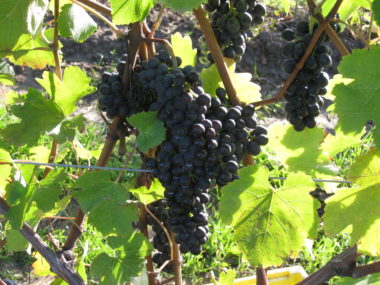
9:00: Dew finally gone, off to hand-pick some Five Rows Shiraz.
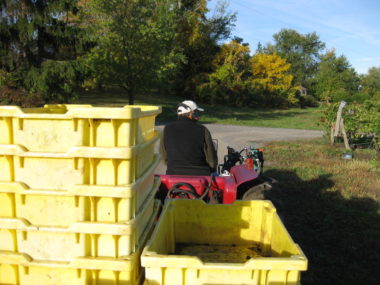
9:03: “Man, they look beautiful!”
10:30: coffee #5
10:30 – 6:00: A sun-filled, back-achin’ day of quality Father/Son/Shiraz time.
Out With the Old, In With the New
It’s an exciting time at the Lowrey Vineyard. The majority of 2010 fruit has been harvested, and the usually stress-inducing late varieties are ripe already! Summer wine sales have exceeded our initial projections and we’ve sold out of most vintages much sooner than expected. I still have to pinch myself at times to make sure this is all really happening.
I’m continually amazed at the awesome people who happen upon our winery each weekend. It turns out that if you build it, they really will come. They pick me up on rough days and drive my passion to continually push viticultural boundaries. They are always patient when I’ve got a barrel to fill or tank to clean, so I will always try my best to craft wines that keep them coming back.
As the old vintages sell out, I quell my nostalgic thoughts with the early reviews of our 2009s. We’ve been selling a few hastily labelled and waxed bottles of our new 2009 Sauvignon Blanc to a few customers who refused to leave until I could prove to them that this wine was not ready to sell yet. They ended up winning the argument and left with bottles 1 through 12. We are now taking case orders for this wine ($25/bottle).
In other news, we’ve recently made a decision not to actively promote our wines through submissions to wine writers. I’m happy to arrange a tasting for any reviewer at any time, but unfortunately we just don’t have the quantities to send samples to all those who have put in a request. Up to this point in our evolution as a craft winery we’ve relied mainly on “word of mouth” to sell our wines, and I see no reason that needs to change.
Harvest 2010
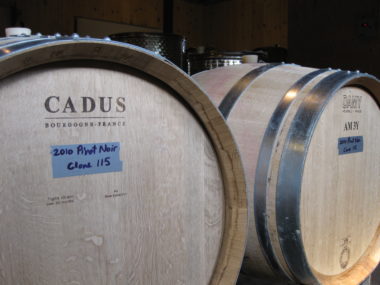
Three down, three to go. In one fell swoop, we now have all of our 2010 Pinot Noir, Pinot Gris and Sauvignon Blanc off the vines and in the tanks. All were harvested earlier and riper than in any previous vintage, including the much heralded 2007 crop.
It was a hectic start to harvest this year as all three early-ripening varieties were deemed ready to pick much quicker than anticipated due to rapidly decreasing acid levels. What a difference a year makes! I would like to sincerely thank the skilled crew who helped us painstakingly hand-pick our Pinot Noir. It’s always a challenge to harvest Pinot because every rotten or under-ripe berry must be carefully removed from each cluster before I deem it acceptable. The harvested fruit is then sorted both in the vineyard and at the crusher. This ensures that our Pinot gets off to a good start, with no “off” aromas or flavours in the must. Excess rot can also play havoc with fermentation and eventually filtration.
Just prior to harvest we were able to schedule a bottling run of our 2009 whites, including the much anticipated (at least by my mom) 33 case debut of our Five Rows Riesling. I intend to release these wines sometime soon, so keep an eye on the blog and website. All three of these wines showcase exciting aromatic intensity. I can’t wait for you to try them.
Every Wine Has a Story
Every vintage and every wine has a story. Some are thrillers, some are tragedies, some are uplifting romantic dramas and some, like the story of “Howie’s Own” 2008 Vidal, are dark comedies.
Tonight I cracked a bottle of this ’08 Vidal (bottled elegantly in a recycled Creekside Cabernet bottle) and marveled at the irony of how this wine that I cared about the least, neglected the most, and don’t sell to the public, turned out to be so damn good.
It’s an understatement to say that I wanted no part of making this wine in the late fall of 2008. Those unfortunate enough to be around me at that time would no doubt be able to describe the kind of mood I was in. Frazzled and crabby only begins to describe my state of being. Having just completed our first full-scale “Five Rows” vintage, in facilities that rivaled only the most modest of U-Brew joints, I’d actually spent the majority of my time scouting vineyards for other wineries to make ends meet. I was officially burnt out.
With evey sip of Vidal the stroy gets clearer.
My father, and I give him credit for mustering up the courage to do this, meekly suggested that we make a small tank of Vidal from the little bit of leftover fruit that falls onto the ground after mechanical harvesting, just for the fun of it. The fun of it? “You’ve got to be kidding me!” I thought or perhaps yelled aloud along with some interesting adverbs. I’d been slugging away for three months straight and making Vidal for fun was not high on my To Do list. I didn’t have the tank space, the yeast or the patience for this venture and made my feelings perfectly clear to a bewildered Howie.
“No problem.” he calmly stated, “I’ll make it myself.” Now this was funny. He didn’t have the foggiest notion about the practice of whole bunch pressing, the use of pectic enzymes, the protective benefits of potassium metabisulphate or how to properly monitor a fermentation. “Good luck with that!” I rudely exclaimed.
I arrived early the next morning to see him diligently stooping to pick up the fallen bunches of Vidal. I went on to tend to my other wines and after a while he pulled up to the crush pad with his wagon load of roadkill. Then, in a fateful moment of weakness, I decided to can the attitude and help my old man press some grapes. I suggested we press them “whole bunch” in an effort to be gentler on fruit. I’d done this before with Chardonnay in Nova Scotia and really felt that the end product was more complex. It also meant skipping the destemmer-crusher, which I didn’t feel like cleaning anyway.
We loaded the press quickly, I was probably still giving him the bum’s rush, and soon the sweet free-run juice began to flow. Normally, pressing is done slowly with gradual increases of pressure and a periodic break-up of the press cake. Sadly, this was not our protocol. I cranked the pressure input valve, quickly achieving one bar of pressure when, mysteriously, the free-run juice stopped flowing. Judging by the high-pitched squeal emanating from behind the wooden slats, I guessed we had an air pocket somewhere within our small basket press. Stupidly, instead of dismantling the press and breaking up the cake, I increased the pressure and leaned in for a closer look. All of a sudden, in one almighty instant, a tsunami of angry Vidal riding two bars of pressure streamed violently between a crack in the press screen, directly into my eyes and clear onto the roof of our barn!
Now if I say that I hit the ground and rolled around like I thought I was blind for life…it wouldn’t be a lie. I tend to be a bit of a drama queen at times, but I swear that this situation warranted my blasphemous screams. When I think back now, I truly believe that I’m lucky I wasn’t seriously injured. A seed or stem hitting an eye at that velocity could have done some serious damage, but the juice just stung. When I regained my vision enough to see blurry images, I quickly felt around and opened the pressure release valve to stop the geyser.
There are still a few Vidal skins adorning our barn roof to this day. When my dad and I recovered from the shock of the situation, we had a good and much needed laugh. I think we agreed not to tell my mother how bad it really was, but she will know now. Sharing that experience was priceless. I will never forget the look on his face when my vision finally returned. It was a weird amalgam of shock and stifled laughter that he’d be hard pressed to ever duplicate. Winemaking has since seemed less complicated and my attitude at vintage time has lightened tremendously. Taking time to enjoy the experience is my new motto.
In the end, we were able to scrape together some yeast and cold-fermented the Vidal in a small stainless steel tank. Last summer we bottled (more or less siphoned) 23 cases of Vidal, unfiltered, into sterilized, recycled bottles. We’ve been enjoying it ever since. The aromatics and presence of this wine are captivating. Our supplies are getting low, however, so maybe we’ll make some again this year…just for fun.
Good Reviews
When the back aches from successive days of thinning Pinot Gris that is trellised annoyingly too low (remind me to raise that damn bottom wire next year) its especially nice to retire to the winery for a pleasant afternoon tasting with someone who has recently “discovered” our wines. This has happened quite a bit lately, which signals to me that our wines are finding their way to the right people despite our lack of promotion.
My mother has shouldered the load for the majority for these pop-in tastings which she quite enjoys. Despite her claims of nervousness, I think she has really found her niche. She is passionate about our vineyards and loves to talk wine, especially Pinot!
We both feel very lucky when we receive firsthand positive feedback from our guests. It’s by far the most rewarding part of what we do. I’m still humbled and tremendously grateful every time people decide to purchase our wines.
Good reviews from a wine writer are nice too. Read what Michael Pinkus of Ontario Wine Review recently wrote about our 2007 reds here.
Slowly they turn…
That faint thud you just heard was my jaw hitting the terroir when I returned home from a quick vacation to find colour, yes colour, in my Pinot Gris and Pinot Noir. It seems eerily too early. The race is on, it’s veraison.
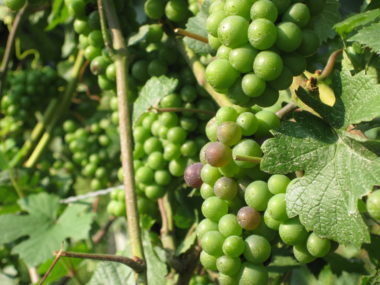
Veraison is the physiological stage of grape development where the hard, green berries finally soften and start to accumulate sugars and gradually turn colour. That first flash of colour is always a “noose tightener” of sorts, in that so many jobs need to be squeezed in before the imminent harvest. In early years such as this one, we are already fighting to keep the clusters exposed and canopy trimmed, but now it is even more important. Recent studies out of Cornell University have shown that longer fruit exposure to sun can decrease methoxypyrazine levels (green, vegetal characters) in late ripening varieties like Cabernet Sauvignon and Cabernet Franc.
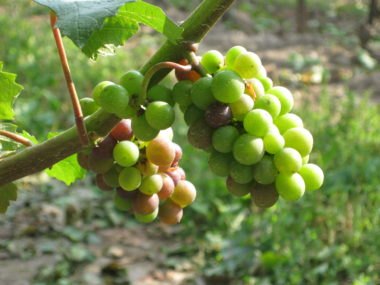
Coloured berries also attract hungry birds, so our protective netting needs to be put up as soon as the hedging, leaf removal and cluster thinning is complete. I honestly can’t decide if I’m excited or horrified at the prospect of working every day for the next three months. I reassure myself that we go through the same song and dance every year, but that doesn’t seem to quell my uneasiness. Amid the vineyard duties, we have to squeeze in a bottling run and get all tanks and crush equipment ready for the first fruit of the season.
Just as my anxiety peaks, the faint light at the end of the tunnel begins to emerge. “Push on lad!”, I tell myself. Pluck a few more leaves, thin a few more bunches, finish one more row. Visions of brilliant autumn colours and cozy fall clothes begin to warm my thoughts. The thrill and challenge of ripening Shiraz emboldens me. I can taste that luscious free run juice now!
Bring on veraison!
Sold Out
Due to an unanticipated boon in sales, I regret to inform that our 2005 Cabernet Sauvignon and 2008 Sauvignon Blanc are now sold out. Maybe all this hot weather is making people really thirsty.
To build a library of past vintages I’ve decided to hold back a few cases of each red wine that we produce. I intend to personally monitor the aging process of these wines to determine when they are drinking best. A relatively new wine region like ours has little knowledge of the long term aging potential of our reds. Wines are generally drunk young, and perhaps ahead of their best days. I hope to shed some light on this age-old conundrum.
A couple of weeks ago I decided to crack a bottle of our 2004 Cab Sauv at a dinner with family and friends. Upon nosing and tasting, I cooly expressed my pleasant surprise to the group (privately I was downright giddy) at the immense progress this wine had made since the last time I tried it 6 months ago. I would encourage those who still have a bottle of the ’04 in their cellar to give it a try sometime soon with a nice red meat dish. It’s also a goal of mine to keep our regular customers abreast of the development of these wines through invite-only vertical tastings. I’ve also held back some unfiltered versions of each vintage, which would be fun to try at these events as well. Stay tuned to the blog for details.
For a limited time it’s still possible to purchase the 2008 Sauv Blanc and 2005 Cab Sauv at our great stable of Licensees, which now includes Spencer’s at the Waterfront in Burlington, About Thyme Bistro in Vineland, and Langdon Hall in Cambridge.