
Don’t Look Now…
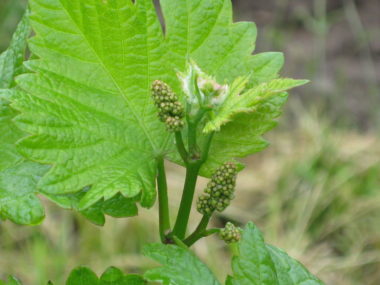
Don’t look now, but we have some serious viticultural growth going on out there! Despite the cool and damp conditions, shoots are expanding at a rapid pace. It’s as if the vines couldn’t hold it in any longer and just exploded with life.
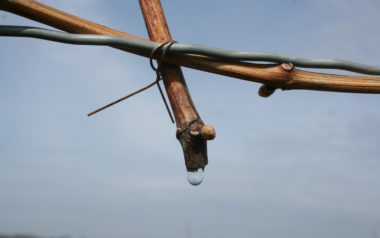
As a precaution for potential winter injury, we always leave an extra “insurance” cane on each vine that is not tied down with the others. Initial observations tell me that we can safely go through and remove these extra canes, as most primary buds are appear to be viable. This job will keep my dad and I busy for a couple of weeks – but don’t hesitate to pull me out of the vineyard for a quick tasting should you decide to pop in for a visit!
Come One, Come All
As we head into the summer season, I would once again like to extend an open invitation to all wine lovers. Please do join us for a tasting over the coming months during our weekend retail hours (11-5). It’s an exciting time at Five Rows, as we’ve just released our 2008 Shiraz, 2008 Pinot Noir, 2010 Sauvignon Blanc and 2010 Pinot Gris. The weekend barn traffic has ramped up dramatically in recent weeks and there has been a very positive response to our new products. Anyone wishing to reserve a case, please call or email sometime soon. History has shown us that these wines will not be around very long!

One by One, the Waxing Gets Done
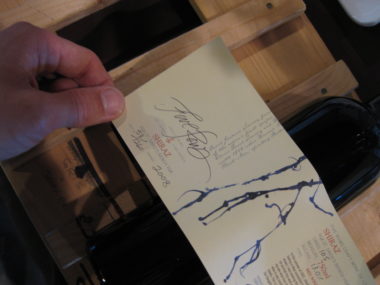
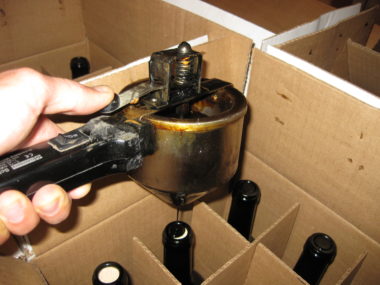
Hot Wax Meets Cool Climate Shiraz.
Is it Spring yet?
It’s depressing to look back at my April 24th post from last year and read just how promising things were looking in the vineyard. In fact, the guy who wrote that passage deserves a good slap in the face for exuberantly rubbing our noses in it. Aren’t you lucky! Two weeks ahead of schedule you say? Well GOOOOOD FOR YOU!
(I apologize for the seething sarcasm, my attitude has not been exemplary ever since a large tree fell onto my car the other day)
Rain, cold and wind are the reality this year. I don’t feel like the buds are too far behind schedule just yet, but we definitely won’t be afforded the 10-14 day head start we saw in 2010. The only advantage of this slight delay might be reducing the window for frost damage over the next few weeks. I’m grasping at straws here.
On the bright side, I’ve actually had my jacket off while tying grapes the last couple of days. What a feeling of liberation! The symbolic removal of one’s jacket and subsequent hanging of it over the top wire is one of my favourite rites of Spring. I almost went “skins” the other day just to stick it to mother nature, but then I realized I might frighten my Aunt Lonna who was out for a stroll with her dogs. The shirt stayed on.
On rainy days I’ve begun the massive task of waxing and labeling our new wines. This job has been expedited by the fact we are nearly sold out of 2009 Pinot Gris and Sauvignon Blanc. Look for a release announcement concerning the 2010 whites and 2008 reds sometime in June. If it keeps raining I should have enough bottles labeled by then!
Exhale
In the past, all of our bottling has taken place offsite at other wineries. There was always a calming sense of security associated with these occasions knowing that we were at a place where this had been done many times before. On the eve of the first ever bottling day at our own barn, these secure feelings were nowhere to be found. I’d spent three months preparing and going over every possible problematic scenario in my head, but doubt still lingered. Would there be enough room to maneuver in our barn? Would the truck fit on our crush pad? Would my bottle choices pan out and, most disturbingly, would bottling icewine prove to be the nightmare I had heard tale of?
All these troubling thoughts kept me awake on the eve of April 6th. I was to be at the barn for 6am sharp the next morning to greet Glenn Hunt and his mobile bottling crew. As the minutes ticked by, I actually started feeling nauseous and got up to take some Pepto Bismol. It didn’t help.
I took solace in the fact that Glenn and Randy do this every day, convincing myself that they must have encountered every conceivable problem and were very seasoned at dealing with anxious winemakers. It was still dark when the truck rolled in and right away Glenn put me at ease when he looked up at the clear sky and confidently stated, “It’s going to be a great day for bottling!” If he could be excited about today, then why couldn’t I?
My second boost of confidence came at the arrival of my father-in-law and brother-in-law who had graciously offered to lend a hand. More important than their braun, they offered a good dose of comic relief that kept us all loose despite the fast-paced dynamic. In times of stress I’ve found that it’s good to surround yourself with hardworking Polish pranksters.
Set-up took far less time than I had anticipated and the first Pinot Gris bottles were rolling off the line by 7:30. Riesling, Sauv Blanc, Pinot Noir, Shiraz and Cab Sauv followed in quick succession. I figured it must be close to lunch at that point and had to look twice when my watch read 10:30! We were flying – but the dreaded icewine still loomed.
Bottling into 200ml icewine glass presents a bevy of problems to the line. The bottles are very tippy, and filling consistently with such a small amount of wine is tricky. Thankfully, our Cabernet Sauvignon Icewine was fairly cooperative and we were able to wrap up bottling by noon. I’d endured months of sleepless nights and we had bottled our entire 600 cases in half a day…the sheer stupidity of this is not lost on me.
I would like to thank Glenn, Randy and all my helpers for making the first Five Rows bottling day a huge success.
Bottling Looms
Perhaps the number one stress for a winemaker on a yearly basis stems from getting his or her wine safely into a bottle. On the surface it seems like such an easy and routine task. In reality it involves a lot of preparation, hair-pulling, and moolah. For small wineries who put “all their eggs into one basket” so to speak, there is no room for error. Every little spill or bottle gone bad is greatly magnified.
Thankfully, there are people who specialize in this field. Mobile bottling lines are a very useful tool for small craft wineries like ours. It does not make fiscal sense for us to purchase a bottling line when the mobile unit can set up and bottle our entire portfolio in one day. Unfortunately, the mobile line does not alleviate the vast amount of prep work and the high cost of raw materials. I’m currently working through an extensive pre-bottling checklist which includes: final blending of wines, protein and cold stability tests, VQA lab and panel testing, coarse and sterile filtration, ordering bottles and corks, floor plan logistics, and shamelessly enlisting family members to help me out on bottling day. Our labeling and waxing is done by hand at a later date, so that removes two finicky variables from the marathon undertaking. The fewer things that can go wrong the better!
The bulk of my worries come long before bottling day and involve decisions like the type of closure to choose and the extent of filtration to employ. The screw cap closure is becoming more and more common these days for good reason. It’s much cheaper and it provides the perfect seal. I thought long and hard about going to a screw cap for this season’s wines, but in the end I’ve opted to remain faithful to good old cork. Call me old fashioned, but it just feels like the right closure for our wines. The potential savings in price by using screw caps is substantial (high grade cork is 70 cents per bottle, while a screw cap comes in around 18 cents per bottle), but the traditional visual and tactile appeal of natural cork still resonates with me. I’m also not convinced that screw caps provide the best mechanism for properly aging my wines.
I’ve talked to a number of our customers about this decision and they are overwhelmingly in favour of cork closures in their premium wines. There is still the perception, albeit unwarranted, that screw caps represent lower quality wine. One only has to look at the increasing number of high-end wines using screw caps to know this is not the case. Aside from cost, a second significant drawback to cork is the inevitable problem of “corked” wines caused by the cork taint chemical TCA. Encouragingly, new technologies and sterilization procedures have gone a long way in reducing the number of “corked” bottles to a manageable level (under 3%). Higher grade corks generally have fewer nooks and crannies for TCA to hide, so we’ve always spent a bit more money for the added security they bring. We’ve been lucky with TCA to this point, but I would encourage anyone who ends up with a “corked” bottle to return it in exchange for a new one.
I’ll probably re-visit this closure debate every year around this time so, as always, I reserve the right to change my mind in the future!
On April 6th we’re scheduled to bottle our 2008 reds (Shiraz, Cabernet Sauvignon, Pinot Noir), 2010 whites and 2009 Cabernet Sauvignon Icewine. The 2008 Shiraz and 2009 Cab Sauv Icewine are first time entries into our portfolio that I’m very excited to have you try. I plan to release these wines early in the summer.
Validation
March 4th, 2011 is a day that will forever live in Five Rows lore. It is the day our roadside sign was stolen. We put it out in the morning and it was gone at the end of the day. That hand-painted little red sign has probably helped sell more wines than I have. I hate to see it go.
But this day, the day my sister Catherine turned 30, had an interesting and unforseen twist in store. Later on that evening at the Cuvee 2011 Gala, an annual competition celebrating the best in Ontario wines, our name was called in two categories: 2nd place for Best Sauvignon Blanc and 1st place for Best Pinot Gris. We were surprised and thrilled to be recognized at such a prestigious event. As longtime Niagara grape growers, Cuvee has always held a special place in our heart. In past years when our friends at Creekside won awards for wines featuring our grapes, it always felt neat to know we played a small role. To win this year with wines that I crafted from our own fruit is a completely different feeling that I’m frankly having a hard time getting my head around.
As a rookie winemaker, I’m always nervous having my wines subjectively judged by others. I make wines that appeal to my palate, but worry they may not always appeal to yours. The fact that Cuvee winners are judged by my winemaking peers gives me an uplifting feeling of validation and acceptance. So many days as a winemaker are spent banging your head off a barrel repeatedly in frustration, that its nice to have a night where your head can swell for an altogether different reason. Don’t worry, my pruning tuque still fit this morning (thankfully it stretches). In all seriousness, I don’t see this award as a pat on the back, but as more of a kick in the ass to keep working hard and striving to get better.
In the days leading up to the Gala I read a couple of reviews from Michael Pinkus and John Szabo that gave me an inkling our wines might have shown well. Both writers felt our 2009 Sauvignon Blanc merited inclusion in their personal Top 5 lists from a pre-Cuvee media tasting. These reviews meant a lot to me, but I still didn’t hold out much hope of bringing home any hardware in a room filled with award-winning juggernauts.
Surprise, surprise.
PS: The irony of losing a sign on the day you win some big wine awards is that people still manage to find you the next day.
A Night To Remember
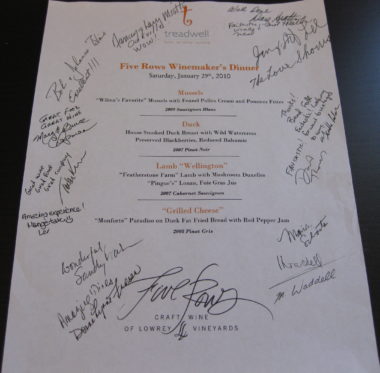
I want to take the opportunity to sincerely thank everyone who attended our first Winemaker’s dinner this past Saturday at Treadwell’s. It was an amazing night of food, wine and merriment.
James was a great host, as always, and his astute pairings worked out perfectly. He really gave our wines a chance to shine. In the end, we all agreed that we should do this more often!
2009 Riesling “Jean’s Block”
We often discuss a vineyard year in terms of the wonderful wines that result. I’ve certainly heard many superlatives thrown around in describing just that from Niagara’s 2007 Vintage. For a change, I’d like to give a different account of 2007, one of extreme vineyard challenges and of personal highs and lows. This is the story of Jean’s Block.
I was blessed on February 24th of 2007 to marry my soulmate. Our honeymoon would have to wait, however, as my hard working new spouse still had some schooling to take care of. Having just moved back from the easy-goin’ east coast, I was about to embark on my first summer at the helm of our yet to be named winery. There wasn’t really any wine yet, just nerves and self-doubt. Were we making the right decision? Am I really a winemaker? There was only one way to find out.
My mother-in-law, Jean Tkaczyk, was always a fan of Riesling. She’d made it clear to me over the years at many lively family dinners that I’d better make her a Riesling one day! I’d always promise her that I would, but there was that small hurdle of not having any Riesling grapes in our vineyard. It was never a variety that our winery clients had desired, so it had never been planted. I fondly remember a trip that Jean, Tanya and I made to Vineland Estates one summer to taste their renowned Rieslings. I quickly became a convert. On that day I was convinced that our new winery needed this variety in its portfolio.
My parents and I decided to plant 14 rows of Clone 49 Riesling on the easternmost part of our farm adjacent to Four Mile Creek. It is a well-drained block, with good airflow and a mixed soil composition of sand and clay-loam. I was well aware that the ultimate challenge with Riesling is keeping the rot at bay, and these parameters would surely help in our efforts. Clone 49 originated in Alsace and is widely considered to be better suited for Niagara-on-the-Lake and St.Davids Bench terroir. It’s known for producing wines featuring floral and tropical fruit notes.
My father spent the spring of ’07 doggedly preparing his field for the coming vines. It was an exciting time. We were off to a hot, dry start to the growing season with all varieties well ahead of schedule. One problem: where were the April showers? They never came. For that reason I’ll always remember 2007 as a challenging drought year more than anything else. We actually had to purchase irrigation equipment! This was unimaginable on a farm that had been bathed with adequate rainfall for five generations. There had been dry years in the past but nothing like this. Maddeningly, it would rain in Queenston and Virgil, but not in St. Davids. It was a bleak prognosis for our soon to be planted Riesling. Young vines need lots of water, and there simply wasn’t enough available in the soil. As the time to plant drew near, however, this was the furthest thing from our minds.
Heartbreak. We lost Jean to cancer that summer. I’ll never be able to understand such things. She will always be remembered with love and her zest for life is still resonant in her children. Her Riesling vines were planted in sorrow.
When I work in Jean’s Block today, three years later, I’m struck by it’s beauty. Not only did it survive the drought of 2007, it thrived. It is without a doubt the prettiest spot on our farm. I’m reminded of Jean every time I look up to see a majestic hawk or encounter a curious cardinal sitting on the top wire. She loved nature and took every opportunity to get her hands dirty in the garden. I’ll never take these earthly pleasures for granted again. My worries magically disappear in Jean’s Block.
The first crack at making wine from this vineyard came in 2009. We harvested about 500kg of fruit on October 25th. The cool ferment was carried out solely in stainless steel with W15 yeast. The wine was left slightly off-dry (14 g/L), but has plenty of acidity to balance the sweetness. We bottled 36 cases on August 30th, 2010.
Bottles #2 through 437 are now available to you. Bottle #1 was put away for someone special. I hope she likes it.
The Best Wines of 2010
Our 2008 Pinot Gris joined some exclusive company recently with its inclusion on a special year end list. You can read about it here.