
2011 “Jean’s Block” Riesling
Many oenophiles consider Riesling to be the best-suited white grape varietal for the rigours of Niagara regional terroir. It’s a treat to grow, with good crop levels and minimal finicky hand-labour compared to tight-clustered Pinot Gris and Sauvignon Blanc. It has decent winter hardiness and tends to thrive in our slightly “cooler climate” (my current air conditioning bill might disagree with this categorization).
Vinifying Riesling is where things get a little more complicated. So many different styles and so many variables to experiment with. Although we grow Alsatian Clone 49 in Jean’s Block, the resultant wines I’ve crafted tend to be an amalgam of varying Riesling profiles. The 2011 vintage features the subtle, mineral-laden nose of an Alsace Riesling, but the richness and depth of flavour of my favourite German styles. The natural acidity is the strength of the wine, balanced with a touch of residual sugar. Over the years, I’ve found that Riesling takes a while to open up after the stress of filtration and bottling, so we usually release it later than our other whites. Riesling fans will tell you that it’s a mistake to drink it too young anyway!
In the ongoing quest to improve wine quality, we decided to employ a different pressing technique in the fall of 2011 – a gentle, whole-bunch squeeze in our old wooden basket press. It proved to be very time consuming and a huge headache to clean out, but I think the end product justifies the extra effort. I also experimented with a different yeast, R2, on 50% of the juice, while using my old standby, W15, on the other half. Fans of our Pinot Gris might recognize some of the elements that R2 brings – rounder mouthfeel, tropical fruit notes – in this Riesling.
2011 “Jean’s Block” Riesling is a wine that means a lot to me personally. I welcome you to come by starting this weekend to give it a try. There are only 48 cases available, so we must limit purchases to 4 bottles per customer. Retail price is $25 per bottle.
Father’s Day
There are days when I feel overwhelmed. It usually occurs around this time of year when despite my best efforts, I just can’t seem to catch up to the work that needs to be done. There are weak moments (humid, dizzy moments) that I actually begin to second guess my calling. Who on earth would be stupid enough to willingly submit themselves to the rigours of thinning grapes in this oppressive heat?
Just as I convince myself that my afternoon efforts might be better spent monitoring the progress of 2011 Pinot Noir barrels in the cool confines of the barn, I spot a cloud of dust emanating from the far corner of our 60 acres. Cue the proverbial forehead slap…
There is an individual in the center of that dust cloud who’s work ethic is second to none. He skillfully guides the tractor and disk, eventually making the careful wide turn for the next row. Four rows over, three rows back. A pattern he has repeated time and again for the last 40 years.
I get to the farm in the morning and he’s out there – I leave in the afternoon and he’s still out there. We may pass each other at some point during the day, but no words need to be spoken. That cloud of dust is his example. My second guessing comes to an abrupt halt. When I was younger I couldn’t wait until it was my turn to do all the tractor work. Now I hope that day never comes.
As I sing his praises, a comical beer commercial flashes to mind and it occurs to me that my father might just be, “The most interesting man in the world” (or at least St. Davids). Some proof:
His pre-dawn enthusiasm puts my Golden Retriever to shame.
Powdery Mildew is afraid of him.
His internal alarm clock laughs at my snooze button.
‘Hydration’ is a foreign term to him. He drinks beer and coffee, and when he’s really thirsty…Lipton Cup-a-Soup.
He could jump-start a canoe.
He doesn’t buy new golf clubs, he buys a new wrench (mainly because he broke something and can’t find the wrench he bought last week…and he can beat you with his old clubs anyway).
Happy Father’s Day to all the early risers and “Stay thirsty my friends!”
2009 Pinot Noir
Starting this weekend, our 2009 Five Rows Pinot Noir will embark on the final leg of it’s three year journey from vine to barrel to bottle to you. I debated letting the wine age a bit longer in bottle prior to release, but a tasting session last week made me realize that the time has come to finally let go. Parting is such sweet sorrow.
2009 Five Rows Pinot Noir:
Sometimes the best of wines and the worst of seasons magically collide to create an unexpected moment of glory. The growing season of 2009 was one of those odd times. A late budbreak set the tone for what would be a cool, wet summer. We usually harvest Pinot Noir and Pinot Gris in early September, but nothing was close to being ripe in the late summer of 2009. Cue the blessing in disguise.
The moderate September days and cool fall nights helped move the Pinot ripening window to a time when Botrytis concerns were at a minimum. This was uncharted territory for Niagara Pinot growers. You must understand that there is one and only one certainty when growing Pinot Noir – they WILL rot at some point. When the inevitable did not happen in 2009, we were afforded the luxury of harvesting at the exact point when tannins, flavours, sugars and acids were aligned to my liking.
We chose to harvest Rows 1 and 2 on October 6, the latest Pinot pick we’ve had in 25 years. The remainder of the fruit was taken in on October 17. Average harvest parameters were 22.9°Brix, 8.4 g/L TA and pH 3.15. Fruit was destemmed and crushed into one tonne fermentation bins and allowed a cold soak at 10°C for five days. All bins were warmed to 14°C and inocualted with RC212 yeast at 250 ppm. Ferments averaged about 7 days, with a peak temperature of 29°C. Each bin was allowed to macerate post-fermentation until tannins showed signs of softening.
The wine was pressed and settled before clean-racking into seven French oak barrels (average age 2.5 years). Malolactic fermentation was carried out in oak. Barrels were racked and returned every 6 months. Total time in wood was 24 months before final blending in November 2011. 182 cases were bottled on April 2nd, 2012.
In my early tasting notes for this wine I have written, “something dark, alluring and mysterious about this Pinot. Reminiscent of a rainy day on our honeymoon spent tasting great Burgundies in the dank cellars of Beaune.”
Aromas: cherry, violet, cassis, smoke, earth
Palate: dried cranberry, Bing cherry, soft tannin, haunting length
Cellaring: 2013-2023
Price: $50/bottle
2011 Whites
2011 Five Rows Sauvignon Blanc:
The fight for quality Sauvignon Blanc grapes begins in earnest during the long, cold nights of winter. Its buds are amongst the most sensitive of all Vitis vinifera cultivars. Providing those buds make it through the rigours of winter and frosts of spring, the job only intensifies. Picture the most vigorous growing vine or weed in your garden, then imagine somehow trying to harness it’s raw desire to grow, but not so much to harm its delicate fruit. Now you’re talking Sauvignon Blanc!
Thanks to a cooler than normal spring, the 2011 growing season got off to a lazy start. A hot, dry summer helped put things back on track, with Sauv Blanc ripening right around schedule in late September. One vineyard trick we’ve employed in recent years is to remove leaves around the clusters early in the season on the cooler, “morning sun” (east-facing) side of the canopy only. Then later in the season, after veraison, we remove leaves from the “afternoon side” as the daytime heat subsides. This helps preserve flavour and acidity in the ripening berries and prevents sunscald.
750 kg of fruit was harvested from each of our two Sauvignon Blanc Vineyard blocks on September 22, 2011. The conditions for fruit ripening were perfect. Acid levels (TA) hovered around 7.5 to 8.0 g/L, but threatened to fall as warm conditions loomed later in the week. The decision to take both blocks in one day was made.
As usual, the younger clay-based block was slightly higher in sugar (22.3°Brix) than the old-vine, sandy loam block (20.6). I always find it difficult to describe just how intense the flavours are in these ripe Sauv Blanc berries. Best just to visit us in September and sneak a few for yourself!
Four older French oak barrels (2 x 2007 DAMY and 2 x 2003 Berthomieu) were used to ferment 75% of the juice. The rest was fermented in stainless steel. All fermentations were carried out with X5 yeast at an average temperature of 12°C. The fermentations were stopped at a specific gravity of 0.998 or, unscientifically, when I thought they tasted good. 99 cases were bottled on April 2, 2012.
Price: $25.00/bottle
Aromas: citrus (lemon/lime), grilled pineapple, gooseberry
Palate: lime, star fruit, great balance
2011 Five Rows Pinot Gris:
I relish the challenges involved in successfully crafting Pinot Gris each vintage. From thinning and leaf removal decisions to barrel/tank ratio and residual sugar content, the complex set of variables is alluring. Every choice made affects the end product and must be considered carefully. I’ve fallen asleep on countless nights labouring over such decisions. In the end, it only makes a winemaker appreciate the finished product that much more.
We harvested 1.5 tonnes of Pinot Gris on September 22, 2011. The fruit was adequately ripe (23°Brix) but starting to show signs of breaking down and rapidly losing acidity. You come to realize that Pinot Gris tells you when to harvest, you don’t tell it.
After gentle pressing and a four-day cold settle, the juice was racked to three older French oak barrels and one tank. It was then inoculated with R2 yeast at the normal rate of 300 ppm. The fermentation proceeded very slowly over the next month with an average temperature of 11°C, until being stopped at a specific gravity of 0.998 and total alcohol of 13.0%. Bentonite fining and coarse filtration were carried out before bottling 102 cases on April 2, 2012.
Visually, this Pinot Gris shows a distinct pinkish hue from the brief amount of skin contact. The striking aromatics include apple, pear torte, vanilla and tropical fruit nuances. The weighty yet velvety smooth texture resolves into flavours of ripe apple, melon, honey and cinnamon. It truly leaves you wanting another sip.
Production: 102 cases
Price: $25.00/bottle
Cellaring: 2012-2014
Serving: serve slightly chilled (10°C) and decant if consumed in 2012
Buds
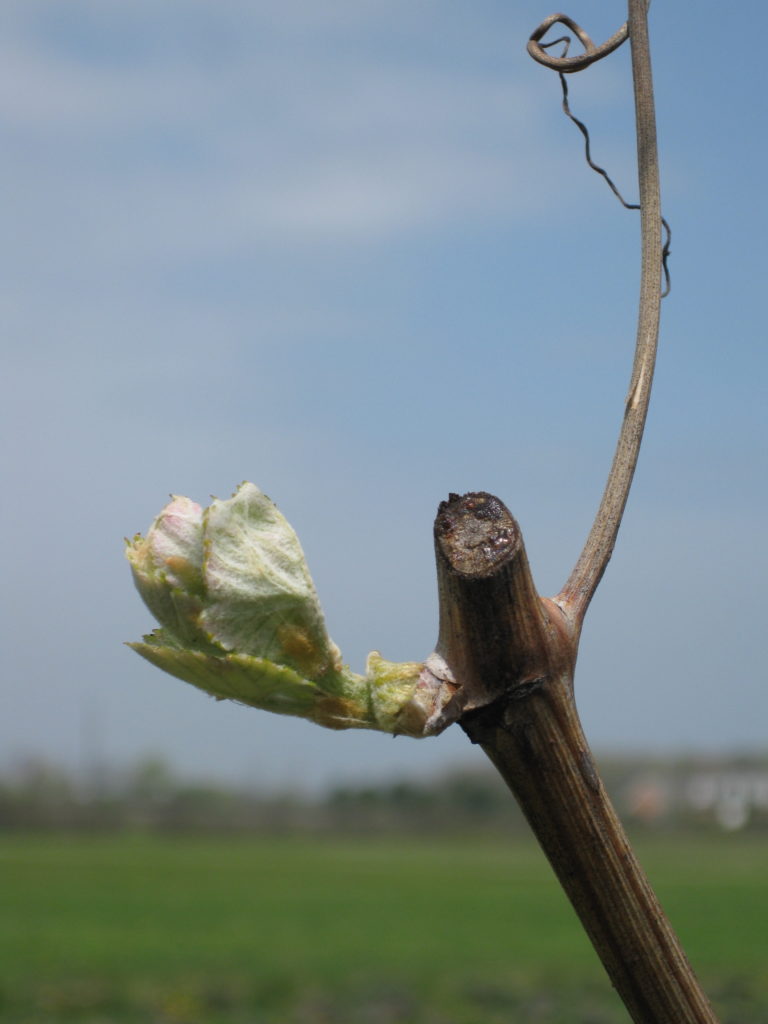
For those curious about how things look in the vineyard these days I have good news…the buds are alive! (At least 75% of them that is). My thoughts go out to those tree fruit farmers who haven’t been as lucky thus far. I’ve heard some staggering reports of damage in local apple and plum orchards as buds emerged way too early for their own good, only to succumb to the cold temperatures we experienced in April. How fickle it can be.
Dinner with “Bruce”
There aren’t many days on the farm that I don’t encounter an unknown automobile meandering slowly down our driveway. They approach very cautiously, sometimes stopping multiple times, seemingly contemplating whether this could possibly be the place they were looking for. If I’m working in the grape rows anywhere near the driveway I try to flag down these folks and invite them in for a tasting. Most times I end up chasing their vehicle while waving my arms wildly. Come to think of it, perhaps that is exactly why most of them speed away in a cloud of dust.
Then there are cars that come in with a purpose. They see me in working in the rows before I see them, and they end up scaring the crap out of me as they sneak up and snap me out of my iPod-induced trance. For some reason these are usually the unabashed people I end up becoming fast friends with. Steven and Jennifer Vipond fall into this category.
Last summer I watched as a red Volkswagen Beetle pulled right up to where I was doggedly defoliating some Clone 7 Shiraz vines. I trotted out to meet them and noticed the “Bruce Wine Bar” logo on their rear window. We exchanged pleasantries and I subsequently sent them up to our barn for a tasting with Wilma. Two hours later, I watched from the far end of that Shiraz row as the red Beetle pulled away. That was how our relationship with Steven and Jennifer began.
They are the proprietors of Bruce Wine Bar and Kitchen, located in Thornbury, Ontario. The Lowreys and the Viponds hit it off right away and Jennifer even ventured all the way from Thornbury to help us hand pick our 2011 Cabernet Sauvignon. What an enjoyable time that was, our last hand pick of the season on a gorgeous Fall day. They have carried our wine at Bruce ever since that fortuitous first meeting.
I’m pleased to say that I finally have the chance to travel to Thornbury and dine at Bruce. They will be hosting a Winemaker’s Dinner featuring Five Rows on Wednesday, May 9th. The menu will feature our 2008 Shiraz, 2009 Cab Sauv Icewine and mark the debut of our 2011 Sauvignon Blanc and Pinot Gris. If you would like to join us and meet Steven and Jennifer, please contact them at the restaurant or flag down the next red Beetle you see. You just might get lucky.
When Life Gives You Lemons…
Pruning in shorts? So much for those ultra-thermal, -70°C rated “Tarantula” boots my Dad got me for Christmas. They’re still in the box. Sap is gushing from the tips of newly pruned grapevine canes and there are pink swollen buds on my Magnolia tree – it’s only March 20th. It was officially winter…yesterday.
Vineyard managers across the region are scratching their heads while sporting cautious grins. They should be tremendously excited about how early this growing season promises to be. Three weeks early is not out of the question at this point. But our enthusiasm is guarded. There will no doubt be multiple frosts between now and the end of May. The extremity of those frost events and just how advanced the buds will be when they happen are nervous variables yet to be determined.
So we sit on a precipice of possible greatness. A vintage for the ages or an apocalyptic frost event that fries most of our delicate shoot growth. At least I can go golfing tomorrow to calm my nerves.
Shifting gears, it’s very exciting to have our 2011 Sauvignon Blanc featured in the April/May issue of Vines magazine. To be included in the article alongside notable Sauv Blanc producers like Hidden Bench and Creekside is a thrill for us. The photo shoot at the Botanical Gardens was a fun change of pace and really symbolizes the vibrancy of Niagara Sauvignon Blanc. I don’t know how they talked me into a few of those poses, but you know what they say, “When life gives you lemons…”
I’ve received numerous inquiries about the barrel sample of 2011 Sauv Blanc that was reviewed in the article, some expressing horror that they had missed a release notice. Not to worry – all 100 cases will be bottled on April 2nd and hopefully ready for release by May 1st. Please let me know if you’d like to reserve a six bottle case (wes@fiverows.com).
An Ode to Oak
I’m generally not an emotional guy. Why then, am I having such a difficult time parting ways with the first two barrels that ever held my wine?
The time has come to cruelly determine which of our used oak barrels must be sent out to pasture, literally. I’ve been through wars with these veteran barriques. They’ve seen good wine, bad wine and everything in between. Some have been a working fixture in our barn for eight years. Now you must decide which old soldiers can no longer carry out their job, good luck with that! This unceremonious send-off just doesn’t seem to befit such a valuable part of our winery.
Good oak is the winemaker’s not-so-secret weapon. Sure they are expensive (our largest capital expense from year to year) but they are essential. I’ve come to learn that new oak should never be taken for granted and never be used in overabundance. Too much new oak can mask and possibly ruin the fine subtleties of an aging wine. Restraint should always be exercised.
My attachment to each individual barrel is surely due to the small size of our operation. Over time I become acutely aware of their “personalities” through weekly tasting and topping regimens. Some are big softies, while others are boldly complex. Some barrels make the retirement decision easy for me. No amount of sterilization can rid them of the contaminants they’ve accumulated over the years, so out the door they go. But what about the barrel who’s only knock is it’s old age and bland neutrality? That is the dilemma staring me in the face right now.
Back in 2004, under the guidance of Creekside Estate Winery winemakers Rob and Craig, I assembled a two barrel blend of Cabernet Sauvignon sourced from our vineyard. With a pool of twelve barrels to choose from, we experimented with 50L from here and 25L from there until we all agreed upon a blend that I could confidently open a winery with. It was decided that the wine should be housed in a couple of beautiful, two year old French oak barrels made by Burgundian cooper Claude Gillet. The wine would stay cloaked in these barrels until 2006, when we bottled our first Five Rows release – the 2004 Cabernet Sauvignon.
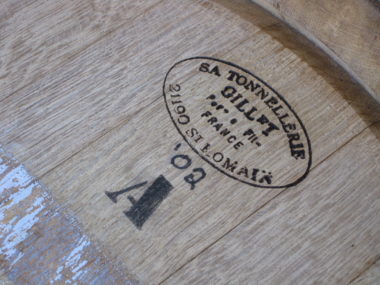
Those same two Gillet barrels proved tremendously versatile with each successive vintage of Five Rows Cab Sauv. What they lost in intensity each season, they gained in character and elegance. This past week I racked some 2009 Cab Sauv from the Gillet twins and was pleasantly surprised at the finished product. I didn’t hold out much hope for the 2009 Cab at this time last year, but an additional 12 months spent soothing in neutral oak really did the trick. We’ll bottle the 2009 Cab Sauv this spring.
So there they sit after ten long years of service, empty and willing…but sadly there is no wine to fill them. Now the decision is upon me. No more stalling filibusters, it’s time to take these two out behind the barn and “pop the bung” for good. I swear I’d have an easier time putting down Old Yeller. At least he had rabies.
One day soon I’ll crack a bottle of 2004 Cab Sauv in their honour. Few times will I enjoy a bottle more.
A Dinner With Friends
A winemaker prepares for a “Winemaker’s Dinner” with the hope that his or her wines will show their best and contribute positively to the evening’s festivities and fare. My pre-dinner jitters were immediately settled when I walked into Treadwell’s on Saturday and was greeted by so many familiar faces. It was like walking into the warm atmosphere of a family dinner.
As we drove to Port Dalhousie, I’d managed to convince myself that by now people must be sick of hearing me rattle on about leaf-removal techniques in Pinot Gris or the benefits of whole-bunch pressing in Riesling, but surprisingly that was not the case! People expressed genuine interest in hearing the behind the scenes viticultural and enological practices that we employ at Five Rows. I found this very encouraging and flattering. But let’s not kid ourselves, the people came to hear Howie and Wilma tell their stories – and those two never disappoint!
As one might anticipate, the true star on this night was the food. James, Jason and staff completely outdid themselves, coming up with a stunning menu that left everyone raving. The liveliest debate was reserved for deciding which course and pairing was our favourite. I was partial to the Pinot and Tuna.
It’s always amazing to me that our wines just seem to smell and taste more intense when served at Treadwell’s. Perhaps it’s the heightened anticipation of the senses or maybe its the proper serving temperature and stemware. Whatever it is, I was relieved that each wine seemed to go over well.
I decided to use this group as guinea pigs (they seemed rather willing) to demo a blending trial of our yet to be released 2009 Pinot Noir. The 2009 vintage was a dream for Niagara Pinot growers, who were treated to perfect ripening conditions for a change. I put together a blend of 85% 2009 Pinot and 5% from each of three different barrels of 2010 Pinot. The blend composition was determined based on some areas where I felt the wine could use a lift. One of the 2010 barrels was Clone 777 (first crop), which added an interesting fresh raspberry dimension to the aromatics. It plays well off the typical burgundian notes always present in the Clone 115 Old Vine Lowrey Pinot.
We decided to pit this 2009 blend against our 2007 Pinot Noir to see how it stacked up. I felt that the 2007 had gained some aromatic complexity since I last tried it, but it’s lively tannins tell me that this wine could still benefit from a bit more time in the cellar. It was agreed that the 2009 blend really showed promise, and some people even preferred it over the 2007! We will bottle the 2009 (maybe this exact blend) in April, with a release anticipated for early in the summer.
Thanks to all who attended for making this such a memorable experience!
Winemaker’s Dinner
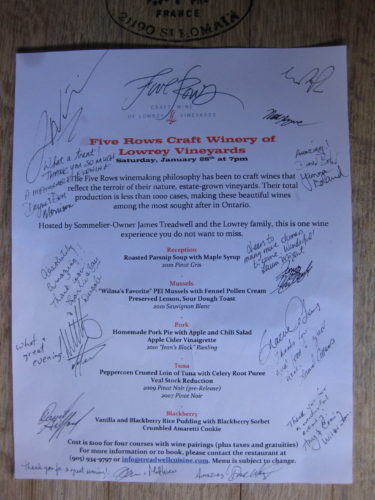
We are currently finalizing plans for our second annual Winemaker’s Dinner to be held once again at Treadwell Farm to Table Cuisine in Port Dalhousie. For those interested in attending, it will take place on Saturday, January 28. I’m told that most of the seats are spoken for by returnees from last year, but there may be a few spots still up for grabs. Best to contact James ASAP (905-934-9797).
The menu and wine pairings are still being conceptualized. You’d be amazed at the amount of thought and debate involved in this process! I don’t want to give too much away, but I may have convinced my mother to part with our final few bottles of 2010 Sauvignon Blanc, 2010 Pinot Gris and 2007 Pinot Noir to pour for the occasion. I can’t think of a better curtain call for these wines.
Over the next couple of weekends (Jan. 14-15th and the 22nd) our barn will be open for tastings from 11-5. We welcome anyone planning to attend the Icewine Festival to stop in for a complimentary sample of our 2009 Single Press Cabernet Sauvignon Icewine.
I’m proud to say that my little sister will be getting married on January 21, so we’ve elected to close Five Rows for the day and use the barn for pictures and festivities. Congratulations Catherine and Steve!