When Life Gives You Lemons…

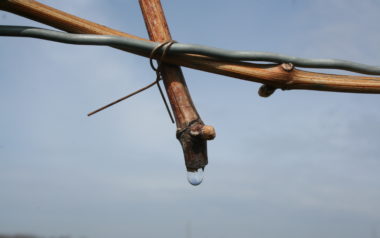
Pruning in shorts?   So much for those ultra-thermal, -70°C rated  “Tarantula”  boots my Dad got me for Christmas.  They’re still in the box.  Sap is gushing from the tips of newly pruned grapevine canes and there are pink swollen buds on my Magnolia tree – it’s only March 20th.  It was officially winter…yesterday.

Vineyard managers across the region are scratching their heads while sporting cautious grins.  They should be tremendously excited about how early this growing season  promises to be.  Three weeks early is not out of the question at this point.  But our enthusiasm is guarded.  There will no doubt be multiple frosts between now and the end of May.  The extremity of those frost events and just how advanced the buds will be when they happen are nervous variables yet to be determined.

So we sit on a precipice of possible greatness.  A vintage for the ages or an apocalyptic frost event that fries most of our delicate shoot growth.  At least I can go golfing tomorrow to calm my nerves.

Shifting gears, it’s very exciting to have our 2011 Sauvignon Blanc featured in the April/May issue of Vines magazine.  To be included in the article alongside notable Sauv Blanc producers like Hidden Bench and Creekside is a thrill for us.  The photo shoot at the Botanical Gardens was a fun change of pace and really symbolizes the vibrancy of Niagara Sauvignon Blanc.  I don’t know how they talked me into a few of those poses, but you know what they say,  “When life gives you lemons…”

I’ve received numerous inquiries about the barrel sample of 2011 Sauv Blanc that was reviewed in the article, some expressing horror that they had missed a release notice.  Not to worry – all 100 cases will be bottled on April 2nd and hopefully ready for release by May 1st.  Please let me know if you’d like to reserve a six bottle case (wes@fiverows.com).
Housekeeping

Now that I have a few moments on my hands, it’s probably a good time to do a little housekeeping and update everyone as to which wines we currently have available.  After a busy summer, I regret to inform that the 2010 Sauvignon Blanc and Pinot Gris have officially been sold out, but the following two wines can now be enjoyed:

2008 Five Rows Cabernet Sauvignon

Much will be written about the fabulous “Bordeaux” reds from Niagara in 2007 and 2010.  Little to nothing will be written about the late-ripening reds from 2008 and 2009.  For that reason, I am perhaps more proud of the Cabernet Sauvignon we grew and vinified in 2008, than any other wine we’ve produced.

Trying climatic circumstances called for extreme measures in the vineyard.  As the harvest approached, it became apparent that early season thinning and leaf removal efforts were not going to cut it in 2008.  We doubled our efforts and dropped more fruit than I am normally comfortable with.  The winery I envisioned, however, could only be built on these tough decisions.

On October 24th we harvested only 68 picking boxes from two full rows of our Clone 169 Block.  The fruit was very clean and showed surprising ripeness in both flavour and tannin for its 22.5 degrees Brix.  It was a pleasure to pick and process.  We went on to harvest 82 more picking boxes from our “Old Block” on November 2, after extracting as much life as we possibly could from the dwindling foliage.

The two blocks of fruit were processed into separate one tonne bins, and cold-soaked on the skins for five days.  I decided to try a new yeast strain, Zymaflore FX10, with the slightly riper Clone 169 fruit.  FX10 is known to produce wines defined by their elegance through a combination of structure, volume on the palate and intense colour.  The Old Block fruit was fermented with F15, a new favourite yeast of mine after a successful experiment in 2007.   Both ferments concluded uneventfully after six days with peak temperatures around 30C.  The wine was left on the skins for a further 4 days of post-ferment maceration before pressing.

Malolactic fermentation was carried out in 1 new and 3 older French oak barrels.  It was left in oak for 24 months before final blending and bottling on April 6th, 2011.  Based on previous vintages, I felt that two full years spent in barrel and resisting the temptation to use more new oak were essential to properly aging this Cab Sauv.

The two blocks produced remarkably different wines, ultimately leading to an interesting, complex blend.  I’m always amazed at the differences between individual barrels of wine from the same vineyard.  Is it due to terroir, clonal difference, oak influence, yeast strain, fermentation dynamics or all of the above?  As the years go by I hope to peel back the layers and discover just what makes our Cab Sauv end up the way it does.

The 2008 is an elegant wine, with an aromatic intensity that is unexpected by many who’ve tried it.  It has a delicate, soft mid-palate that suggests early drinkability, unlike 2007.  It is very reminiscent of the 2004 Five Rows Cabernet Sauvignon at this early stage.


2010 Five Rows Riesling  “Jean’s Block”

The 2010 vintage was a hot one.  Niagara vineyards amassed more growing degree days than any year in current recorded history.  This is perfect for ripening reds but can present challenges to producing crisp, aromatic whites.  It was very easy to produce “flabby” and “blousy” white wines in 2010 if grapes were over-thinned, over-exposed to sunlight or left hanging too long.

We harvested and pressed about one tonne of Riesling from Jean’s Block on Septmeber 30, a full two weeks earlier than in 2009.  The picking decision was based strictly on acid and flavour.  Around mid-September the grapes had plenty of sugar (19 degrees brix) to make the style of Riesling I was after, but it took a while to coax out the wonderful flavours I remembered from last year.  Waiting too much longer to pick was a risk, however, as acid levels were declining quickly in the late summer sun.  So September 30th was the day I pulled the trigger.

Following the addition of pectinase enzyme, pressed juice was cold-settled at 4 degrees Celsius for two days.  The clear rackings were then inoculated with W15 yeast, a great choice for optimizing bright fruit characters in aromatic whites.  It’s also a good cool-fermenter, able to withstand temperatures as low as 10C.

I was able to stretch the ferment over two months at an average temperature of 11C.  It was stopped at a specific gravity of 1.005, a level that I felt exhibited balance to my palate.  You have to be careful when stopping a ferment for off-dry balance as sometimes the carbon dioxide bubbles can lead to a raised perception of acidity, tempting you to halt the ferment too soon.  My rule of thumb is to taste often until I find the right balance, then wait 12 hours before killing the ferment.   It seems to have worked for most of my whites thus far.

Over the course of the next three months, the wine was cold stabilized, fined with bentonite and sterile filtered.  78 cases were bottled on April 6, 2011.  As with the 2009, this Riesling went through a lengthy period of bottle shock before I was comfortable that it had returned to the wine I remembered in tank.  Consequently, we waited to release the Riesling three months later than our other 2010 whites.  In the end this proved advantageous, as the 2010 Sauvignon Blanc and Pinot Gris both sold out very quickly.

Aromatics: citrus, peach, floral notes

Palate: a surprisingly weighty Riesling, it has ample acid to balance the slight amount of residual sugar; pleasing minerality and fruit characters

Price: $25.00/bottle

Production: 78 cases

2009 Cabernet Sauvignon Icewine Release


As winter draws near, it’s fitting that our 2009 Cabernet Sauvignon Icewine is finally ready for release.  The bottles are signed, the labels have been folded and the wine is drinking beautifully!

Excitingly, we were just informed that this wine has received a silver medal in the Icewine category at the 2011 Canadian Wine Awards.  Full results will be made public in the December issue of Wine Access.  I must admit that this was not an easy wine to make (it drew my ire on many occasions) and to be recognized in this manner is especially gratifying.

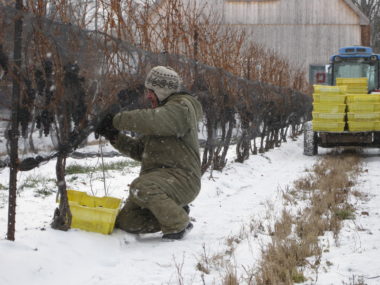
I remember the day we harvested this fruit very fondly.  After an evening of perfect freezing conditions (-12 degrees Celsius) it was decided that we would hand pick five rows of specially selected Clone 169 Cabernet Sauvignon.  A beautiful day unfolded before us, with a light snow gently filtering the weak rays of winter sun.  Having spent the last three months fending off voracious flocks of starlings, the relief of harvesting was palpable that morning, and probably helped us brave the cold.

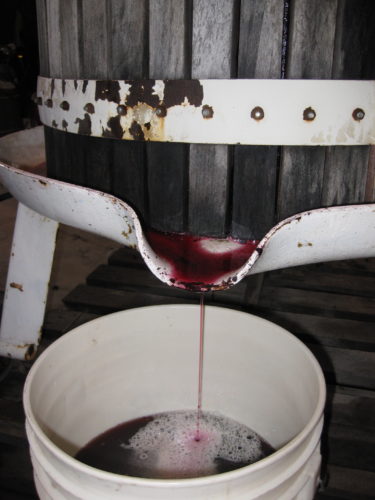
I quickly learned that everything involved in Icewine production is slow and difficult.  Pressing was a very long and drawn out process, but we were thankful for each singular drop of juice that slowly dangled and fell from the press spout.  The fermentation was also a marathon, as yeast don’t normally take kindly to such extreme conditions.  Proper nutrition and attention to fermentation dynamics were of the utmost importance.  Slowly but surely the sugar became alcohol and the amazing Icewine flavours began to reveal themselves.  The goal was to produce an Icewine that would not be perceived as being “too sweet” and I think we achieved that.

The challenge continued when it came to filtering and bottling this lucious, thick liquid.  In fact, it required as many pads to filter this measly 270L as I used for the rest of my entire 2009 vintage!  Bottling into narrow 200ml glass was a treat as well.  First the corks wouldn’t fit properly, then the bottles started tipping over on the filling line.  Keep in mind that any spillage of icewine is magnified many times simply due to it’s scarce supply.

Perhaps the easiest and most enjoyable part of this wine was the label design.  It’s a fun process and I’m always impressed with the original concepts that are born on the magic blackboard at Insite Design.  They always seem to come up with ways to make my wines feel special.  For a sneak peek at the package concept of this wine click here.

Many times over the course of this Icewine experiment I promised myself that under no circumstances would I ever do this again.  Based on the tremendous response to this wine, however,  I may now have to eat crow and reconsider.

Sometimes crow tastes good.


2011 Vintage Update

Call me Chicken Little.

At the first sign of rotten berries and fruit flies in our Pinot Noir I run to my father and proclaim, “the sky is falling”.  I rattle off all the jobs that need to be done IMMEDIATELY: gotta get the bins ready for harvest, gotta cut the rot out, gotta check the sugar and acid levels, gotta thin out green bunches, gotta take the nets down…

He takes in all the “gotta’s” and I manage to catch my breath while swatting away invisible fruit flies.   My anxiety stems from sheer amount of time I’ve put into that damn vineyard, and coming to grips with the concept that no amount of time and care can trump mother nature.  Water is always the great equalizer.   These overly tight Pinot clusters just can’t resist taking in excess water.  They are starting to rot from the inside out, as mid-cluster berries begin to split.  This condition is worse than a simple bird peck or hail strike which often times dries up on the cluster exterior.  The only cure for this malady is the strategic removal of rotten berries, not a fun prospect.

Howie takes it all in stride.  The calm look on his face reminds me that we go through this same excruciating Pinot dance every year.  He knows that we will cut the rot out and the resulting fruit will ripen-up enough to make good wine.  If not, then at least we can rest assured that we gave it our best shot.  Why can’t I be this wise and even-keeled?  I guess that is where we differ.

He goes on to recall the words of a sage vineyard manager we both know who under similar circumstances proclaimed, “They are just grapes and we’re just making booze.”  I shudder and remind him that this fellow no longer manages vineyards.

Individual Vine Viticulture


What is it that makes our wines unique?

I’ve been asked to answer this question quite a few times over the last couple of weeks, so maybe some further explanation is necessary.  I always start by stressing that the intricacies of our wines originate from thorough hand labour in the vineyard.  But I now realize that this is a vague reason to many people.  So I racked my brain today, while thinning Sauvignon Blanc, for a moniker to best describe the practice I employ.  I settled on “Individual Vine Viticulture”.

Through many hours spent doing the same jobs to the same vines, I’ve come to realize that every vine is subtly different and needs to be treated as such.   It really becomes obvious as you prune, tie down, shoot thin, shoot position, remove leaves and cluster thin, that each vine has its own “personality”.  I’ve written about the broad definition of terroir in the past, and it’s effects are certainly applicable here.

These individual vine differences are especially observable in the Niagara region due to extreme soil variability and a consistently high incidence of winter injury.  The re-planting of winter-killed vines leads to rows filled with multiply-aged vines, thus adding yet another level of variability that must be accounted for by the grower.  I challenge anyone to find a vineyard in our region that has not been touched with winter injury over the years.

As the size of a vineyard increases it becomes next to impossible to treat each vine as an individual.   That is why crew-based and mechanized labour (for leaf removal and pruning in particular) are on the rise in most vineyards.  Jobs are done quickly, with a broad stroke and questionable accuracy.  I strive to trend in the opposite direction, precise and methodical, where  every vine gets my full attention.  I can now better explain the second most asked question in the last two weeks:  Why don’t you just expand your operation and make more wine?

It is my goal to continue to craft wines whilst practicing Individual Vine Viticulture on the rows I choose to vinify.  Right now, I spend nearly every day from March to November obsessively tweaking my vines in one way or another. Scheduling days for actual “winemaking” jobs is always problematic but ultimately doable at our current production size of 500 cases.  With wine quality at stake, Five Rows has no plans for expansion in the foreseeable future.

Go small or go home!

The Longest Row

Where do the days go?

Every year, right around this time, I shift from basking in the joys of summer to flat out panic.  Days are spent trying to motor through jobs in the vineyard, but soon the stark reality sinks in.  There just aren’t enough days left before harvest to complete the monster list of tasks.

I find myself in a row of Pinot Gris on this hot Sunday, trying to rationalize how I seem to get into this mess every year, yet somehow manage to get most of the work done.  This brings no comfort.  The vines just keep growing (even on weekends).  There is minor satisfaction in each row of thinning and shoot positioning that I get through, but no time to really enjoy it.  I seem to remember more enjoyment in years past.  Perhaps this is tied to the fact we now have a winery occupying a large portion of our time.  As the sun beats down and I feel the sting of sweat in my eye, I begin to second guess why we decided to start a winery in the first place.  Growing grapes alone was sooo much easier.  No retail hours, no Interac, no problem!

Just as my self-pity hits a fevered pitch, and I’m convinced that I’ll never finish thinning this unbelievably long row of Pinot Gris,  I sense something beside me that causes me to jump with fear (only those who have been surprised out in a vineyard will truly understand my terror).  I went from mellowly singing along with John Denver to actually shrieking like a female punk vocalist.  Quickly wheeling around I found myself face to face with….what is that?….a coyote wearing sun glasses?  Alas no, it was only my Dad coming to aid his slightly heat-stroked son.  Without fail, the shock of abruptly meeting someone or something amid the tranquil cocoon of music and vines always makes me jump.

Thankfully, this was just the spark I needed.  Together we finished that marathon row and then hiked back to the barn for lunch.  Upon arrival, Wilma informed us that we had just missed out on a “crazy Shiraz flurry” and delighted to tell us how much she enjoyed tasting wines with the exuberant group.  The excitment on her face brought a smile to mine.

The reward of opening a winery was never more clear.  How selfish of me to think of it as a burden, even on this grueling day.  Five Rows started as a hopeful brand but has evolved into our lifestyle.  For this brief moment in time, we are able to achieve success together as a family.  Despite our foibles, the jobs eventually get done and wine seems to magically disappear out the door.  I’m increasingly aware that our current arrangement is unique, and not one that can last forever.  Therein lies both the paradox and the beauty of Five Rows.

Let’s all enjoy this “Shiraz flurry” while we can.

2008 Five Rows Shiraz Vinification Notes

2008 Five Rows Shiraz:

The tale of Lowrey Shiraz began many years ago with a firm handshake.  Our relationship as a grower for Creekside Estate Winery started in the late 90’s and continues to this day.  Shiraz is a staple for Creekside, grown and vinified to perfection year after year.  Given this success, we naively agreed to plant some of these vines soon after our partnership began.  Little did we know just how sensitive and vigorous Shiraz could be!

This combination of winter sensitivity and summertime vigor is a challenging prospect for the grape grower.  Early in their lives, these vines saw some pretty severe winters that almost led to their extinction in our vineyard.  Massive re-plantings and constant re-trunking were needed to restore their numbers.  Our hard work and patience was rewarded with some stellar vintages in the 2000s, ultimately inspiring me to take a crack at making my own Shiraz in 2008 (and yes, it will always be “Shiraz” not “Syrah” to us because we planted it for an Aussie!).

The fruit for this wine was harvested on October 23 following some pretty dodgy conditions in the summer of 2008.  We initially thinned the vines down to two bunches per shoot, but had to remove additional clusters in the fall, as it became clear that ripening would be a challenge.  We hand-harvested about one tonne of fruit from each of our Shiraz clones (7 & 100), then sorted before de-stemming into fermentation bins.

A long cold soak was employed to help with colour extraction and tannic development.  I chose to ferment the slightly riper Clone 7 fruit with RX60 yeast, but opted for F15 with the Clone 100 bin.  Ferments were carried out at an average pace, with four daily punch-downs.

One new Taransaud barrel, two older French and a lone American oak barrel were used for the maturation process of this wine.  Malolactic fermentation was carried out in barrel.  After 24 months in oak, the final blend was assembled and allowed to mingle for about 8 more months.  This exciting wine was bottled April 6th, 2011.

Aromas:  blackberry, black currant, lavender, smoked game

Flavours:  dark chocolate, coffee bean, raspberry

Production:  105 cases

Technical data:  13.0% alcohol,  pH 3.30,  TA 8.55

Price:  $50.00/bottle

Don’t Look Now…


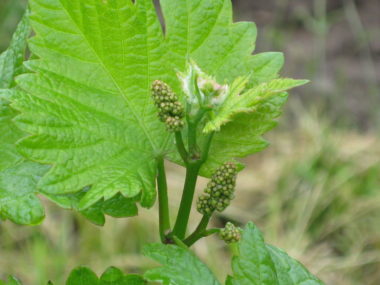
Don’t look now, but we have some serious viticultural growth going on out there!  Despite the cool and damp conditions, shoots are expanding at a rapid pace.  It’s as if the vines couldn’t hold it in any longer and just exploded with life.

As a precaution for potential winter injury, we always leave an extra “insurance” cane on each vine that is not tied down with the others.  Initial observations tell me that we can safely go through and remove these extra canes, as most primary buds are appear to be viable.  This job will keep my dad and I busy for a couple of weeks – but don’t hesitate to pull me out of the vineyard for a quick tasting should you decide to pop in for a visit!

Is it Spring yet?


It’s depressing to look back at my April 24th post from last year and read just how promising things were looking in the vineyard.  In fact, the guy who wrote that passage deserves a good slap in the face for exuberantly rubbing our noses in it.  Aren’t you lucky!  Two weeks ahead of schedule you say?  Well GOOOOOD FOR YOU!

(I apologize for the seething sarcasm, my attitude has not been exemplary ever since a large tree fell onto my car the other day)

Rain, cold and wind are the reality this year.  I don’t feel like the buds are too far behind schedule just yet, but we definitely won’t be afforded the 10-14 day head start we saw in 2010.  The only advantage of this slight delay might be reducing the window for frost damage over the next few weeks.  I’m grasping at straws here.

On the bright side, I’ve actually had my jacket off while tying grapes the last couple of days.  What a feeling of liberation!  The symbolic removal of one’s jacket and subsequent hanging of it over the top wire is one of my favourite rites of Spring.  I almost went “skins” the other day just to stick it to mother nature, but  then I realized I might frighten my Aunt Lonna who was out for a stroll with her dogs.  The shirt stayed on.

On rainy days I’ve begun the massive task of waxing and labeling our new wines.  This job has been expedited by the fact we are nearly sold out of 2009 Pinot Gris and Sauvignon Blanc.  Look for a release announcement concerning the 2010 whites and 2008 reds sometime in June.   If it keeps raining I should have enough bottles labeled by then!

Validation

March 4th, 2011 is a day that will forever live in Five Rows lore.  It is the day our roadside sign was stolen.  We put it out in the morning and it was gone at the end of the day.  That hand-painted little red sign has probably helped sell more wines than I have.  I hate to see it go.

But this day, the day my sister Catherine turned 30,  had an interesting and unforseen twist in store.  Later on that evening at the Cuvee 2011 Gala, an annual competition celebrating the best in Ontario wines, our name was called in two categories: 2nd place for Best Sauvignon Blanc and 1st place for Best Pinot Gris.   We were surprised and thrilled to be recognized at such a prestigious event.  As longtime Niagara grape growers, Cuvee has always held a special place in our heart.  In past years when our friends at Creekside won awards for wines featuring our grapes, it always felt neat to know we played a small role.  To win this year with wines that I crafted from our own fruit is a completely different feeling that I’m frankly having a hard time getting my head around.

As a rookie winemaker, I’m always nervous having my wines subjectively judged by others.  I make wines that appeal to my palate, but worry they may not always appeal to yours.  The fact that Cuvee winners are judged by my winemaking peers gives me an uplifting feeling of validation and acceptance.  So many days as a winemaker are spent banging your head off a barrel repeatedly in frustration, that its nice to have a night where your head can swell for an altogether different reason.  Don’t worry, my pruning tuque still fit this morning (thankfully it stretches).  In all seriousness, I don’t see this award as a pat on the back, but as more of a kick in the ass to keep working hard and striving to get better.

In the days leading up to the Gala I read a couple of reviews from Michael Pinkus and John Szabo that gave me an inkling our wines might have shown well.  Both writers felt our 2009 Sauvignon Blanc merited inclusion in their personal Top 5 lists from a pre-Cuvee media tasting.  These reviews meant a lot to me, but I still didn’t hold out much hope of bringing home any hardware in a room filled with award-winning juggernauts.

Surprise, surprise.

PS: The irony of losing a sign on the day you win some big wine awards is that people still manage to find you the next day.