
2010 Five Rows Cabernet Sauvignon

One decision a winemaker is faced with as a wine evolves is whether they are making that wine for now or for the future.  Variables such as the amount of time spent in barrel, new or previously used oak, French or American oak, health tannin level, acidity and pH all must be addressed.  It is where experience really comes into play, as the decisions you make now may lead to the wine being tougher to enjoy in the short term, but hopefully pay dividends later on.

Then there are rare wines like the 2010 Cabernet Sauvignon that are enjoyable now while also exhibiting good aging potential.  These wines can make winemakers look very clever, but are probably the easiest to craft.  The fruit comes in ripe and clean with ideal parameters and the fermentations go exactly according to plan.  After many years of dealing with devilish Pinot Noir, this is a welcome luxury!

The 2010 Cab Sauv was harvested on October 28th and 29th.  If we push it, Howie, Wilma and I can hand-harvest and process about 1.5 to 2 tonnes in a day.  We normally tackle the Clone 169 block first, then bring in the Old Block Cab on day two.  It’s always a relief to get through these two days as the Cab Sauv is the last variety we harvest each year.  Needless to say, we slept in on October 30th.

70 picking boxes were harvested from rows 4 and 13 in the Clone 169 Block and 78 boxes from rows 5 and 8 in the Old Block.  Following a four-day cold soak, the two bins of fruit were inoculated and warmed to start fermentation.  Two yeasts were chosen to work with the specific strengths of each vineyard.  The slightly riper Clone 169 fruit was fermented with FX10, known to retain polyphenolic potential (structure and colour), release and bind polysaccharides, and aid in the expression of terroir through minimal “fermentation odour” production.  The Old Block was inoculated with CSM, a yeast that specializes in producing intense aro­matic profiles of berries, spice and licorice, while concurrently reducing vegetal aromas.  A winemaker can only hope that these yeasts live up to such bold claims!

Finished wines were racked to four barrels:  Clone 169 to a new Taransaud and two-year-old Billon; Old Block to a two-year-old Taransaud and five-year-old DAMY.  Through the years I’ve found that Taransaud barrels do magic for my Cab Sauv.  They have a way of “framing” the fruit components of the wine, while contributing just the right amount of oak spice and wood tannin.  I usually opt for a tight grain oak, medium toast level with three years of air drying to balance the longer time our red wines spend in barrel.  After 24 months in oak, the 2010 Five Rows Cabernet Sauvignon was blended and allowed to bulk age in a tank for five more months.  103 cases were bottled on March 26, 2013.  This wine is now available for purchase.

Aromas:  blueberry, cherry, Stanley prune, mint

Palate:  soft tannin, ripe cherry, savoury mouthfeel/flavour

Cellaring:  I personally enjoy drinking this wine now (call it winemaker bias), but it should really be cellared for at least another six months.  It has the tannin and structure to age and improve for many years to come, I prefer not to put a limit on it.

Price:  $50/bottle

Alcohol:  13.3%
2010 Five Rows Shiraz


Is it a Shiraz or is it a Syrah?  The debate over the name of this wine has played out numerous times around our tasting table since we released our first one back in 2008.  That 2008 “Shiraz” was a hit with our friends, but most agreed it was more reminiscent of a “Syrah” in style.

I get a kick out of this debate because it brings me nostalgically back to the origins of this grape in our vineyard.  We planted Shiraz Clone 100 back in the late 90’s at the request of Creekside Estate Winery, who were bravely setting out to turn Shiraz into a key part of their varietal portfolio and winery identity.  Fueled by the knowledge and vision of an enterprising Australian winemaker, Marcus Ansems, my parents agreed to plant the 11 rows of Shiraz that now stand tall along our driveway, across from Wilma’s lavender.

Upon planting, we quickly found out that these vines loved to grow!  They shot up like the most vigorous of weeds, making us wonder why few farmers had attempted to grow this grape variety in Niagara before.  The first cold winter would provide us the harsh answer to that question.

Just as the vines were starting to mature and bear their first fruit, we were hit with some cold winter conditions that killed nearly half the vines in our new Shiraz vineyard.  The Achilles heel of this fast-growing, high-cropping varietal was now all too clear.  Should we replant the vineyard or wash our hands with Shiraz altogether?  This was a tough call, but in the end we decided to give it one more shot.  Thankfully, the winters have been more co-operative since then and we’ve also learned a few tricks in the vineyard to help the vines overwinter better.  We switched from a Scott-Henry training system to a more simple, two-arm pendelbogen trellis.  More attention was paid to controlling vine vigour through soil nutrition and cropping levels.  The vines performed well enough to merit planting 8 more rows of a second Australian Shiraz Clone (#7) in soil with higher clay content to aid in vine development.  Both blocks are doing well to this day.

Due to the success of these Shiraz vineyards on our farm and the legitimacy brought to the varietal by Creekside (think luscious Broken Press Shiraz…mmmm!) it was a no-brainer that I would order a large run of labels adorned with “Shiraz” for my 2008 debut.  However, as it came time to blend my 2008 Shiraz – the jammy, hot (high-alcohol) and bold notes present in all of our favourite Aussie “critter” wines were nowhere to be found!  In fact, every time I sampled these barrels I felt as if I had just tacked up a horse and ridden through a fragrant lavender field, only to suddenly realize I was surrounded by blackberry bushes and Marijuana plants (for the record this has never happened…yet).  Alas, despite what thousands of freshly printed labels now proclaimed, my first Shiraz had just become a Syrah – and I didn’t mind one bit!

A second issue with growing Shir..I mean Syrah in a cool climate is that it tends to ripen very late in the season, making it a challenge to vinify in lackluster, “shorter” growing seasons like 2009.  For that reason we decided not to attempt a Syrah in 2009 as the acidity levels never seemed right for crafting a premium wine.

The opposite was true for 2010.  It will be remembered as one of the warmest vintages Niagara has ever seen.  The growing season started early and never slowed down.  Precipitation was spotty but adequate – just perfect for wine grapes.  We harvested the Syrah on October 11, much earlier than any other vintage.  Sugar levels hit an all-time high (24°Brix) and the skins and seeds showed excellent maturity.  Three rows were selected from the older Clone 100 block (#2,9,10) along with two rows from the younger Clone 7 block (#4,8).

The fruit was de-stemmed into bins, which were then sealed for a four-day cold soak on the skins.  Fermentations were allowed to start wild, then inoculated with a yeast known as “Enoferm Syrah” (an isolate from the Côtes du Rhône in France).  It was chosen for this ripe fruit because it’s known to be a good glycerol producer for smoother mouthfeel with typical aromas including violets, raspberries, cassis, strawberries and black pepper.  Fermentations lasted about 8 days with temperature peaks around 28°C.  I could tell early on that this wine would one day be something special!

Five barrels were filled following pressing.  The Clone 7 fruit was racked to a new Taransaud barrel and a two-year-old Billon, while the Clone 100 fruit was split between two older French and one American oak barrel.  The wine was allowed to mature in oak for 24 months.  We bottled 118 cases of this Syrah on March 26th, 2013.  This wine, along with all of our 2010 reds, is now available for purchase.

Price: $50/bottle

Alcohol:  13.4%

Cellaring:  3-5 years

Rainy Day, Peace of Mind

As I sit here in the barn on a rainy day in April, find staring at stacks and stacks of unlabelled and unwaxed bottles…I feel a strange sense of calm.  With the stresses of bottling now past, I wistfully look forward to the 2013 growing season and the six exciting new wines we’ll soon be introducing to our guests.

In stark contrast to 2012, spring conditions have been consistently cool to this point.  That’s just fine with most grape growers, who would rather see their buds emerge slowly from a long winter slumber.  Eager buds mean sleepless nights for farmers and especially those in charge of operating wind machines.  The week of rain we are currently experiencing is actually much needed to help replenish water tables and soil moisture levels before we’re faced with the rigours of summer heat.

Rainy days are also great for catching up on things like racking, labelling, waxing and for reflecting (i.e. blog writing);  like right now when I glance over at my three dogs cuddled up on the floor and find myself smiling, warmed with a happiness bordering on tearful pride. These dogs have come to mean a lot to me, and I consider myself very lucky to be able to bring them to work every day.

The mere fact that I’ve accumulated this fur triumvirate speaks to my personal weakness for saying no to rescue animals (don’t ask how many cats we have).  Three dogs can be a handful – especially three of this ilk.  They are equal parts cute, crazy and vision impaired.  A fixture in the barn, they are usually adored and doted on by our guests.  One soon learns, however, that excited dogs, cheese platters and fine stemware don’t mix.  Despite their shortcomings, I am fully aware that these three have given me far more than I will ever be able give to them.

A big change is that I’m now forced to take lunch breaks, a rarity prior to their arrival.  To be responsible for living creatures has been a wake-up call of sorts, although many times that call comes way too early in the morning in the form of a blood-curdling Nova Scotia Duck Toller scream (Google it).  The lighter moments they supply are a welcome distraction from the inevitable hail storms, bottle shock, mildew, rotten Pinot Noir and determined starlings that I always seem to be worrying about.  Come to think of it, they even help ward off those pesky starlings!  Most importantly they make me stop and enjoy life, for both human and dog years go by way too quickly.

Over the coming weeks I’ll be posting the vinification notes for each of our six new wines and sending out an email order request to all those who’ve left their contact information in our guest book.  In the meantime, dedicated followers of this blog are welcome to pre-order any of our 2010 reds or 2012 whites they would like (wes@fiverows.com).  They should be ready for pick-up by May 1st.


The Wine That Almost Wasn’t

We are in the midst of a summer for the ages – and that’s all I’m willing to say at the moment.  I will spare the superlatives in an effort not to tempt fate.   So much can (and probably will) go wrong between now and the end of harvest.  Suffice it to say we are mere days away from taking in the first of our fruit.  That’s silly early!

While experiencing these ideal conditions I like to reminisce about years when we weren’t so fortunate.  I remember well the late, cool and wet summer of 2009.  Conditions were optimal for the early varieties, but proved a serious challenge for ripening Shiraz and Cabernet Sauvignon.  We thinned down to ridiculous levels (a few bunches per vine) but the acid levels in the grapes remained very high in both varieties.  I clearly remember making the sad decision not to harvest any of this fruit for our Five Rows wines.  It was decided to sell the Shiraz to another winery and hang the Cab Sauv for Icewine.  Before the Icewine nets went up, my ever optimistic Mother made the suggestion to go through our Cab Sauv blocks and select only the ripest of bunches in an effort to salvage a couple barrels worth of fruit.  Every ounce of winemaker in me screamed no, but how could I say no to Wilma?  The next day we set out to do our tedious selective picking.

So begins the tale of our 2009 Cabernet Sauvignon or as I like to call it “The wine that almost wasn’t”.  This elegant wine is now for sale in our barn, which is a minor miracle based on how many times it was written off.

It was intensely aromatic from the get go, but took 30 months in some magical old barrels to achieve it’s current mouthfeel, structure and flavour profile.  During those 30 months in my beloved (but soon to be retired) 2002 Gillet barrels, this wine was always an afterthought.  In fact, I even looked into selling it as bulk a couple of times just to get it out of the barn.  Fortunately, there were no takers.  Sometime around the two year mark spent in barrel, things began to change and those two black sheep began to get my attention.  I found myself tasting them at least once a week, just to make sure I wasn’t going nuts.  I began to feel that this 2009 Cab could actually one day don a Five Rows label.  My first thought was to use it as a silent partner with our 2010 Cab, but the blending trials flopped.  I proceeded to try a Shiraz/Cab Sauv blend, but that idea was also eventually nixed.

The resilient 2009 Five Rows Cabernet Sauvignon had managed to dodge every bullet I could muster.  There was no other option than to let it rightfully stand on its own.  I now consider this wine to be a secret bonus for those open-minded oenophiles who don’t practice vintage discrimination.  There are people who will never try this wine simply because it was made in 2009.  That just leaves more for the rest of us.  This Cab is texturally gorgeous and delivers classic Lowrey Cab Sauv aromatics (blackberry, cherry, cassis) and wonderful balance that literally appeared out of nowhere.  50 cases were bottled on April 6th, 2012.  It will be fun to compare and contrast this wine with the big bombers on the horizon (2010 and 2012).

2011 “Jean’s Block” Riesling


Many oenophiles consider Riesling to be the best-suited white grape varietal for the rigours of Niagara regional terroir.  It’s a treat to grow, with good crop levels and minimal finicky hand-labour compared to tight-clustered Pinot Gris and Sauvignon Blanc.  It has decent winter hardiness and tends to thrive in our slightly “cooler climate” (my current air conditioning bill might disagree with this categorization).

Vinifying Riesling is where things get a little more complicated.  So many different styles and so many variables to experiment with.  Although we grow Alsatian Clone 49 in Jean’s Block, the resultant wines I’ve crafted tend to be an amalgam of varying Riesling profiles.  The 2011 vintage features the subtle, mineral-laden nose of an Alsace Riesling, but the richness and depth of flavour of my favourite German styles.  The natural acidity is the strength of the wine, balanced with a touch of residual sugar.  Over the years, I’ve found that Riesling takes a while to open up after the stress of filtration and bottling, so we usually release it later than our other whites.  Riesling fans will tell you that it’s a mistake to drink it too young anyway!

In the ongoing quest to improve wine quality, we decided to employ a different pressing technique in the fall of 2011 – a gentle, whole-bunch squeeze in our old wooden basket press.  It proved to be very time consuming and a huge headache to clean out, but I think the end product justifies the extra effort.  I also experimented with a different yeast, R2, on 50% of the juice, while using my old standby, W15, on the other half.  Fans of our Pinot Gris might recognize some of the elements that R2 brings – rounder mouthfeel, tropical fruit notes – in this Riesling.

2011 “Jean’s Block” Riesling is a wine that means a lot to me personally.  I welcome you to come by starting this weekend to give it a try.  There are only 48 cases available, so we must limit purchases to 4 bottles per customer.  Retail price is $25 per bottle.

2009 Pinot Noir


Starting this weekend, our 2009 Five Rows Pinot Noir will embark on the final leg of it’s three year journey from vine to barrel to bottle to you.  I debated letting the wine age a bit longer in bottle prior to release, but a tasting session last week made me realize that the time has come to finally let go.  Parting is such sweet sorrow.

2009 Five Rows Pinot Noir:

Sometimes the best of wines and the worst of seasons magically collide to create an unexpected moment of glory.  The growing season of 2009 was one of those odd times.  A late budbreak set the tone for what would be a cool, wet summer.  We usually harvest Pinot Noir and Pinot Gris in early September, but nothing was close to being ripe in the late summer of 2009.  Cue the blessing in disguise.

The moderate September days and cool fall nights helped move the Pinot ripening window to a time when Botrytis concerns were at a minimum.   This was uncharted territory for Niagara Pinot growers.  You must understand that there is one and only one certainty when growing Pinot Noir – they WILL rot at some point.  When the inevitable did not happen in 2009, we were afforded the luxury of harvesting at the exact point when tannins, flavours, sugars and acids were aligned to my liking.

We chose to harvest Rows 1 and 2 on October 6, the latest Pinot pick we’ve had in 25 years.  The remainder of the fruit was taken in on October 17.  Average harvest parameters were 22.9°Brix, 8.4 g/L TA and pH 3.15.  Fruit was destemmed and crushed into one tonne fermentation bins and allowed a cold soak at 10°C for five days.  All bins were warmed to 14°C and inocualted with RC212 yeast at 250 ppm. Ferments averaged about 7 days, with a peak temperature of 29°C.  Each bin was allowed to macerate post-fermentation until tannins showed signs of softening.

The wine was pressed and settled before clean-racking into seven French oak barrels (average age 2.5 years).  Malolactic fermentation was carried out in oak.  Barrels were racked and returned every 6 months.  Total time in wood was 24 months before final blending in November 2011.  182 cases were bottled on April 2nd, 2012.

In my early tasting notes for this wine I have written, “something dark, alluring and mysterious about this Pinot.  Reminiscent of a rainy day on our honeymoon spent tasting great Burgundies in the dank cellars of Beaune.”

Aromas: cherry, violet, cassis, smoke, earth

Palate: dried cranberry, Bing cherry, soft tannin, haunting length

Cellaring:  2013-2023

Price: $50/bottle

2011 Whites

2011 Five Rows Sauvignon Blanc:

The fight for quality Sauvignon Blanc grapes begins in earnest during the long, cold nights of winter.  Its buds are amongst the most sensitive of all Vitis vinifera cultivars.  Providing those buds make it through the rigours of winter and frosts of spring, the job only intensifies.  Picture the most vigorous growing vine or weed in your garden, then imagine somehow trying to harness it’s raw desire to grow, but not so much to harm its delicate fruit.  Now you’re talking Sauvignon Blanc!

Thanks to a cooler than normal spring, the 2011 growing season got off to a lazy start.  A hot, dry summer helped put things back on track, with Sauv Blanc ripening right around schedule in late September.  One vineyard trick we’ve employed in recent years is to remove leaves around the clusters early in the season on the cooler, “morning sun” (east-facing) side of the canopy only.  Then later in the season, after veraison, we remove leaves from the “afternoon side” as the daytime heat subsides.  This helps preserve flavour and acidity in the ripening berries and prevents sunscald.

750 kg of fruit was harvested from each of our two Sauvignon Blanc Vineyard blocks on September 22, 2011.  The conditions for fruit ripening were perfect.  Acid levels (TA) hovered around 7.5 to 8.0 g/L, but threatened to fall as warm conditions loomed later in the week.  The decision to take both blocks in one day was made.

As usual, the younger clay-based block was slightly higher in sugar (22.3°Brix) than the old-vine, sandy loam block (20.6).   I always find it difficult to describe just how intense the flavours are in these ripe Sauv Blanc berries.  Best just to visit us in September and sneak a few for yourself!

Four older French oak barrels (2 x 2007 DAMY and 2 x 2003 Berthomieu) were used to ferment 75% of the juice.  The rest was fermented in stainless steel.  All fermentations were carried out with X5 yeast at an average temperature of 12°C.  The fermentations were stopped at a specific gravity of 0.998 or, unscientifically, when I thought they tasted good.   99 cases were bottled on April 2, 2012.

Price:  $25.00/bottle

Aromas:  citrus (lemon/lime), grilled pineapple, gooseberry

Palate:  lime, star fruit, great balance


2011 Five Rows Pinot Gris:

I relish the challenges involved in successfully crafting Pinot Gris each vintage.  From thinning and leaf removal decisions to barrel/tank ratio and residual sugar content, the complex set of variables is alluring.  Every choice made affects the end product and must be considered carefully.  I’ve fallen asleep on countless nights labouring over such decisions.  In the end, it only makes a winemaker appreciate the finished product that much more.

We harvested 1.5 tonnes of Pinot Gris on September 22, 2011.  The fruit was adequately ripe (23°Brix) but starting to show signs of breaking down and rapidly losing acidity.  You come to realize that Pinot Gris tells you when to harvest, you don’t tell it.

After gentle pressing and a four-day cold settle, the juice was racked to three older French oak barrels and one tank.  It was then inoculated with R2 yeast at the normal rate of 300 ppm.  The fermentation proceeded very slowly over the next month with an average temperature of 11°C, until being stopped at a specific gravity of 0.998 and total alcohol of 13.0%.  Bentonite fining and coarse filtration were carried out before bottling 102 cases on April 2, 2012.

Visually, this Pinot Gris shows a distinct pinkish hue from the brief amount of skin contact.  The striking aromatics include apple, pear torte, vanilla and tropical fruit nuances.  The weighty yet velvety smooth texture resolves into flavours of ripe apple, melon, honey and cinnamon.  It truly leaves you wanting another sip.

Production:  102 cases

Price:  $25.00/bottle

Cellaring: 2012-2014

Serving:  serve slightly chilled (10°C) and decant if consumed in 2012

When Life Gives You Lemons…

Pruning in shorts?   So much for those ultra-thermal, -70°C rated  “Tarantula”  boots my Dad got me for Christmas.  They’re still in the box.  Sap is gushing from the tips of newly pruned grapevine canes and there are pink swollen buds on my Magnolia tree – it’s only March 20th.  It was officially winter…yesterday.

Vineyard managers across the region are scratching their heads while sporting cautious grins.  They should be tremendously excited about how early this growing season  promises to be.  Three weeks early is not out of the question at this point.  But our enthusiasm is guarded.  There will no doubt be multiple frosts between now and the end of May.  The extremity of those frost events and just how advanced the buds will be when they happen are nervous variables yet to be determined.

So we sit on a precipice of possible greatness.  A vintage for the ages or an apocalyptic frost event that fries most of our delicate shoot growth.  At least I can go golfing tomorrow to calm my nerves.

Shifting gears, it’s very exciting to have our 2011 Sauvignon Blanc featured in the April/May issue of Vines magazine.  To be included in the article alongside notable Sauv Blanc producers like Hidden Bench and Creekside is a thrill for us.  The photo shoot at the Botanical Gardens was a fun change of pace and really symbolizes the vibrancy of Niagara Sauvignon Blanc.  I don’t know how they talked me into a few of those poses, but you know what they say,  “When life gives you lemons…”

I’ve received numerous inquiries about the barrel sample of 2011 Sauv Blanc that was reviewed in the article, some expressing horror that they had missed a release notice.  Not to worry – all 100 cases will be bottled on April 2nd and hopefully ready for release by May 1st.  Please let me know if you’d like to reserve a six bottle case (wes@fiverows.com).

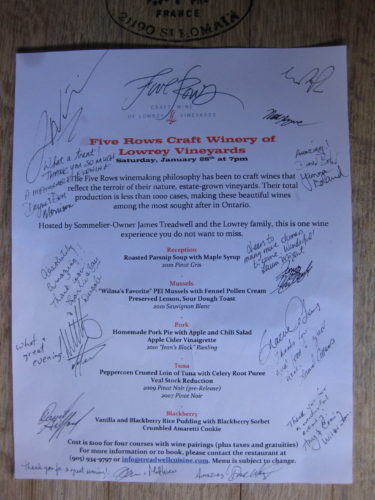
A Dinner With Friends


A winemaker prepares for a “Winemaker’s Dinner” with the hope that his or her wines will show their best and contribute positively to the evening’s festivities and fare.  My pre-dinner jitters were immediately settled when I walked into Treadwell’s on Saturday and was greeted by so many familiar faces.  It was like walking into the warm atmosphere of a family dinner.

As we drove to Port Dalhousie, I’d managed to convince myself that by now people must be sick of hearing me rattle on about leaf-removal techniques in Pinot Gris or the benefits of whole-bunch pressing in Riesling, but surprisingly that was not the case!  People expressed genuine interest in hearing the behind the scenes viticultural and enological practices that we employ at Five Rows.  I found this very encouraging and flattering.  But let’s not kid ourselves, the people came to hear Howie and Wilma tell their stories – and those two never disappoint!

As one might anticipate, the true star on this night was the food.  James, Jason and staff completely outdid themselves, coming up with a stunning menu that left everyone raving.  The liveliest debate was reserved for deciding which course and pairing was our favourite.  I was partial to the Pinot and Tuna.

It’s always amazing to me that our wines just seem to smell and taste more intense when served at Treadwell’s.  Perhaps it’s the heightened anticipation of the senses or maybe its the proper serving temperature and stemware.   Whatever it is, I was relieved that each wine seemed to go over well.

I decided to use this group as guinea pigs (they seemed rather willing) to demo a blending trial of our yet to be released 2009 Pinot Noir.  The 2009 vintage was a dream for Niagara Pinot growers, who were treated to perfect ripening conditions for a change.  I put together a blend of 85%  2009  Pinot and  5% from each of three different barrels of 2010 Pinot.  The blend composition was determined based on some areas where I felt the wine could use a lift.  One of the 2010 barrels was Clone 777 (first crop), which added an interesting fresh raspberry dimension to the aromatics.  It plays well off the typical burgundian notes always present in the  Clone 115 Old Vine Lowrey Pinot.

We decided to pit this 2009 blend against our 2007 Pinot Noir to see how it stacked up.  I felt that the 2007 had gained some aromatic complexity since I last tried it, but it’s lively tannins tell me that this wine could still benefit from a bit more time in the cellar.  It was agreed that the 2009 blend really showed promise, and some people even preferred it over the 2007!  We will bottle the 2009 (maybe this exact blend) in April, with a release anticipated for early in the summer.

Thanks to all who attended for making this such a memorable experience!


Housekeeping

Now that I have a few moments on my hands, it’s probably a good time to do a little housekeeping and update everyone as to which wines we currently have available.  After a busy summer, I regret to inform that the 2010 Sauvignon Blanc and Pinot Gris have officially been sold out, but the following two wines can now be enjoyed:

2008 Five Rows Cabernet Sauvignon

Much will be written about the fabulous “Bordeaux” reds from Niagara in 2007 and 2010.  Little to nothing will be written about the late-ripening reds from 2008 and 2009.  For that reason, I am perhaps more proud of the Cabernet Sauvignon we grew and vinified in 2008, than any other wine we’ve produced.

Trying climatic circumstances called for extreme measures in the vineyard.  As the harvest approached, it became apparent that early season thinning and leaf removal efforts were not going to cut it in 2008.  We doubled our efforts and dropped more fruit than I am normally comfortable with.  The winery I envisioned, however, could only be built on these tough decisions.

On October 24th we harvested only 68 picking boxes from two full rows of our Clone 169 Block.  The fruit was very clean and showed surprising ripeness in both flavour and tannin for its 22.5 degrees Brix.  It was a pleasure to pick and process.  We went on to harvest 82 more picking boxes from our “Old Block” on November 2, after extracting as much life as we possibly could from the dwindling foliage.

The two blocks of fruit were processed into separate one tonne bins, and cold-soaked on the skins for five days.  I decided to try a new yeast strain, Zymaflore FX10, with the slightly riper Clone 169 fruit.  FX10 is known to produce wines defined by their elegance through a combination of structure, volume on the palate and intense colour.  The Old Block fruit was fermented with F15, a new favourite yeast of mine after a successful experiment in 2007.   Both ferments concluded uneventfully after six days with peak temperatures around 30C.  The wine was left on the skins for a further 4 days of post-ferment maceration before pressing.

Malolactic fermentation was carried out in 1 new and 3 older French oak barrels.  It was left in oak for 24 months before final blending and bottling on April 6th, 2011.  Based on previous vintages, I felt that two full years spent in barrel and resisting the temptation to use more new oak were essential to properly aging this Cab Sauv.

The two blocks produced remarkably different wines, ultimately leading to an interesting, complex blend.  I’m always amazed at the differences between individual barrels of wine from the same vineyard.  Is it due to terroir, clonal difference, oak influence, yeast strain, fermentation dynamics or all of the above?  As the years go by I hope to peel back the layers and discover just what makes our Cab Sauv end up the way it does.

The 2008 is an elegant wine, with an aromatic intensity that is unexpected by many who’ve tried it.  It has a delicate, soft mid-palate that suggests early drinkability, unlike 2007.  It is very reminiscent of the 2004 Five Rows Cabernet Sauvignon at this early stage.


2010 Five Rows Riesling  “Jean’s Block”

The 2010 vintage was a hot one.  Niagara vineyards amassed more growing degree days than any year in current recorded history.  This is perfect for ripening reds but can present challenges to producing crisp, aromatic whites.  It was very easy to produce “flabby” and “blousy” white wines in 2010 if grapes were over-thinned, over-exposed to sunlight or left hanging too long.

We harvested and pressed about one tonne of Riesling from Jean’s Block on Septmeber 30, a full two weeks earlier than in 2009.  The picking decision was based strictly on acid and flavour.  Around mid-September the grapes had plenty of sugar (19 degrees brix) to make the style of Riesling I was after, but it took a while to coax out the wonderful flavours I remembered from last year.  Waiting too much longer to pick was a risk, however, as acid levels were declining quickly in the late summer sun.  So September 30th was the day I pulled the trigger.

Following the addition of pectinase enzyme, pressed juice was cold-settled at 4 degrees Celsius for two days.  The clear rackings were then inoculated with W15 yeast, a great choice for optimizing bright fruit characters in aromatic whites.  It’s also a good cool-fermenter, able to withstand temperatures as low as 10C.

I was able to stretch the ferment over two months at an average temperature of 11C.  It was stopped at a specific gravity of 1.005, a level that I felt exhibited balance to my palate.  You have to be careful when stopping a ferment for off-dry balance as sometimes the carbon dioxide bubbles can lead to a raised perception of acidity, tempting you to halt the ferment too soon.  My rule of thumb is to taste often until I find the right balance, then wait 12 hours before killing the ferment.   It seems to have worked for most of my whites thus far.

Over the course of the next three months, the wine was cold stabilized, fined with bentonite and sterile filtered.  78 cases were bottled on April 6, 2011.  As with the 2009, this Riesling went through a lengthy period of bottle shock before I was comfortable that it had returned to the wine I remembered in tank.  Consequently, we waited to release the Riesling three months later than our other 2010 whites.  In the end this proved advantageous, as the 2010 Sauvignon Blanc and Pinot Gris both sold out very quickly.

Aromatics: citrus, peach, floral notes

Palate: a surprisingly weighty Riesling, it has ample acid to balance the slight amount of residual sugar; pleasing minerality and fruit characters

Price: $25.00/bottle

Production: 78 cases