2022 Sauvignon Blanc


2022 Five Rows Sauvignon Blanc

If I learned one thing from the light crop year of 2022, it was to appreciate what you have and never take a full crop for granted.

In the Southern Ontario climate, it seems like just enough time passes between severe winterkill events to lull you into the false sense that a vineyard is invulnerable, and vines producing fruit is a given.  Sometimes I even catch myself complaining about having to endure the laborious task of removing excess clusters – oh the humanity!

Suffice it to say, there was no such complaining in 2022.  A myriad of events led to a depressing amount of trunk damage and vine death heading into the growing season.  The main culprits, in my opinion, were the late season disease incidence in 2021 and the severely up and down nature of the subsequent winter.

What we were left with was 25% of a normal crop, much like the yields harvested in 2005 and 2015.  The challenges of a light crop are many, with the most obvious being no room for error!  Finding balance within a block, in terms of nutritional requirements, can prove very difficult when vines are bearing variable amounts of fruit or are dead altogether.  A lighter crop will tend to ripen quicker as well, often times leading to issues with diminished acidity and overripe characters.  Some vines even budded out promisingly, only to wither up later in the summer along with our false hopes.

With all that in mind, and given the popularity of Sauvignon Blanc within our winery portfolio, you can probably infer my feelings on the precious bit of fruit I was tending to in the summer of 2022.  Thankfully, the growing season was excellent overall and very conducive to our needs.  We were spared the usual blast of heat and humidity in the days leading to harvest, allowing the few hanging clusters a chance to ripen gracefully.

One odd phenomenon that came about was the noticeable increase in bird damage in our Sauvignon Blanc vineyard.  The birds normally ignore the Sauv Blanc in favour of the adjacent Pinot Noir block, but they sure seemed to take a liking to those tasty golden berries in 2022.  It marked the first time we had to apply netting as a means of protection.  Upon reflection, it is surely the scarcity of fruit throughout the region that altered their feeding habits.

Our entire crop, 2478 kg, was harvested on September 13th.  What it lacked in quantity, it certainly made up for in quality, as the fruit came in at 19.0 degrees Brix and 8.25 g/L TA.

84% of the juice was fermented in French oak (mainly neutral) and 16% in tank using Zymaflore X5 yeast.  All vessels were fermented cool (9C)  and stopped at an average specific gravity of 0.998, just slightly off dry.  The finished wines were aged for another six months before blending.  177 cases were bottled on April 6th, 2023.

A noticeably riper and rounder version than previous vintages, there is also a crisp core to this wine that I find irresistible.  Aromas include peach, lychee and pineapple with flavours of peach candy most prominent at this stage of its evolution.  To that end, I am far more bullish on the notion of aging Sauv Blanc these days.  We recently cracked a 2013 SB that blew me away, shattering my notion that aromatic Sauv Blanc is best enjoyed within a year or two of release.  The fact that this wine could transform in such an interesting way after ten years in bottle, whilst maintaining its hallmark tropical fruit aromatics, was truly eye-opening.  Who knew?
A Walk With Thomas

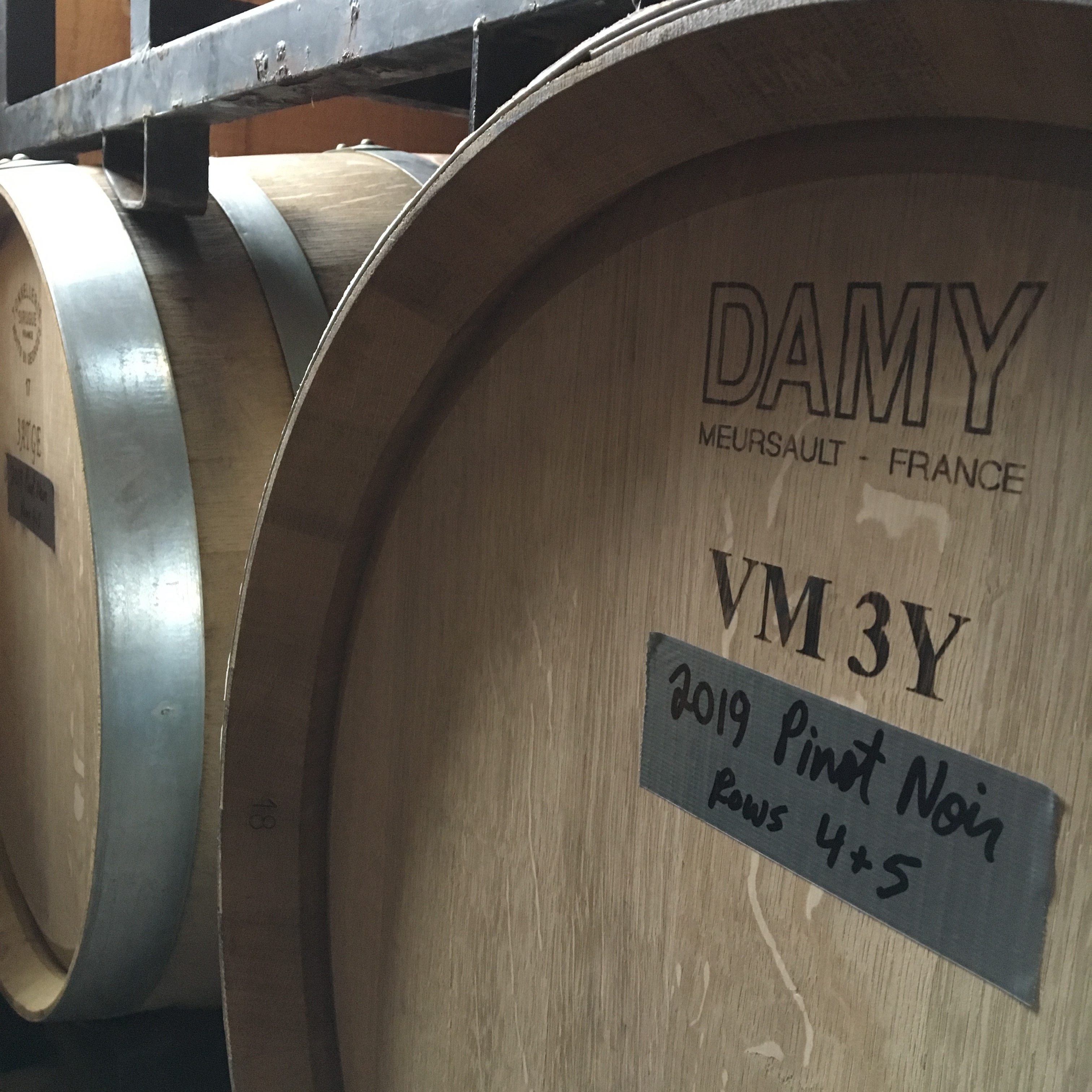
The 2019 Five Rows Pinot Noir is still in its infancy, but it has the potential to become one of the most exciting expressions of our terroir that we’ve released to date.  The journey to attaining this precocious potential was harrowing at times, but ultimately very rewarding.

Every year, there comes a time when I am at my wits’ end with Pinot Noir.  To those around me it’s a predictable and annoying phase that I’m convinced they refer to as “his rotten Pinot days”, behind my back.

It usually falls somewhere near the end of veraison, at the first sign of a rotting cluster.  Inevitably, I manage to convince myself that all the work leading up to that exact moment had been in vain, and continuing the efforts would surely be a waste of time.  The daunting nature of the situation lies in the amount of time still required to properly ripen the fruit before harvest.  Successfully navigating those remaining weeks is always challenging – even in the years when the weather does co-operate!

The reliable voice of reason is always my father.  His steadying emotional keel is usually enough to steer me back to the grind of thinning out undesirable clusters from the vineyard.  This time, however, when he innocently reminds me not to worry, that this happens every year – he is met with a snappy retort of, “exactly why, then, do we still do this?”

In 2019, I had reached that boiling point during the second week of September after four straight days of rain.  The Pinot were starting to go downhill, but not quite ripe enough to consider harvesting.  Little did I know that my rejuvenation would come in the form of a tall Pinot soothsayer who had stopped by for our annual tasting walk through the Old Block.

My relationship with Thomas Bachelder goes back to when he was starting out with Le Clos Jordanne and I was finishing my Master’s Degree in Viticulture at Brock University.  From the first time we met, I was struck by his knowledge of all things Pinot and how much he already knew about my family vineyard.  Our shared passion for Pinot has been a connection ever since, eventually leading to Thomas making his own wine from our vineyard starting in 2011.

There are many benefits to having Thomas make wine from your grapes, but I treasure our pre-harvest walk and chats the most.  In September of 2019, it may have indeed saved the vintage – or at least restored my sanity.  He arrives in a whirlwind of phone calls and consulting-related tasks (he somehow navigates vintages in multiple countries at once) and is usually out of the car and tasting berries before I am able to catch up with him.

I eventually get swept into his gravitational pull and he manages to reinvigorate, educate and praise me all in one tasting swoop of a few rows.  We compare notes on the current growing season, previous vintages, Pinot Noir clones, Karl Kaiser, harvest logistics, the effect of rain on Pinot, expressing terroir vs chasing overripe characters, the potential evils of chaptalization, berry skin thickness and, finally, how I should stop referring to our 2007 planting as the “Young Block”.  This all takes place in about 15 minutes – the full Thomas experience.

Ultimately, it reminds me not to look at things under a pessimistic microscope, but rather to embrace the macro, bigger picture.  He looks at the entire block in relation to its terroir expression, while I tend to focus on the effect of a few teetering, less than perfect clusters that will probably get sorted out anyways.

I’m not sure that Thomas has any “rotten Pinot days”, but he certainly helped me escape mine on that September day in 2019.

The fruit for this wine was harvested on October 1st, and sourced predominantly (90%) from our original five rows.  It was a pleasure to watch this wine evolve over its long 24 months in barrel;  from its fruity and tight origins through opening up to become an intriguing combination of red fruit (cherry, cranberry), floral nuances and noticeable, terroir-driven minerality.

In its current state, this Pinot starts smooth on the palate with late grip and a lingering finish.  Flavours include strawberry, raspberry, mocha and vanilla.  It is always difficult for me to advise not drinking a wine now, but I feel this one could be particularly ageworthy – perhaps to 2030 and beyond.

$60/bottle


2019 Syrah


2019 Five Rows Syrah

One of the true joys of being both a farmer and a winemaker, is that one transitional day when the two jobs collide.  Tasting the fruit and making the decision when to harvest can simultaneously prove to be both nerve-racking and a relief.  The farmer mindset is nearly always “get them off ASAP”, while the winemaker is more obliged to “let them hang”.

I get to wear both hats at Five Rows, so vetoing the decision either way tends to be a little less contentious.  It does not, however, preclude me from massive bouts of second guessing and remorse.  To that end, there are a couple of coping methods I’ve employed in recent years to aid in arriving at harvest timing decisions a little more confidently.

The first is to seek the advice of as many of my farmer and winemaker colleagues as possible.  How are things looking to them?  Have they harvested any of that particular varietal yet?  Do the crop level or conditions in this vintage remind them of any others?  If so, how did the wines turn out?  What are some techniques for dealing with fruit harvested a little early or hung a little too late?

The second method is splitting picking dates – i.e., harvesting a portion of the crop early and hanging the rest until after the troubling weather forecast.  My tendency has been to err on the side of good fruit condition over the years, but I’ve become a little more willing to roll the dice with split picks in the last few vintages.  This could involve flagging individual vines or entire rows depending on the varietal and block.  Perhaps the most interesting case study in this respect was the 2019 Syrah.

We grow two different Syrah clones on our farm (7 and 100), each inhabiting a unique plot of soil.  The Clone 7 is planted a little further north, in heavier clay, while the more vigorous Clone 100 vines can be seen lining the driveway in to our barn.  The decision to split the picking dates in late October 2019 was based on the rapid onset of Botrytis and looming rain.

The fruit for the first bin was harvested from a combination of the cleanest rows in both blocks.  After some rain and a week of drying out and bonus ripening time, the second “later harvest” bin was filled predominantly with fruit from Clone 7, which tends to stave off Botrytis a little longer than Clone 100 on our site, due to slightly less vigour and increased distance from the headlands.

The early bin (cleaner, higher TA) was given a little longer cold-soak and allowed to start fermenting wild, while the later picked bin (riper, softer skins) was inoculated with RX60 yeast after a four day soak.  The bins were pressed to separate barrels (100% French, 20% new oak) after 15 total days on the skins.

There were some jitters about the split pick decision early on, as the higher acidity in the “early pick” barrels (pre-malolactic fermentation, mind you) was evident, but it was so clean and varietally pure (red fruit, spice, pepper) that I held out hope.

When it came time to blend, the two picks came together harmoniously, complementing one another and zigging where the other zagged.  It proved to me that there is more than one way to make a complex wine.

Aromas include blackberry, cherry and pepper.  This drinkable Syrah comes across smooth and ripe on the palate with flavours of dark chocolate and sweet peppercorn.  It will continue to soften and open up in bottle – best enjoyed 2023 to 2028.

$60/bottle


2019 Cabernet Sauvignon


2019 Five Rows Cabernet Sauvignon

It takes guts to grow a late-ripening varietal like Cabernet Sauvignon in a place like Canada.

At least that’s what I tell myself every year around the first week of September, in an internal pep talk of sorts, when there are still a few green berries in my Cabernet clusters and every other varietal is fully through veraison.

A real-world analogy to this situation would be being confident in your seemingly independent 4-year-old’s maturity level, until one day they come home from school with a craft-scissor hairstyle and you realize that they weren’t quite as mature as you gave yourself credit for.  There is a gut-wrenching moment of reckoning, followed by the realization that there is a lot more work to do than you initially thought.  The irony here, of course, is that both situations require a lot more cutting to remedy the problem.

When I look back at my notes for the 2019 vintage, the first thing I have written is “very wet year – 50% meant 100% PoP”.  There aren’t many other entries in those notes that are fit for print, so let’s focus on the positives!

Some of my favourite Cabernet Sauvignon wines, over the years, have come from “cooler” vintages.  Providing that the vines were properly thinned and allowed to hang to the bitter end of the season, they show remarkable ability to ripen fruit.  It is in those cooler vintages where the St. David’s Bench really demonstrates its versatility in regard to Terroir.  The SDB can give you the heavy hitter Cabs of 2007, 2010, 2012 and 2016; while managing to offer a somewhat more elegant version in years like 2019.

Call me a sucker for the underdog, but I tend to gravitate to some elements of the cooler vintage Cabs – especially when aged to perfection.  The combination of slightly higher acidity and brighter red fruit components is right up my alley.

The 2019 Cabernet Sauvignon was hand-harvested on November 5th, with 48 picking boxes sourced from our Clone 169 Block and 110 boxes from our Old Block (mixed clones).  The fruit was allowed to cold-soak for five days before warming for fermentation.  The bins were dry within five days and achieved peak fermentation temperature of 32C.  Four French Oak barrels (one new) were filled after pressing and the wine was allowed to undergo malolactic fermentation in barrel.  After spending 24 months in oak and 6 months bulk aging in tank, 108 cases were bottled on April 25th, 2022.

Far from reaching its peak, this young wine is loaded with aromas of red licorice, wild blueberry and cassis.  There is a familiar, oak-related spice which I usually associate with Radoux medium toast barrels, that is carried harmoniously through the aromatics to the palate.  This wine has the potential to age well for 7-10 years (2029-2032).

$60/bottle

2021 Sauvignon Blanc

2021 Five Rows Sauvignon Blanc

Time flies when you’re having fun.

It’s difficult for me to fathom that I’ve been making wine from Sauvignon Blanc grapes for 15 years.  Never once in my formative years on the farm had I ever thought, “Sauvignon Blanc, that’s the ticket!”

I give all the credit to the brain trust at Creekside Estate Winery, circa 1998.  Whether it was Peter, Marcus, Rob or Craig (or likely a combo of the four) who convinced my parents to plant this notoriously winter sensitive and vigorously growing varietal, I am the ultimate beneficiary.

It has been a pleasure to see those vines flourish and mature over the years, despite the odd re-trunking winter disaster (2004, 2014).  Tending to two distinct blocks of Sauvignon Blanc (heavy clay vs. sand/loam/clay) has illustrated to me just how sensitive these vines can be to specific vineyard conditions.  As the vines have aged, I’ve noticed that they tend to handle extreme stress situations better than they used to.  The varied nutritional and canopy management needs of the two blocks took a while to ascertain, but I feel like we’ve gotten enough reps now to be confident in our practices.

Consequently, making the wine from this fruit is no longer as stressful as it used to be.  The consistency of the vineyard has a lot to do with that.  I have developed trust that my fermentations will produce those familiar aromatics that fill the barn with tropical delights, and that time spent in my treasured French oak barrels will enhance the structure and flavour profile.

The real decision is when to integrate new barrels into the portfolio.  I’ve always opted to ferment and age about 80% of our Sauv Blanc in very neutral, 10-12-year-old barrels.  Eventually those barrels need to be replaced, so I try to do so with something gentle that will complement the overall blend.  In 2021, that newbie was a DAMY barrel with a special “Light-Long ++ Toast” that aims to “soften the initial presence of the oak and elevate the integration and harmony between the fruit, oak and toast.”  Coopers have a way of making these things sound romantic that I will always be a sucker for.

The 2021 Sauvignon Blanc was harvested on September 13th.  The fruit was pressed and racked to nine barrels and one tank.  Fermentations were carried out with X5 yeast at about 8-9 degrees C.  After 30 days, the vessels had reached my desired specific gravity level of 0.998.  The barrel potion went through partial malolactic fermentation prior to bentonite fining and filtration.  248 cases were bottled on April 25th, 2022.

Collectors of Five Rows SB will likely note that this vintage falls somewhere between 2019 and 2020, stylistically speaking.  In a way, you get the best of both worlds – the tropical ripeness of 2020 and the lively vein of natural acidity found in the 2019.  Aromas and flavours include lemon, lime, gooseberry, melon and vanilla.

$45/bottle

2021 Pinot Gris

2021 Pinot Gris

The 2021 Vintage was…well…hard to describe.  I will do my best to shed some light on it from the unique perspective of my Pinot Gris.  The following is their firsthand account, and yes, grapes can talk if you are willing to listen.

Coming off a growing season like 2020, that even the crotchetiest of farmers and winemakers would agree was a spectacular one off, we were surely bound for a letdown in 2021…or were we?

The spring and summer of 2021 was splendid, as our buds came out early and thrived in the warm and dry conditions.  The crop did appear to be a little heavy, but nothing that we couldn’t handle ripening given the “2020” rose-coloured glasses of recent memory.

At first, we welcomed the abundance of precipitation in July, but suddenly that little bit of extra fruit became a quickly swelling burden that needed to be addressed with substantial cluster thinning.  Veraison came early, near the end of July, when the first signs of what would come to haunt us later in the vintage, rode in on the choking humidity.

August was a hazy memory of 30+ degree heat and welcome sun, with a brief respite from the rain and humidity.  All ripening parameters were progressing nicely as the calendar flipped to September.  Idyllic warm days and cool nights lulled us into a false sense of security.

Scribbled in the caring vineyard manager’s notes for September 8th: “an obscene amount of rain overnight and through the next day, approx. 100 mm!”

Cue visions of exploding Pinot berries set to Tchaikovsky’s 1812 Overture.

Miraculously, however, our berries did not explode.  Within a week they had shed the excess water weight and were ready to harvest on September 13th.  No one is quite sure just how this unprecedented rain event didn’t have more effect on the fruit condition, but there is some thought that much of the water ran off before absorption, and that perhaps it came at a time when things had started to shut down from the extreme heat.  Whatever the case, we were extremely lucky to end up with fruit rivalling that harvested in 2020.  Enjoy!

Winemaker’s Description

There is something uniquely tropical about this Pinot Gris compared to previous vintages.  I get notes of baked banana, sweet coconut and lemon drop candy.  It was left ever so slightly off-dry and has the familiar Pinot Gris weight and texture that I’ve grown to love.

One behind the curtain note is that this wine was the showstopper on filtration day.  My Dad helps me with filtration every year, and it is often his first exposure to the wines.  I try not to get overly emotional about his reactions, but I must confess to an inkling of pride that day when he complemented me on this Pinot Gris.

$40/bottle

2021 Riesling

2021 “Jean’s Block” Riesling

Spending time within our 14-row block of Riesling can be a sublime experience.  It is the easternmost planting on our farm and sits a stone’s throw away from the Four Mile Creek.

It is the place I escape to when I want to get furthest away from the winery, both physically and emotionally.  There is something very soothing about the uniformly trained VSP trellis and vibrant green foliage and clusters.

I’m transported back to my early days on the farm, when the creek was our playground and pear and plum orchards surrounded this very spot.  If I close my eyes, I can picture crews of local youth and family friends pitching in to scale rickety ladders, braving bees and poison ivy, to reach that last beautiful pear or plum atop the tree.  The little ones were usually tasked with picking lower hanging fruit, something I grew to resent when I was deemed old enough to ascend that rickety ladder.  Ahh yes…I can still feel that heavy 11-quart basket dangling from an annoyingly uncomfortable harness around my shoulders.

The “glamour” of modern-day grape farming is suddenly more apparent.  I get to do this job in an era of grape harvesters that actually destem and sort grapes, GPS and GIS maps of soil composition, protecting windmills, air-conditioned tractors, podcasts and earbuds.  There are still bees and poison ivy, but, thankfully, no ladders are involved.

The 2021 “Jean’s Block” Riesling was harvested on September 29th.  The fruit composition numbers were just to my liking – 17.8 degrees Brix, TA 8.9 g/L, pH 3.09 – and most importantly, the fruit was relatively clean (for Riesling!).

The juice was fermented in tanks using two different yeasts, W15 and X5.  After three weeks of cool fermenting, the tanks had reached the desired specific gravity of 1.004, just slightly off-dry.  94 cases were bottled on April 25th, 2022.

Somewhere along the line this wine morphed into all things peach; with notes of fresh peaches, peach blossoms, fuzzy peach candy and homemade peach pie.  There are some other subtle floral and citrus aromatics hiding between the peach trees that make this Riesling as fun to nose as it is to drink.

$40/bottle

Tasting a Year of My Life

It occurred to me one evening, while trying to come up with an explanation for the complicated feelings I have about releasing new wines:  How many people get the opportunity to actually taste and share a year of their life?

Wine can be like a diary or growth rings on a tree – it tells the story (good and bad) of what happened in a defined window of time.  Perhaps that is why I find drinking my own wines to be such an intense, self-reflective experience, akin to critically looking at yourself in a mirror.

Would this wine be any different if I tried harder or, conversely, was more hands-off?  It’s obvious that vintage conditions and all things terroir are the ultimate variables in shaping a wine, but would any of my viticultural or winemaking decisions have been different if I was getting more sleep or eating better or invited more cooks into the kitchen?

Being intimately involved in all steps of the process, from the first pruning cuts to the final seal of wax atop the cork, the wine becomes a time capsule of that particular year of my life, something unique to our small winery.  Like it or not, you are getting a revealing view of yours truly every time you crack open a bottle of Five Rows wine.

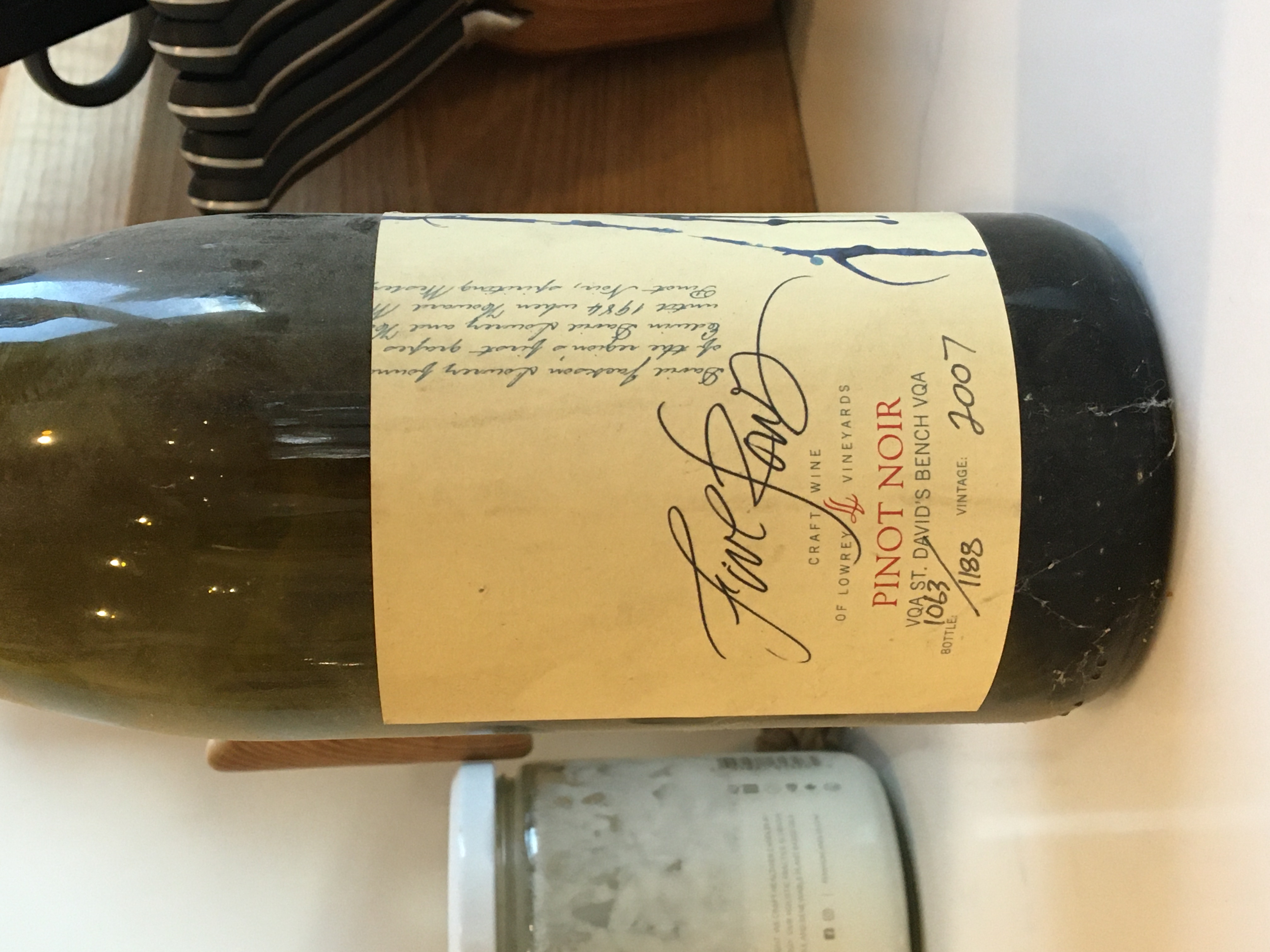
I feel very lucky to have been able to share so many of my years.  Each evokes an immediate and distinct set of feelings – despite the obvious similarities in some wines from vintage to vintage.  It is why I often first associate a wine with the life events of that year, more so than the vintage conditions or how I feel the wine turned out.  A recent tasting of our 2007 Pinot Noir, the first ever Five Rows Pinot, showed unmistakable hints of “unbridled optimism” and “naiveté” that only a newly married, 30-year-old winemaker who just started his own winery could have created.

There is far more comfort in perceiving my new wines in this manner, as opposed to worrying about how they will be judged upon release.  As a winemaker, there is always a yearning for people to like what you make, but our job is to capture that snapshot in time, regardless of external circumstances.

The wine is the living story of that vintage and I am one of the characters central to it’s plot.  That story can evolve and change over time (as we all do), but the original setting and characters involved in its production remain the same.

In the end, I am both the biggest critic of my own wines and the one who gets the most nostalgia from drinking them.

2020 Release and a New Website

Welcome back!

The new wines are finally in bottle and I couldn’t be more excited to share them with all those who’ve been patiently awaiting their release.  The pre-orders are flooding in, the labels are being written and now we begin the monumental task of waxing, labelling and shipping a year’s worth of wine in the shortest time possible.  The Five Rows team is certainly up to the task!

For obvious COVID-related safety reasons and wine distribution logistics, we have opted to keep our barn closed to tastings for the remainder of 2020.  Although we are truly saddened not to be able to offer our normal tasting experience, we hope that all will understand how critical the health of our small team is to the continued operation of our vineyard and winery.

On a much happier note, we will soon be unveiling an updated fiverows.com website, fully equipped with an online store.  I realize as I write this that most of the new wines might already be spoken for, but selling through the remaining inventory will be a good test project for managing online sales in future releases.  My worry is that an online store may be a little less generous than Wilma when it comes to Sauv Blanc limits, but we will strive to find a happy medium!

As always, orders can still be sent to wines@fiverows.com until the website is up and running.

For those who’ve been with us from the beginning, my hope is that the new website will feel both contemporary and familiar at the same time.  This Blog, the Provenance bottle registry and much of the content will be the same, but the addition of the online store and a proper mobile version should make purchasing our wines a more user friendly endeavour.

Many thanks to Barry and his team at Insite Design for helping us adapt to a new decade and a new reality.  The nostalgic in me will be saddened to see the old site go, as it represented the true beginnings of our brand and a time of limitless possibilities.  Thankfully, the software may have gotten a little dated, but the original vision of the designers still inspires a confidence in us to keep chasing those limitless possibilities into a new decade.


The Wines

2017 Syrah

Hand-harvesting for the 2017 Syrah took place on October 27th, with about 900 kg sourced from each of our Clones: 7 and 100.  The fermentations were conducted in open top bins and manually punched down three times daily.  They were allowed to initiate spontaneously after a 4-day cold soak, then inoculated with RX60 (Clone 100) and XPure (Clone 7) on day 6.

Both bins were pressed on November 13th, and then racked into five French Oak barrels (20% new oak).  Malolactic fermentation took place in barrel and the wine was aged in oak for 24 months.

This wine showcases the familiar Lowrey Syrah aromas of black raspberry, cherry, smoked meat and peppercorn.  Surprisingly smooth and drinkable at this stage, it features the typical Syrah savouriness along with good balancing acid to compliment the ripe dark fruit flavours.  It should become even more expressive with a year or two in bottle.

Price:  $60


2017 Cabernet Sauvignon

On November 14th, 2017 we hand-harvested 1771 kg of beautiful Cab from a combination of rows 7-10 & 16 in our Clone 169 Block and rows 11 & 12 in our Old Block.  The fruit was very clean, but the stems were a little brittle on picking day due to a heavy frost sustained the night before.  Although not great for maintaining green foliage, a few nights of freezing temperatures in the fall can actually have a beneficial concentrating affect on the berries.

The fermentations were allowed to start spontaneously after a 4-day cold soak, then inoculated with FX10 (Clone 169) and F15 (Old Block) on day 6. Peak fermentation temperature reached 30C, and the bins were pressed after 16 total days on the skins.  Aging and malolactic fermentation were carried out in French oak (20% new) for 24 months.

Aromas include a dark fruit component of black raspberry, plum jam and cherry, as well as some floral undertones.  Well-balanced, bright fruit shines through on the palate, but the underlying tannic structure is the secret sauce of this ageworthy Cab.  Tannins will likely soften in 1-2 years and it should start to peak by 2025.

Price:  $60


2017 Pinot Noir

The favourable vineyard conditions in 2017 allowed for a later than average harvest date for Pinot Noir.  It’s rare that we can hang Pinot into October, but most times we do have resulted in memorable wines (think 2009).

We chose to hand-harvest 2484 kg of fruit from rows 2, 3, 4, 5 & 12 of our Old Block on October 3rd, 2017.  The large, tight clusters were sorted three times on their way to three separate one-tonne bins, and fermentations were allowed to start spontaneously after a 4-day cold soak at 15C.  One bin was allowed to ferment wild, one was inoculated at 1/3 sugar depletion with RC212 and the other with W15.  All bins were pressed after a total time of 15 days on the skins, then racked to barrel and inoculated with malolactic strain MBR31.  The wine was housed in French oak (28% new) for 24 months.

The 2017 Pinot Noir features terroir-driven notes of wild strawberry, cherry, truffle and violets.  Tannins are smooth initially, allowing you to take in the flavours and texture, then pick-up in intensity near the finish to extend the length and invite another exploratory sip.

I’m excited to see if this Pinot evolves as interestingly as those from other cooler vintages. Could be a candidate for long term cellaring (2025-2027).

Price: $60


2019 Riesling

The 2019 vintage will be remembered for its abundances.  Primarily the abundant rainfall, which led to dense canopies, tight clusters and heavy disease pressure in all varietals.  Botrytis removal was a full time job in the days leading up to harvest, just to assure the grapes would be acceptable to ferment!  Luckily, Riesling is one varietal where a little bit of botrytis is the norm, and something we take into account when crafting our particular style.

Pressed juice was 100% fermented in stainless steel with two separate yeast strains: W15 (55%) and X5 (45%). Tanks were fermented cool (10C) for 37 days and stopped slightly off-dry (specific gravity 1.005) to balance the ample natural acidity – another abundance in 2019!

The 2019 “Jean’s Block” Riesling exhibits intense aromas of white peach, apple, pear and honeysuckle. It is refreshing yet balanced, and relatively full-bodied for a Riesling. The interesting texture might be the result of extended lees aging and the minor botrytis influence.

It is best enjoyed slightly chilled at 50-60F. I took the liberty of trying many bottles at many different temperatures to make this determination. This is as close to a Five Rows “Winemaker’s favourite” as I’ve ever been willing to admit.

Price:  $40


2019 Sauvignon Blanc

What is it that makes our Sauvignon Blanc unique?

This is a question I’ve been asked with great regularity over the years, but always chalked it up to the fact that many people hadn’t tried Niagara Sauvignon Blanc before.  As the years roll by, and more people continue to inquire about this wine they can’t believe is from a vineyard in St. David’s, I am starting to realize there might be more to the story – so lets dig in.

It always starts with terroir.  There is a uniqueness to where these grapes are grown that is evident in the differences between our “Young” and “Old” blocks, planted a mere lane width away from each other.  One resides in heavy clay and the other clay-loam.  Remarkably, the fruit is vastly different in both flavour and ripening profile.  Blended together they always make for a more complex wine.

In the vineyard, I tend to train and thin Sauvignon Blanc (and Pinot Gris for that matter) more like red varietals – with lower crop levels, good exposure, and “social distancing” of clusters to minimize disease.

Then there are the magic old barrels.  I used to be embarrassed to admit I’ve been using the same barrels for ten years without properly sterilizing them (we don’t have a barrel washer), but I’m starting to think that these tartrate-laden vessels might be part of the reason our Sauv Blanc smells and tastes so distinctive.

In 2019, equal amounts of fruit were harvested from our Young and Old blocks on September 21st, with ideal parameters for crafting aromatic and lively Sauv Blanc (19.2 degrees Brix, 7.88 g/L TA).  I chose to ferment 80% of the juice in mostly older French oak (12% new) and the remaining 20% in stainless steel.

Everything was inoculated with yeast strain X5 and the barrel-fermented portion went through partial spontaneous malolactic fermentation. All vessels were fermented cool (10 C) for 27 days and stopped at a specific gravity of 0.998.

Due to the COVID-related delay in bottling, this wine was nervously barrel aged for 2 months longer than initially planned.  Thankfully, the extra bulk aging time seemed to benefit the aromatic complexity and overall texture of this wine.

It features intense notes of ripe pineapple, starfruit and lime along with great natural acidity. Best served between 55-65F.

Price:  $40


2019 Pinot Gris

Roughly 1500 kg were harvested on September 21th, following a stretch of hot, humid conditions that had been absent for the majority of summer.

The rare luxury in 2017 was being able to harvest the Pinot Gris with good natural acidity (TA = 8.7 g/L) to balance the ripe flavour components in the juice. 80% of the juice was fermented in neutral French oak barrels and 20% in stainless steel.

Two different yeast strains (X5, R2) were used to ferment cool (9C) over 26 days, and stopped at a specific gravity of 0.998. Partial spontaneous malolactic fermentation took place in the barrel-fermented portion of wine.

The appearance of this Pinot Gris is unmistakable, with its golden straw colour and light pinkish hue. The aromas come in subtle layers: I get Honeycrisp apple, apricot, vanilla and fresh melon, but you’ll probably pick out a few more.

This wine is best served at 55-65F to highlight its balance and wonderful Pinot Gris texture.

Price: $40