Page Archive for the ‘Field Notes’ Category

Monday, August 2nd, 2010

That faint thud you just heard was my jaw hitting the terroir when I returned home from a quick vacation to find colour, yes colour, in my Pinot Gris and Pinot Noir.  It seems eerily too early.  The race is on, it’s veraison.

veraison in Pinot

Veraison is the physiological stage of grape development where the hard, green berries finally soften and start to accumulate sugars and gradually turn colour.  That first flash of colour is always a “noose tightener” of sorts, in that so many jobs need to be squeezed in before the imminent harvest.  In early years such as this one, we are already fighting to keep the clusters exposed and canopy trimmed, but now it is even more important.  Recent studies out of Cornell University have shown that longer fruit exposure to sun can decrease methoxypyrazine levels (green, vegetal characters) in late ripening varieties like Cabernet Sauvignon and Cabernet Franc.

Slowly they turn...

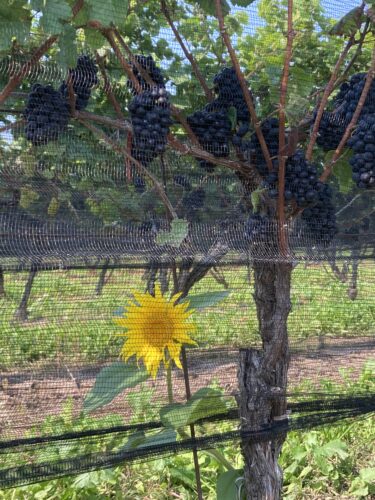
Coloured berries also attract hungry birds, so our protective netting needs to be put up as soon as the hedging, leaf removal and cluster thinning is complete.  I honestly can’t decide if I’m excited or horrified at the prospect of working every day for the next three months.  I reassure myself that we go through the same song and dance every year, but that doesn’t seem to quell my uneasiness.  Amid the vineyard duties, we have to squeeze in a bottling run and get all tanks and crush equipment ready for the first fruit of the season.

Just as my anxiety peaks, the faint light at the end of the tunnel begins to emerge.  ”Push on lad!”, I tell myself.  Pluck a few more leaves, thin a few more bunches, finish one more row.  Visions of brilliant autumn colours and cozy fall clothes begin to warm my thoughts.  The thrill and challenge of ripening Shiraz emboldens me.  I can taste that luscious free run juice now!

Bring on veraison!

Wednesday, June 23rd, 2010

It dawned on me today,  as I  hurriedly thinned Pinot Gris in the midst of an earthquake, that I hadn’t given a thorough vineyard update in a while.  So here goes…

Mother nature is two weeks ahead.  I’m three weeks behind.  This good news / bad news situation is the familiar refrain I’ve heard in talking to many grape growers throughout the peninsula.  We’ve seen a boon of growth in all vines over the last couple of weeks, leaving us scrambling to keep up with the expedited hand labour chores.  Adequate rainfall, heat, and blistering sun are making my vines very happy, but leaving me a little worried.  Disease pressure has been low to this point (kiss of death) but the current humid conditions will challenge even the best of viticultural practices.

The accelerated growth creates the need to shoot-thin and shoot-position all vines before we are able to start hedging.  As always, vine vigour was particularly problematic in our Shiraz blocks, so I targeted them first.  After two weeks of what felt like hacking through a rainforest with a dull machete, I was happy to kiss the Shiraz good-bye and move on to the more manageable Cabernet  Sauvignon.  We are well through bloom in all varieties, and very close to berry touch stage in the Pinot Gris.  Air flow through the canopy is critical at this stage, as is fruit exposure for optimum fungicide penetration.

I’m happy to report that the young Pinot Noir vines we planted last season are doing very well, with less than 5% vine failure.  In the spirit of Father’s Day, I give my dad all the credit for these thriving vines.  It was he who ploughed the field ad nauseam to his own exacting specifications, he who sat vigil through many winter and spring evenings waiting to fire up the windmill, and he who artfully maneuvered the grape-hoe around each baby vine with the deft touch of a surgeon.  Judging by a couple of the catastrophic first year fields I’ve witnessed while out consulting this year (upwards of 60% vine death), I really believe that the use of the windmill combined with proper site selection and field preparation helped save our bacon.

PS:  I send a special thank-you and congratulations to Insite Design for designing an Ontario Wine Awards silver medal winning wine label that still makes me proud every time I slap one on a bottle!

Wednesday, May 12th, 2010

What a pleasure it was to have a keen group of culinary/hospitality students from Assiniboine Community College (Manitoba) stop by our barn this morning.  Prior to their arrival, I worried that it may be tough to keep our guests entertained for the full two and a half hours they were scheduled for, but once I met them I knew it wouldn’t be a problem!

They were all ears as my mother and I took turns explaining the history of our farm and some of the viticultural practices we employ.  The rest of the time was filled with very well thought out questions and subsequent discussion.  We concluded the morning with a tasting of our wines, of which I received some great feedback.  It is a perk of my job to be able to meet such engaging and talented young people getting set to embark on their careers.  I wish them all the best of luck in their future endeavours, and thank them for bringing a sampling of Five Rows back home to Brandon, Manitoba.

A special thanks also goes to Barbara Leslie from Niagara College for hooking us up with our new friends.

Saturday, April 24th, 2010

Starting Saturday May 1st, the barn doors will be open once again.  I encourage all friends of Five Rows to stop in for a quick sip and chat.  We’d love to hear how your winter was and give you a sneak peek at our upcoming release schedule.  All the wines are drinking well right now and, consequently, their numbers are dwindling rapidly.

Make sure to bring your boots and take a leisurely stroll through the vineyard. It’s a great time of year to witness new buds popping right before your eyes.  I’d be happy to lead a tour for anyone interested.  Thanks to the wonderful spring weather that’s graced Niagara, we are a good 10-14 days ahead of a normal year.  As I envision what the 2010 vintage could potentially become, I hear the voice of my wise and battle-tested father reminding me not to count my chickens just yet.

img_1950

Wednesday, March 3rd, 2010

After a brief respite, work in the vineyard has begun again in earnest.  It’s time to evaluate just how many buds have made it through winter, then make an educated guess at how many to leave for the upcoming season.  We look at things like bud viability, cane density, internodal gap distance, and the long-range forecast before making our first cuts.

Generally, we prune our vines back to two trunks, each housing a cane of ten or so buds.  We’ve been lucky with a mild winter to this point and bud viability is relatively high compared to previous years.  However, one frigid night can quickly change this rosy outlook, so as an insurance measure we’ll leave a third cane on one of the trunks just in case March decides to go out like a lion.  This third cane is left untied early in the spring then either cut off or tied down at a later date based on how many total buds survive through the dreaded frost window.

The art of pruning may seem like a boring, monotonous chore to some, but I actually quite enjoy it.  I look at each vine as a blank canvas, ready to be fashioned into a viticultural masterpiece.  Laugh not, for the responsibility to empower a vine to produce stellar fruit should not be taken lightly.  This important task of renewal sets the tone for the year ahead and restarts the cycle of life.  With each successive snip of the pruners, it’s hard not to anticipate and envision the bounty this vine will bring us in the fall.

Monday, March 23rd, 2009

Spring is here, and over the last week I’ve had the pleasure to host a couple of fun and lively tasting sessions.  It was a welcome break from pruning to be joined by groups of both wine “lovers” and wine “makers”, respectively, for a tour of our barn and a taste through the Five Rows portfolio.  I have to admit that I still get butterflies when pouring our wines for those who have yet to try them, and I don’t think that will change anytime soon.

I like to use these tastings to gauge the general vibe that people are getting from our winery, and based on our first few sessions the feedback has been tremendous.  It excites me that our new friends really get what we are trying to do and often express a desire to lend a hand in the vineyard sometime next season.  I’m hoping they all realize that I just might have to take them up on that offer!  

I’m finding that each tasting takes on its own dynamic, which keeps me on my toes and very engaged.  Often times I like to slip in a new barrel blend that I’ve been working on, as this is a great way to get valuable opinions directly from the people that matter…the wine buyers.  Despite subjecting my guests to this “guinea pig” treatment, I’ve yet to receive any complaints.

For example, I’m always trying to fine-tune our 2007 Pinot Noir by experimenting with different amounts of 2008 Pinot as part of the blend.  As a rule, we are allowed to blend up to 15% of different vintages into a single varietal wine.  The potential marriage of these two vintages is very intriguing.  The 2007 Pinot abounds with tannin, colour, and bold “new world” flavours, while the 2008 is more reminiscent of a classic Lowrey Pinot; subtle, elegant and classically Burgundian.  To date I’ve experimented with 5-10% of the 2008 in the blend, and results have been mixed.  Some loved it, some wanted more 2008, and some felt that it is simply too early to evaluate the potential of the 2007 alone.  I tend to fall into the latter category, so perhaps I’ll stop bugging the Pinot and let it do it’s thing for a little while longer.


To our friends in Niagara-On-The-Lake:  we are pleased to announce that you can now enjoy our 2004 Cabernet Sauvignon at the historic Charles Inn.

Thursday, December 18th, 2008

The friendly little town of St. David’s was a great place to grow up.   Family members lived around every corner, and the public school playground was within walking distance.  Grandma Lowrey’s house was always a hub of activity after school, as my cousins and I feasted on cookies and went exploring around the farm until our parents got off work.  Little did we know that the dirt we came home covered in would one day be heralded for  “uniquely expressing regional wine character”.

“Terroir”, the French word for “soil”, means many things to many people, and has evolved into an all-encompassing term.  I like to think of it as the combination of environmental, biochemical and geological factors that influence both the fruit of a growing grapevine and the resultant wine.  It’s the “je ne sais quoi” behind many of the world’s greatest wines.  That part of the wine that is seemingly out of our control and expressed in its unique taste, aroma and texture.  The cool thing is that single varietal wines crafted from the same vineyard terroir tend to produce similar characteristics year after year.

We are located in the VQA Ontario ”St. David’s Bench” Appellation.  I’m not sure whether my Great, Great Grandfather was aware of all the potential “vinifera-growing” benefits of this site when settling here, but he did have a keen intuition for which fruit crops to plant back in his day.  I’ll spare you the geology lesson, but the Bench and Niagara Escarpment combine to provide excellent air circulation, drainage, and groundwater supply.  The ancient shores of glacial Lake Iroquois have left our vineyard with soils that range from sandy loam to clay loam and hard clay.   Limestone deposits are also abundant, helping to add to the overall mineral complexity.

Looking back at some newspaper clippings of wines made from our Pinot Noir over the years, I was amazed to see the similarities in flavour descriptors used by the reviewers.  In 1993, the Inniskillin Alliance Pinot Noir was described as having flavours of “candied cherry, raspberry, anise, earth, pepper, vanilla and firm tannin”.   The 1999 Creekside Pinot showed ”raspberry, violets and a touch of pepper” and the 2001 Creekside Pinot featured “cherry, beet root and smoky notes”.  Our 2007 Pinot Noir is in its infancy right now, but the preceding characteristics could aptly describe this wine as well.  I take no credit for this…chalk it up to the terroir.

Our First Review! :  Check out the “Last Drop” column of the Jan/Feb edition of Vines Magazine (seen above) for a review of our 2004 Cabernet Sauvignon.